


In short ⚡
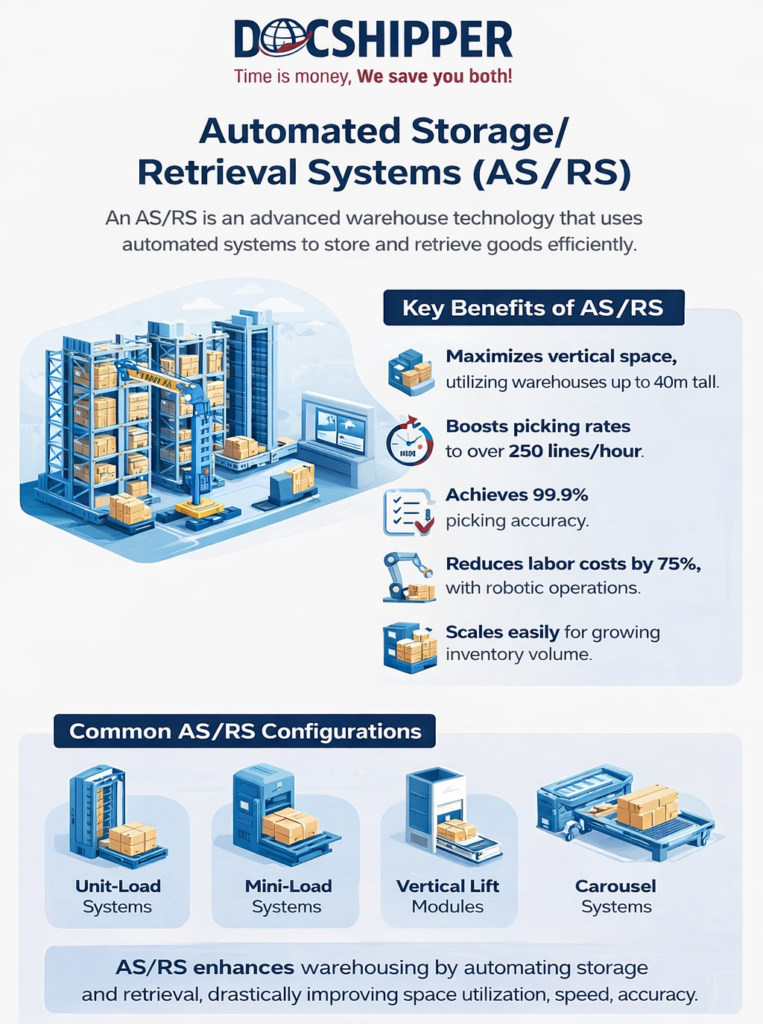
An Automated Storage/Retrieval System (AS/RS) is a computer-controlled warehouse technology that automatically stores and retrieves goods using robotic mechanisms, conveyors, and sophisticated software. This system eliminates manual handling, maximizes vertical space utilization, and significantly accelerates order fulfillment in modern logistics operations.
Introduction
Warehouse managers constantly face the challenge of balancing storage density with retrieval speed. Traditional manual systems consume excessive floor space and labor hours while introducing human error.
AS/RS technology addresses these pain points by automating the entire storage-retrieval cycle. In international trade, where inventory turnover and accuracy directly impact profitability, this system has become essential infrastructure.
Key characteristics of AS/RS include:
- Vertical optimization: Utilizes warehouse height up to 40 meters
- Real-time inventory tracking: Integration with WMS and ERP systems
- 24/7 operation capability: Uninterrupted storage and retrieval cycles
- Error reduction: Accuracy rates exceeding 99.9% in picking operations
- Scalability: Modular design allows capacity expansion without workflow disruption
Technical Mechanisms & Operational Framework
AS/RS operates through three integrated components: storage structure, retrieval machinery, and control software. The storage structure consists of high-density racking systems designed for specific load types.
Retrieval machinery includes stacker cranes that move horizontally and vertically along fixed aisles. These cranes use telescopic forks or vacuum grippers to handle pallets, totes, or individual items. Modern systems achieve speeds of 200 meters per minute horizontally and 60 meters per minute vertically.
The control layer employs Warehouse Management Systems (WMS) that optimize storage locations using algorithms. Popular strategies include ABC classification, which places high-turnover items in easily accessible zones. At DocShipper, we integrate AS/RS planning into our warehouse design services to ensure seamless customs clearance workflows.
Safety mechanisms include collision avoidance sensors, emergency stop protocols, and redundant power systems. European AS/RS installations must comply with EU Machinery Directive 2006/42/EC standards.
There are five primary AS/RS configurations:
- Unit-load systems: Handle full pallets (500-2,500 kg)
- Mini-load systems: Manage totes and cartons (up to 100 kg)
- Vertical lift modules: Compact solutions for small parts
- Carousel systems: Rotating shelves for high-frequency picking
- Shuttle systems: Multi-depth storage with autonomous vehicles
Performance Metrics & Industry Applications
Quantifiable benefits demonstrate why AS/RS adoption has grown 18% annually since 2020. Leading implementations show measurable improvements across operational KPIs.
| Metric | Manual System | AS/RS | Improvement |
|---|---|---|---|
| Storage Density | 40% space utilization | 85% space utilization | +112% capacity |
| Picking Speed | 60 lines/hour | 250 lines/hour | +317% throughput |
| Accuracy Rate | 97.5% | 99.95% | -83% error rate |
| Labor Cost | $18/pallet moved | $4.50/pallet moved | -75% cost |
| Energy Consumption | 15 kWh/1000 movements | 8 kWh/1000 movements | -47% energy use |
Use Case: Pharmaceutical Cold Chain
A European pharmaceutical distributor implemented a mini-load AS/RS for temperature-controlled storage. The system maintains ±1°C precision across 12,000 SKU locations. Retrieval time dropped from 8 minutes to 45 seconds per order line. Regulatory compliance documentation became automated through direct ERP integration, reducing audit preparation time by 92%.
Industry adoption patterns reveal sector-specific preferences:
- E-commerce: 68% use shuttle-based systems for high-velocity fulfillment
- Automotive: Unit-load AS/RS dominates parts distribution centers
- Food & Beverage: FIFO-optimized configurations ensure freshness compliance
- Electronics: ESD-protected mini-load systems handle sensitive components
- Third-party logistics: Multi-client configurations with segregated inventory zones
Return on investment typically occurs within 3-5 years. DocShipper analyzes your specific volume profiles and SKU characteristics to determine optimal AS/RS configuration during our warehousing consultations.
Conclusion
AS/RS technology transforms warehouse operations by combining space efficiency, speed, and accuracy into a single automated solution. For companies handling international shipments, this system provides the reliability and traceability required in global supply chains.
Need expert guidance on implementing AS/RS in your logistics operations? Contact DocShipper for a customized warehousing assessment.
📚 Quizz
Test Your Knowledge: Automated Storage/Retrieval System (AS/RS)
Q1 — What best defines an Automated Storage/Retrieval System (AS/RS)?
Q2 — A logistics manager claims that AS/RS and AGV systems are essentially the same technology. Is this correct?
Q3 — A pharmaceutical distributor needs to store 12,000 SKUs at a precise temperature of ±1°C and reduce retrieval time from 8 minutes to under 1 minute per order line. Which AS/RS configuration is most appropriate?
🎯 Your Result
📞 Free Quote in 24hFAQ | Automated Storage/Retrieval System (AS/RS): Definition, Benefits & Real-World Applications
Most AS/RS systems require at least 10,000 square feet of floor space and 20-foot ceiling height. Vertical lift modules can operate in smaller footprints of 150 square feet with 12-foot ceilings.
Standard installations require 6-12 months from design approval to full operation. This includes structural modifications, equipment installation, software integration, and staff training phases.
Standard systems accommodate uniform loads up to 2,500 kg. Custom configurations with adjustable shelving and specialized grippers can manage non-standard dimensions at increased cost.
Preventive maintenance includes monthly mechanical inspections, quarterly software updates, and annual safety certifications. Average downtime is less than 0.5% with proper maintenance schedules.
Modern AS/RS uses standard protocols like OPC-UA and RESTful APIs for WMS integration. Most systems connect seamlessly with SAP, Oracle, Manhattan, and other major platforms.
Battery backup systems provide 30-60 minutes of operation for critical retrieval. Redundant controllers and manual override capabilities ensure inventory remains accessible during extended outages.
Specialized AS/RS operates in temperatures from -30°C to +40°C. Cold storage configurations use insulated components and heated mechanisms to maintain performance in frozen environments.
Automated systems reduce picking labor by 60-80% but require skilled technicians for operation and maintenance. Total headcount typically decreases by 40-50% while shifting toward technical roles.
Modular designs allow horizontal expansion by adding aisles and vertical growth by increasing rack height. Software scalability supports capacity increases without replacing control systems.
AS/RS uses fixed infrastructure with vertical storage capability, while AGVs provide flexible ground-level transport. AS/RS offers higher density; AGVs provide greater route flexibility.
Barcode scanning, RFID verification, and weight confirmation at every transaction eliminate manual counting errors. Real-time system updates maintain perpetual inventory accuracy above 99.9%.
Capital purchase, operating leases, and equipment financing are common. Some vendors offer performance-based contracts where payments correlate with productivity gains achieved.
Need Help with Logistics or Sourcing ?
First, we secure the right products from the right suppliers at the right price by managing the sourcing process from start to finish. Then, we simplify your shipping experience - from pickup to final delivery - ensuring any product, anywhere, is delivered at highly competitive prices.


Fill the Form
Prefer email? Send us your inquiry, and we’ll get back to you as soon as possible.
Contact us


