


In short ⚡
ATD (Arrival Time Depot) refers to the precise moment when a shipment or container physically arrives at a designated depot, warehouse, or distribution center. This timestamp is critical for inventory management, customs clearance coordination, and calculating storage fees in international logistics operations.Introduction
Many importers confuse ATD with estimated arrival times or port discharge dates, leading to miscalculated demurrage fees and storage costs. Understanding Arrival Time Depot is essential for optimizing your supply chain’s final mile and avoiding unexpected charges.
In international freight forwarding, the ATD marks the transition from carrier responsibility to warehouse custody. This timestamp triggers multiple downstream processes including customs release notifications, inventory updates, and delivery scheduling.
- Legal timestamp: Official record for contractual obligations and liability transfer
- Cost trigger: Activates storage fees and demurrage calculations
- Process initiator: Starts customs clearance procedures and quality inspections
- Performance metric: Measures carrier reliability and transit time accuracy
- Documentation requirement: Essential for insurance claims and dispute resolution
Technical Framework & Operational Implications
The ATD timestamp is typically recorded through automated gate systems using RFID technology, GPS tracking, or manual check-in procedures. This data feeds directly into warehouse management systems (WMS) and transport management systems (TMS).
Customs clearance coordination depends heavily on accurate ATD reporting. Customs authorities require precise arrival documentation to process release orders. Delays in ATD notification can extend clearance times by 24-48 hours, directly impacting delivery schedules.
From a contractual perspective, the ATD establishes when risk transfers from the carrier to the consignee or warehouse operator. According to Incoterms 2020, this moment varies depending on the agreed trade terms (DAP, DDP, etc.).
Storage fee calculations begin immediately after ATD. Most facilities offer a grace period (typically 24-72 hours), after which daily or hourly charges apply. Understanding your ATD helps you plan pickup operations to minimize these costs.
At DocShipper, we implement real-time ATD tracking systems that automatically notify clients the moment their cargo arrives at the depot, enabling proactive customs clearance and pickup scheduling to reduce storage expenses.
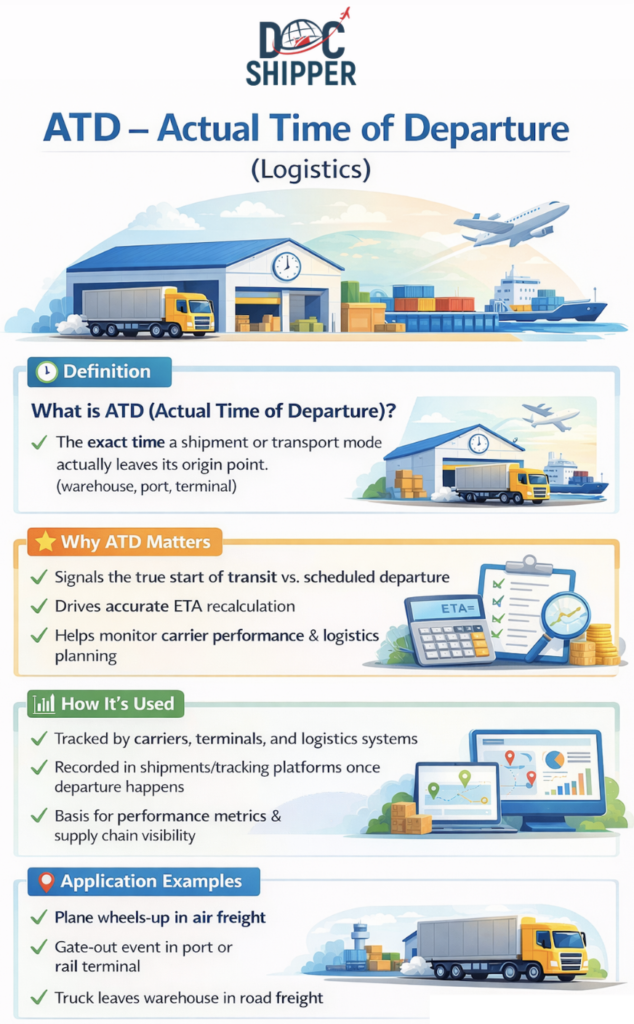
The difference between ATD and ETA (Estimated Time of Arrival) is crucial. While ETA provides forecasted arrival, ATD is the actual recorded time. Discrepancies between these two metrics indicate transit delays or operational inefficiencies that require investigation.
Practical Examples & Performance Data
Consider a typical ocean freight shipment from Shanghai to Los Angeles. The container is discharged from the vessel on Day 1 at 14:00. However, the ATD at the inland depot occurs on Day 3 at 09:30 due to port congestion and drayage delays.
| Event | Timestamp | Cost Impact |
|---|---|---|
| Vessel Discharge | Day 1 – 14:00 | Port fees begin |
| Container Gate-Out | Day 2 – 16:45 | Demurrage avoided |
| ATD at Depot | Day 3 – 09:30 | Storage clock starts |
| Customs Release | Day 4 – 11:00 | 1 day storage fee |
| Final Delivery | Day 5 – 08:15 | 2 days total storage |
Cost scenario analysis: If the depot charges $75/day for a 40ft container, the 48-hour delay between ATD and pickup generates $150 in avoidable storage fees. Multiply this across 100 annual shipments, and the cost impact reaches $15,000.
Performance benchmarking data shows that companies with automated ATD notification systems reduce average dwell time by 31% compared to those relying on manual updates. This translates to significant cost savings and improved inventory turnover.
In air freight operations, ATD precision is even more critical. A pharmaceutical shipment arriving at a temperature-controlled depot must be processed within hours. The ATD triggers immediate quality checks and temperature validation protocols.
- Average ATD accuracy: ±15 minutes in modern automated facilities
- Notification speed: Real-time systems alert within 5 minutes of physical arrival
- Storage cost variation: $25-$200 per day depending on facility type and cargo
- Dwell time reduction: 25-40% improvement with proactive ATD management
- Customs processing acceleration: 18-hour average reduction with pre-ATD clearance preparation
DocShipper Platform
Cut logistics costs. Not corners.
See exactly where your logistics costs are bleeding — and how to fix it. Book your expert demo.

Conclusion
Mastering ATD tracking and management directly impacts your bottom line through reduced storage costs, faster customs clearance, and improved supply chain visibility. Accurate arrival timestamps enable proactive decision-making throughout the final delivery phase.
Need assistance optimizing your depot arrival processes? Contact DocShipper for expert guidance on implementing ATD tracking systems and reducing logistics costs.
📚 Quiz
Test Your Knowledge: ATD (Arrival Time Depot)
Q1 — What does ATD (Arrival Time Depot) specifically refer to in international logistics?
Q2 — A common misconception about ATD is that it is the same as ATA (Actual Time of Arrival). What is the key difference?
Q3 — A 40ft container arrives at the depot (ATD recorded) on Day 3 at 09:30. The facility charges $75/day with a 24-hour grace period. The cargo is picked up on Day 5 at 09:30. What is the total storage cost?
🎯 Your Result
📞 Free Quote in 24hFAQ | ATD (Arrival Time Depot): Definition, Calculation & Practical Examples
ATD (Arrival Time Depot) refers specifically to warehouse arrival, while ATA (Actual Time of Arrival) typically indicates port or airport arrival. ATD occurs after ATA in most logistics chains.
The receiving depot or warehouse facility records ATD through gate systems, security checkpoints, or warehouse management software upon physical container arrival.
Most facilities begin calculating storage fees from the ATD timestamp, often after a grace period of 24-72 hours depending on contractual terms.
Yes, modern freight forwarders and 3PL providers offer automated ATD alerts via email, SMS, or API integration with your internal systems.
Typically, the delivery order, bill of lading, customs release documentation, and identification are required when cargo arrives at the depot.
Automated gate systems provide accuracy within 5-15 minutes, while manual recording may vary by 30-60 minutes depending on facility procedures.
Yes, ATD marks the transition point where cargo insurance responsibility may shift from carrier coverage to warehouse or consignee policies.
Inaccurate ATD documentation can lead to disputes over storage fees, delayed customs clearance, and complications in insurance claims processing.
Ocean freight ATD occurs at container yards, air freight at cargo terminals, and road freight at distribution centers—each with different operational protocols.
Yes, pre-clearance procedures can start using advance shipping notices, but final release typically requires confirmed ATD documentation.
Standard grace periods range from 24 hours for air freight to 72 hours for ocean freight, though this varies by facility and contract terms.
Real-time ATD visibility enables proactive pickup scheduling, reduces dwell time by 25-40%, and minimizes storage costs through optimized cargo flow management.
Need Help with
Logistics or Sourcing ?
First, we secure the right products from the right suppliers at the right price by managing the sourcing process from start to finish. Then, we simplify your shipping experience - from pickup to final delivery - ensuring any product, anywhere, is delivered at highly competitive prices.


Fill the Form
Prefer email? Send us your inquiry, and we’ll get back to you as soon as possible.
Contact us


