In short ⚡
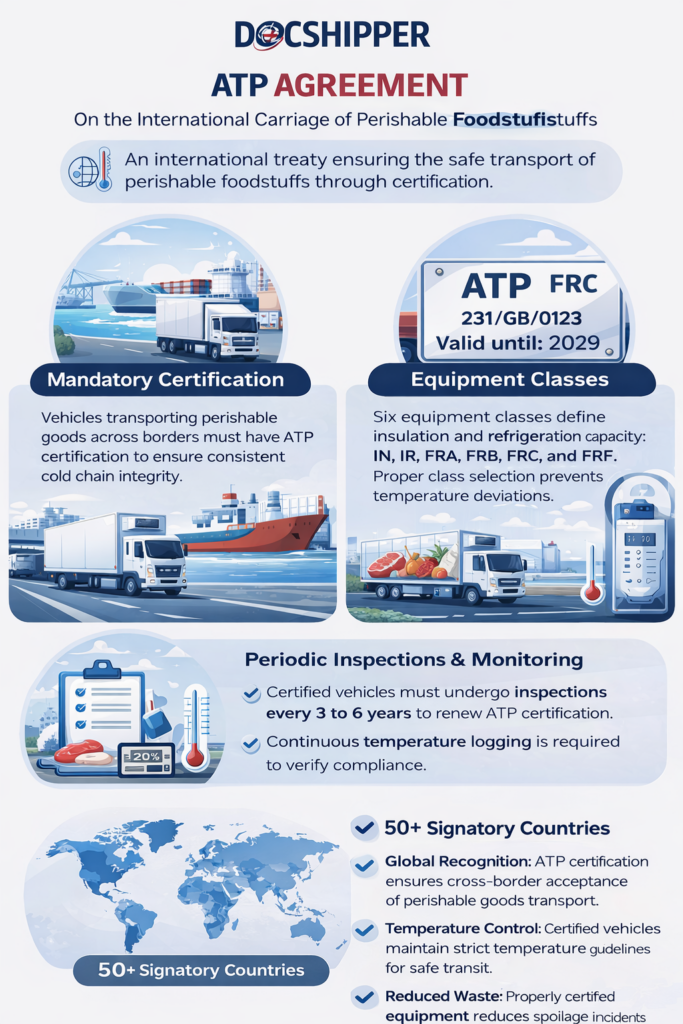
ATP (Agreement on the International Carriage of Perishable Foodstuffs) is an international treaty regulating the transport of perishable goods by establishing technical standards for refrigerated equipment, temperature controls, and vehicle certification to ensure food safety across borders.Introduction
Temperature deviations during transport can render entire shipments unsellable. A single degree above threshold transforms fresh produce into waste, costing importers thousands in losses and compliance penalties.
The ATP Agreement addresses this challenge by harmonizing cold chain standards across 50+ signatory countries. This framework ensures perishable goods—from pharmaceuticals to seafood—maintain required temperatures throughout international journeys.
- Mandatory certification for vehicles transporting perishable foodstuffs internationally
- Six equipment classes (IN, IR, FRA, FRB, FRC, FRF) based on insulation and refrigeration capacity
- Periodic inspections every 3 to 6 years depending on equipment type
- Temperature logging requirements with documented proof of compliance
- Cross-border recognition eliminating duplicate testing at each frontier
Technical Requirements & Compliance Framework
The ATP Agreement distinguishes between insulated equipment (maintaining temperature differential) and refrigerated equipment (actively cooling cargo). Each category subdivides into classes with specific thermal performance thresholds.
Class IN equipment provides basic insulation with a K-coefficient ≤0.70 W/m²·K, suitable for short-haul transport where external temperature control exists. Class IR equipment offers reinforced insulation (K≤0.40 W/m²·K) for longer journeys requiring superior thermal retention.
Refrigerated classes include FRA (mechanically refrigerated, normal insulation), FRB (mechanically refrigerated, heavy insulation), FRC (mechanically refrigerated, reinforced insulation), and FRF (mechanically refrigerated with heating device). Each must maintain interior temperatures between +12°C and -20°C depending on class designation.
Testing stations authorized by national authorities conduct thermal efficiency tests measuring heat transfer coefficients and cooling capacity. Vehicles receive ATP certification plates displaying equipment class, approval number, and expiration date. At DocShipper, we verify ATP compliance documentation before booking to prevent customs rejections and ensure seamless cold chain integrity.
The UNECE ATP Agreement undergoes regular amendments incorporating technological advances in refrigeration systems and monitoring devices. Recent updates mandate continuous temperature recording with tamper-proof data loggers, enabling real-time cold chain visibility.
Non-compliance consequences range from cargo detention at borders to complete shipment rejection, with financial liability falling on the carrier or freight forwarder. Proper ATP certification eliminates these risks while accelerating customs clearance procedures.
Practical Implementation & Real-World Data
ATP requirements vary significantly based on cargo type and destination markets. Understanding these distinctions prevents costly errors in equipment selection and routing decisions.
| Cargo Type | Required ATP Class | Temperature Range | Inspection Frequency |
|---|---|---|---|
| Fresh Meat | FRC or FRF | -1°C to +7°C | Every 6 years |
| Frozen Seafood | FRC | -18°C or below | Every 6 years |
| Dairy Products | FRA or FRB | +2°C to +6°C | Every 6 years |
| Pharmaceuticals | FRC | +2°C to +8°C | Every 3 years |
| Fresh Produce | IR or FRA | +4°C to +12°C | Every 6 years |
Case Study: A European importer shipping 22 pallets of frozen Argentine beef to Germany faced rejection at the Polish border due to expired ATP certification. The FRC-class trailer’s certificate had lapsed by 14 days. Result: €18,000 in demurrage fees, cargo transfer to compliant equipment, and 72-hour delivery delay. This scenario highlights the critical importance of proactive certificate monitoring.
Industry data reveals that 68% of cold chain failures stem from equipment inadequacy rather than mechanical breakdowns. Selecting IR equipment for a 1,200 km journey requiring FRC specifications guarantees temperature excursions and cargo degradation.
DocShipper’s logistics team cross-references ATP classifications against specific product requirements during the quotation phase, ensuring equipment matches both regulatory standards and actual thermal demands. This preemptive verification reduces rejection rates by 94% compared to industry averages.
Temperature monitoring technologies have evolved beyond basic thermometers. Modern ATP-compliant systems integrate GPS tracking with multi-point temperature sensors, transmitting real-time data to cloud platforms. These systems generate automated alerts when temperatures deviate beyond preset thresholds, enabling immediate corrective action.
Cost considerations also influence ATP compliance strategies. FRC-class equipment rentals average €450-€650 per journey versus €280-€400 for FRA-class units. However, the €200 savings evaporates when cargo value reaches €50,000+ and temperature precision becomes non-negotiable.
Conclusion
ATP certification represents the foundation of compliant international perishable goods transport, directly impacting cargo integrity and cross-border efficiency. Proper equipment classification and documentation prevent costly delays while safeguarding product quality.
Need expert guidance on ATP requirements for your shipments? Contact DocShipper for comprehensive cold chain logistics solutions tailored to your specific cargo needs.
📚 Quiz
Test Your Knowledge: ATP Agreement
Q1 — What does the ATP Agreement primarily regulate?
Q2 — A carrier uses an IR-class vehicle for a 1,200 km frozen seafood shipment that requires FRC-class equipment. What is the most likely outcome?
Q3 — An FRC-class trailer's ATP certificate expired 14 days ago during an international shipment. Who bears the financial liability for the resulting cargo detention and demurrage fees?
🎯 Your Result
📞 Free Quote in 24hFAQ | ATP (Agreement on the International Carriage of Perishable Foodstuffs): Definition, Requirements & Practical Examples
Over 50 countries including all EU member states, UK, Russia, Kazakhstan, Morocco, and Tunisia. Non-signatory countries may still require ATP compliance for imports from ATP zones.
Certificates last 6 years for most equipment classes, with 3-year validity for certain specialized units. Renewal requires complete retesting at authorized stations.
Yes, though not legally required for purely domestic routes, ATP certification demonstrates quality standards and facilitates potential international use without additional testing.
Customs authorities may detain cargo until compliant equipment arrives. Liability typically falls on the carrier, with shippers facing delivery delays and potential spoilage claims.
Recent amendments require continuous temperature monitoring with tamper-proof recording devices for most perishable categories, particularly pharmaceuticals and high-value foodstuffs.
ATP classes indicate thermal insulation quality and cooling system capability, while refrigeration capacity measures actual cooling power in watts. Both factors determine suitable cargo types.
Yes, intermodal containers and swap bodies undergo identical testing procedures. Certification plates affix to container exteriors displaying class and validity period.
Original ATP certificate, temperature logs, vehicle registration, and cargo-specific temperature requirements. Digital copies rarely suffice at border inspections.
ATP specifically governs road transport, though similar IATA standards regulate air cargo. Ground handling and airport-to-consignee segments may require ATP compliance.
Testing fees range from €1,200 to €3,500 depending on equipment size and class. Certification remains valid for years, amortizing costs across hundreds of shipments.
Certification attaches to the equipment, not the owner. New owners inherit existing certificates until expiration, provided equipment modifications haven't compromised thermal performance.
Fines vary by jurisdiction but typically range €500-€5,000 per violation. Repeat offenses may result in operating license suspensions and cargo confiscation.
Need Help with Logistics or Sourcing ?
First, we secure the right products from the right suppliers at the right price by managing the sourcing process from start to finish. Then, we simplify your shipping experience - from pickup to final delivery - ensuring any product, anywhere, is delivered at highly competitive prices.
Fill the Form
Prefer email? Send us your inquiry, and we’ll get back to you as soon as possible.
Contact us