


In short ⚡
Attributes are specific characteristics or properties that define, classify, and distinguish goods, shipments, or logistical entities within international trade operations. These data points enable accurate tracking, regulatory compliance, customs clearance, and operational decision-making throughout the supply chain.
Introduction
Many importers and exporters struggle with incomplete or inaccurate product descriptions that lead to customs delays, fines, or shipment rejections. Understanding and properly documenting attributes is essential for smooth international logistics operations.
In global trade, attributes serve as the foundational data elements that customs authorities, carriers, and logistics partners use to process shipments efficiently. Without precise attributes, even routine shipments can face significant obstacles.
Key characteristics of logistics attributes include:
- Mandatory nature: Required by customs and regulatory bodies worldwide
- Standardization: Must follow international classification systems (HS codes, INCOTERMS)
- Traceability: Enable end-to-end shipment visibility and accountability
- Compliance function: Ensure adherence to import/export regulations
- Operational impact: Directly influence routing, handling, and delivery timelines
In-Depth Analysis & Expert Insights
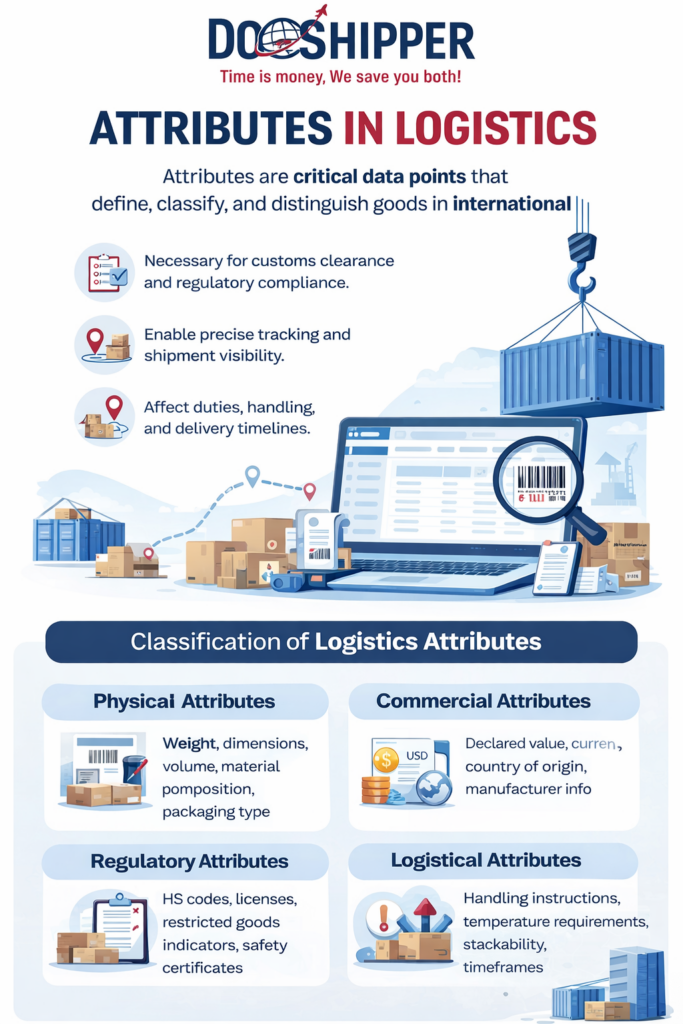
Attributes in international logistics fall into several critical categories, each serving distinct regulatory and operational purposes. Understanding these classifications prevents costly errors and accelerates clearance processes.
Physical attributes describe tangible product characteristics: weight, dimensions, volume, material composition, and packaging type. Customs authorities use these to calculate duties and assess handling requirements. Incorrect weight declarations, for example, can trigger audits and penalties.
Commercial attributes encompass financial and transactional data: declared value, currency, country of origin, manufacturer details, and purchase order numbers. These elements determine applicable tariffs and trade agreement eligibility. The U.S. International Trade Administration provides comprehensive guidance on commercial documentation requirements.
Regulatory attributes address compliance mandates: HS classification codes, licensing requirements, restricted/prohibited goods indicators, and safety certifications. Misclassification of HS codes remains one of the most common causes of customs disputes. At DocShipper, we systematically verify HS code accuracy before shipment to prevent clearance delays.
Logistical attributes guide operational execution: handling instructions (fragile, perishable, hazardous), temperature requirements, stackability, and delivery timeframes. These attributes ensure carriers apply appropriate care and routing.
Digital attributes increasingly include electronic certificates, blockchain-verified provenance data, and IoT sensor readings. Modern customs systems integrate these digital elements to streamline verification processes and reduce manual inspections.
Practical Examples & Data
Consider a typical electronics shipment from Shenzhen to Rotterdam. Proper attribute documentation directly impacts clearance speed and cost structure.
| Attribute Category | Required Data | Compliance Impact |
|---|---|---|
| Physical | Weight: 850 kg, Dimensions: 120x100x90 cm, 15 cartons | Determines freight class and handling fees |
| Commercial | Value: €12,500, Origin: China, Manufacturer: XYZ Electronics | Calculates duty rate (typically 3.7% for electronics) |
| Regulatory | HS Code: 8471.30, CE certification, RoHS compliant | Enables EU market entry; non-compliance blocks clearance |
| Logistical | Fragile, keep dry, stack max 3 high | Prevents damage; affects warehouse storage protocols |
Use Case: Attribute Error Impact
A French importer received 200 units of industrial sensors valued at €45,000. The initial declaration listed an incorrect HS code (8537 instead of 9026). This misclassification triggered:
- 5-day customs hold for verification
- €1,200 in additional storage fees
- Manual inspection requirement
- Duty rate difference: 2.7% vs. 0% (costing €1,215)
- Total delay cost: €2,415 plus lost production time
Correcting attributes before shipment eliminates these risks. DocShipper’s pre-clearance verification service identifies such discrepancies during documentation preparation, ensuring first-time clearance success rates above 98%.
Key data points for attribute accuracy:
- HS code verification reduces clearance time by average 3.2 days
- Complete attribute documentation decreases inspection probability by 67%
- Digital attribute systems cut processing errors by 84%
- Proper origin certification can reduce duties by 0-15% under trade agreements
- Temperature attribute compliance prevents 95% of perishable cargo losses
Conclusion
Mastering logistics attributes transforms international shipping from a compliance burden into a strategic advantage. Accurate, complete attribute documentation accelerates clearance, reduces costs, and builds reliable supply chain operations.
Need expert guidance on attribute management for your shipments? Contact DocShipper for comprehensive logistics support tailored to your specific trade requirements.
DocShipper Platform
Cut logistics costs. Not corners.
See exactly where your logistics costs are bleeding — and how to fix it. Book your expert demo.

📚 Quiz
Test Your Knowledge: Attributes in Logistics
Q1 — What is the primary purpose of attributes in international logistics?
Q2 — A shipment of industrial sensors is declared under HS code 8537 instead of the correct code 9026. What is the most likely consequence?
Q3 — An importer ships perishable goods but omits temperature requirements from the shipment documentation. Which attribute category has been neglected?
🎯 Your Result
📞 Free Quote in 24hFAQ | Attributes in Logistics: Definition, Classification & Practical Examples
HS classification code, declared value, country of origin, and commercial invoice details are essential. Missing or incorrect data in these fields causes 78% of clearance delays.
Consult the World Customs Organization's Harmonized System database, use your country's customs tariff tool, or engage a licensed customs broker for classification verification.
Yes, but corrections require formal amendments submitted to customs before arrival. This process adds 2-5 days and may incur penalty fees depending on jurisdiction.
Carriers will re-measure and apply dimensional weight pricing. Significant discrepancies (>10%) trigger additional fees and may flag your account for future audits.
In most jurisdictions, yes—electronic records have equal legal standing when properly authenticated. The EU, US, and 80+ countries accept digital customs declarations.
Customs authorities use HS code, declared value, and origin attributes to determine applicable tariff rates. Incorrect classification can result in overpayment or underpayment penalties.
UN number, proper shipping name, hazard class, packing group, and emergency contact information. These attributes are mandatory for IMDG, IATA, and ADR compliance.
Core commercial attributes remain identical, but carriers require mode-specific data: air waybill numbers for air freight, container seal numbers for ocean, and vehicle registration for road transport.
Most countries require 3-7 years retention for customs records. The EU mandates 5 years, the US requires 5 years, and China stipulates 3 years minimum.
Yes—modern TMS and ERP systems auto-populate attributes from product master data, reducing manual entry errors by 91%. Integration with customs platforms enables real-time validation.
Documentation proving goods qualify for reduced tariffs under free trade agreements. Includes certificate of origin, manufacturer declarations, and value-added calculations.
While HS codes are globally standardized, additional attributes vary: the US requires manufacturer ID numbers, the EU mandates EORI numbers, and China requires CCC certification for regulated products.
Need Help with Logistics or Sourcing ?
First, we secure the right products from the right suppliers at the right price by managing the sourcing process from start to finish. Then, we simplify your shipping experience - from pickup to final delivery - ensuring any product, anywhere, is delivered at highly competitive prices.


Fill the Form
Prefer email? Send us your inquiry, and we’ll get back to you as soon as possible.
Contact us


