


In short ⚡
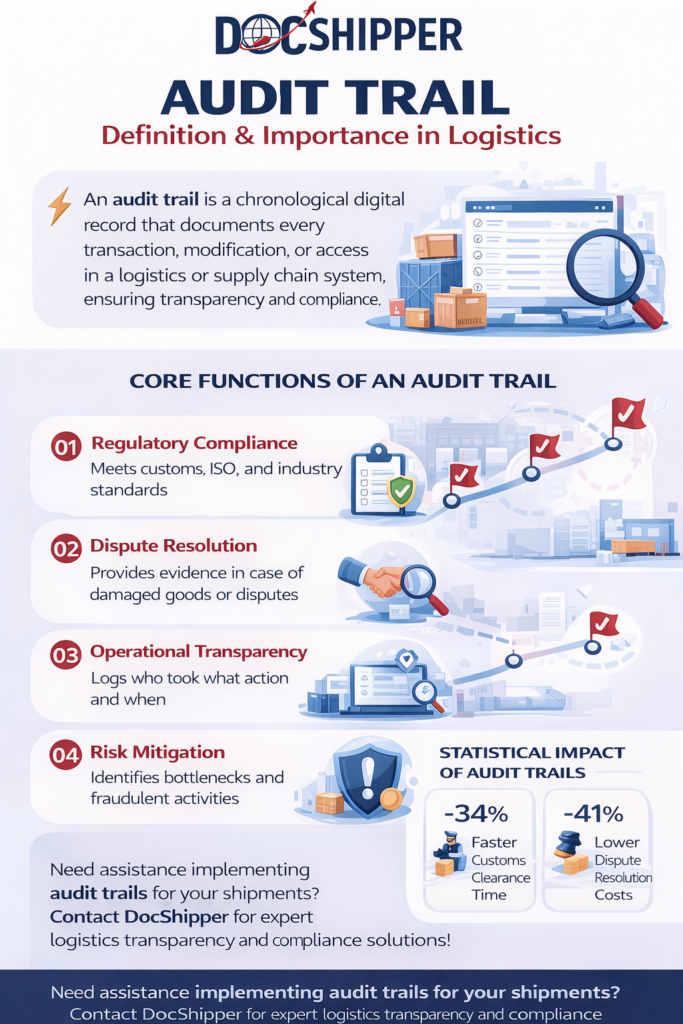
An audit trail is a chronological digital record that documents every transaction, modification, or access within a logistics or supply chain system. It ensures transparency, regulatory compliance, and enables traceability of goods, documents, and operations throughout the international shipping process.
Introduction
In international logistics, confusion often arises when shipments face delays, disputes, or customs holds—yet no one can pinpoint exactly what went wrong or when. This lack of visibility creates financial risks and compliance failures.
The audit trail solves this problem by providing an immutable record of every action taken during the shipping cycle. It’s essential for customs clearance, quality control, and legal protection in global trade.
- Regulatory compliance: Satisfies customs, FDA, and ISO requirements
- Dispute resolution: Provides evidence in case of damaged goods or delivery failures
- Operational transparency: Tracks who did what, when, and where
- Risk mitigation: Identifies bottlenecks and fraudulent activities
- Data integrity: Ensures modifications are logged and traceable
In-Depth Analysis & Expertise
An audit trail functions as a digital footprint that captures every step in the logistics chain. From warehouse entry to final delivery, each interaction—whether human or automated—is timestamped and attributed to a specific user or system.
The immutability principle is critical: once an entry is recorded, it cannot be altered or deleted. This ensures data integrity and prevents tampering, which is crucial for customs authorities and legal proceedings.
Modern audit trails integrate with ERP systems, TMS platforms, and blockchain technologies. These systems automatically log events such as bill of lading issuance, container sealing, customs declaration submission, and payment processing.
From a regulatory standpoint, audit trails are mandatory for industries handling sensitive goods. The European Union Customs Code requires detailed documentation of all customs-related transactions. Similarly, the FDA enforces audit trail standards for pharmaceutical imports.
Key components of a compliant audit trail include: user identification, timestamp precision, action description, data before/after modification, and system source. Without these elements, the trail loses its evidentiary value.
At DocShipper, we implement automated audit trail systems across all shipments. This ensures full visibility for our clients and simplifies customs audits by providing instant access to historical data.
Concrete Examples & Data
Consider a pharmaceutical shipment from India to France. The audit trail captures 47 distinct events across 18 days, including:
| Event Type | Timestamp | User/System | Action |
|---|---|---|---|
| Warehouse Entry | 2024-01-05 08:23 UTC | System_WMS | Container #ABCD123456 scanned |
| Customs Declaration | 2024-01-07 14:51 UTC | User_J.Dupont | HS Code modified: 3004.90 → 3004.50 |
| Payment Validation | 2024-01-10 09:12 UTC | System_Finance | Invoice #INV-2024-0089 paid (€12,450) |
| Delivery Confirmation | 2024-01-23 16:34 UTC | Driver_M.Leclerc | POD signed at Lyon facility |
This granular tracking allowed the importer to prove compliance during a random customs audit. Without the trail, the HS code modification could have triggered penalties.
Use Case: Dispute Resolution
A textile shipment from Bangladesh arrived damaged. The buyer claimed negligence during loading. The audit trail revealed:
- Container inspection at origin: No damage reported (photo timestamp: 2024-02-12 11:03)
- Transshipment in Singapore: Container opened for random inspection (logged by port authority)
- Re-sealing delay: 4 hours 17 minutes (weather event documented)
- Delivery scan: Damage visible on external camera (2024-03-01 07:22)
The trail pinpointed the Singapore transshipment as the liability point. The carrier accepted responsibility, saving the shipper €18,000 in disputed claims.
Statistical insight: According to a 2023 supply chain study, companies with comprehensive audit trails reduce customs clearance time by 34% and dispute resolution costs by 41%.
Conclusion
The audit trail is not just a compliance tool—it’s a strategic asset that protects your business, accelerates operations, and builds trust with partners. In an era of increasing regulatory scrutiny, maintaining a robust digital record is non-negotiable.
Need help implementing audit trail systems for your shipments? Contact DocShipper for expert guidance on logistics transparency and compliance.
📚 Quiz
Test Your Knowledge: Audit Trail
Q1 — What is the primary purpose of an audit trail in international logistics?
Q2 — A logistics manager wants to retroactively correct a wrongly recorded entry in the audit trail to avoid a customs penalty. Is this possible under the immutability principle?
Q3 — A textile shipment arrives damaged and the buyer blames the shipper for negligence during loading. Which outcome best illustrates how an audit trail resolves this dispute?
🎯 Your Result
📞 Free Quote in 24hFAQ | Audit Trail: Definition, Calculation & Concrete Examples
An audit trail is a structured, immutable record designed for compliance and traceability. A log file is a technical output from systems, often modifiable and less regulated. Audit trails meet legal standards; logs are operational tools.
Not universally, but highly regulated industries (pharmaceuticals, food, chemicals) require them. Customs authorities increasingly demand audit trails for high-value or sensitive goods. Best practice: implement them for all shipments.
Retention periods vary by jurisdiction. The EU requires 5-10 years for customs data. The US FDA mandates retention throughout a product's lifecycle plus 1 year. Consult local regulations and maintain records beyond minimum requirements.
Yes, cloud storage is acceptable if providers meet compliance standards (ISO 27001, SOC 2). Ensure data encryption, access controls, and geographic restrictions align with your industry's regulations. Blockchain-based solutions offer additional immutability.
Incomplete trails can trigger customs holds, fines, or shipment rejections. They weaken legal defenses in disputes and may violate industry certifications. Regular audits of your trail system are essential to catch gaps early.
Absolutely. Even small importers face audits and disputes. Basic audit trail tools are affordable and prevent costly errors. Many TMS platforms include built-in audit functions. Start simple, scale as your operations grow.
Blockchain creates decentralized, tamper-proof records. Each transaction is cryptographically linked, making unauthorized changes impossible. This enhances trust in multi-party logistics chains and simplifies verification for customs and partners.
Yes. By logging every action with user attribution, audit trails deter fraudulent document alterations, cargo theft documentation, and false delivery claims. Real-time monitoring flags anomalies immediately, enabling swift intervention.
Top solutions include SAP TM, Oracle SCM Cloud, and specialized platforms like ShipStation or Flexport. Choose based on integration needs, compliance requirements, and scalability. DocShipper integrates with leading systems for seamless trail management.
Not typically, unless handling regulated goods (hazmat, pharmaceuticals). However, maintaining trails domestically improves operational efficiency and prepares your systems for international expansion. Many companies adopt them as a quality standard.
Trails track carbon footprint data (fuel consumption, route efficiency), packaging waste, and supplier compliance. This enables accurate ESG reporting and helps identify optimization opportunities. Transparency in logistics is increasingly tied to corporate sustainability goals.
Costs range from $500/month for basic cloud solutions to $50,000+ for enterprise blockchain platforms. Factors include shipment volume, integration complexity, and compliance needs. ROI typically appears within 12-18 months through reduced disputes and faster clearances.
Need Help with Logistics or Sourcing ?
First, we secure the right products from the right suppliers at the right price by managing the sourcing process from start to finish. Then, we simplify your shipping experience - from pickup to final delivery - ensuring any product, anywhere, is delivered at highly competitive prices.


Fill the Form
Prefer email? Send us your inquiry, and we’ll get back to you as soon as possible.
Contact us


