In short ⚡
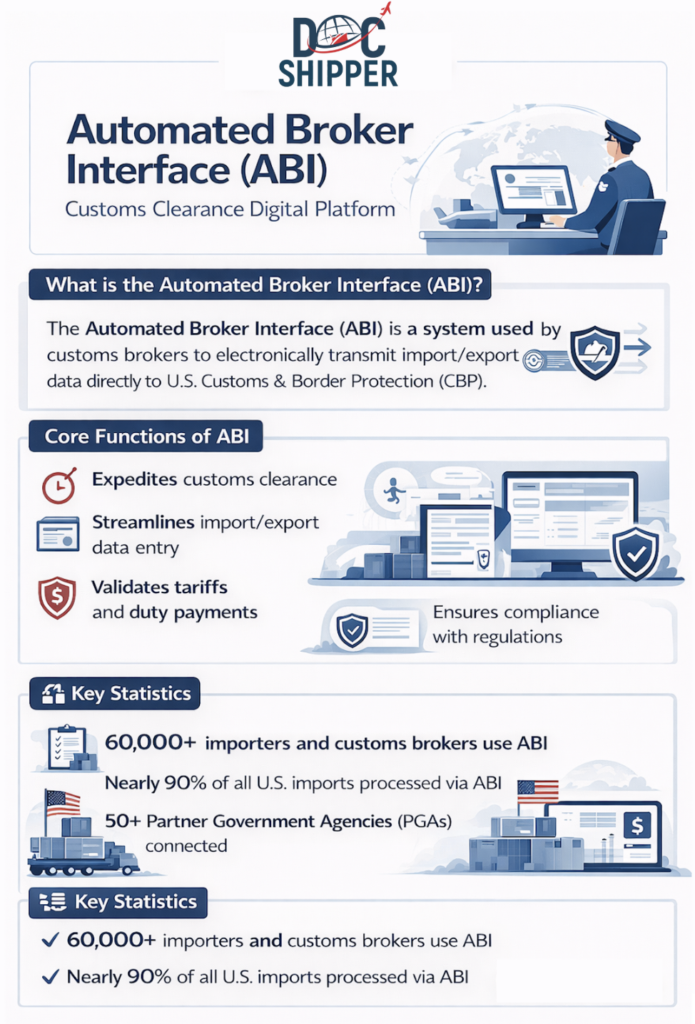
Automated Broker Interface (ABI) is the U.S. Customs and Border Protection electronic system that allows customs brokers and importers to transmit entry documentation and cargo release information directly to CBP. This mandatory interface streamlines customs clearance by replacing paper-based processes with secure, real-time data transmission for faster cargo release and compliance verification.
Introduction
Many importers struggle with customs delays caused by incomplete documentation or manual processing errors. The Automated Broker Interface eliminates these bottlenecks by creating a direct digital pipeline between trade parties and U.S. Customs.
Since its implementation in 1984, ABI has become the backbone of U.S. import operations. Every commercial shipment entering the United States requires ABI transmission for customs clearance. Understanding this system is essential for maintaining supply chain efficiency and avoiding costly delays.
- Mandatory for all commercial imports valued over $2,500 entering the U.S.
- Real-time data transmission enabling same-day cargo release in most cases
- Integrated with ACE (Automated Commercial Environment) for comprehensive trade management
- Secure authentication protocols protecting sensitive commercial information
- Automated duty calculation reducing human error in tariff classification
Technical Framework & Compliance Requirements
ABI operates through the Automated Commercial Environment (ACE), CBP’s primary system for trade processing. Licensed customs brokers must obtain ABI certification and maintain secure Electronic Data Interchange (EDI) connections using standardized message formats.
The system processes five critical document types: entry summaries, cargo release notifications, duty payment instructions, post-entry amendments, and reconciliation records. Each transmission requires specific data elements defined in the CBP Automated Commercial Environment Secure Data Portal guidelines.
According to U.S. Customs and Border Protection regulations, all filers must comply with the Customs Modernization Act requirements, including accurate Harmonized Tariff Schedule classification and proper valuation methods.
Filer codes uniquely identify each customs broker or self-filing importer in the system. These codes link to bonded accounts and determine access privileges within ACE. Entry types vary by shipment characteristics—consumption entries for immediate release, warehouse entries for deferred duty payment, or temporary import bonds for goods returning abroad.
The security protocol employs multi-factor authentication and encrypted transmission channels. All data exchanges are logged with timestamps and digital signatures for audit trail purposes. At DocShipper, we maintain certified ABI connectivity across all major U.S. ports, ensuring seamless transmission regardless of entry point.
Compliance validation occurs in milliseconds as ABI cross-references submitted data against CBP databases, including restricted party lists, antidumping duty orders, and quota allocations. Any discrepancies trigger immediate holds requiring broker intervention before cargo release.
Practical Implementation & Processing Times
ABI transmission must occur within specific timeframes to avoid penalties. For ocean shipments, entry documentation is due within 15 calendar days of cargo arrival. Air and truck shipments require same-day or next-business-day filing depending on arrival time.
Processing efficiency varies by entry complexity and CBP workload. Standard consumption entries with no compliance issues typically receive release authorization within 2-4 hours. Shipments requiring specialized examinations or additional documentation may extend to 24-48 hours.
| Entry Type | ABI Filing Deadline | Typical Release Time | Duty Payment Window |
|---|---|---|---|
| Consumption Entry | 15 days from arrival | 2-4 hours | 10 business days |
| Warehouse Entry | Same day as arrival | 4-6 hours | Deferred until withdrawal |
| TIB (Temporary Import) | Prior to arrival | 1-2 hours | Bond-secured, no payment |
| Informal Entry | Same day | 30 minutes – 2 hours | Immediate at filing |
Use Case: Electronics Importer
A California-based electronics distributor imports 500 laptops valued at $400,000 from Taiwan via Los Angeles port. The customs broker transmits ABI entry at 9:00 AM on arrival day. CBP’s automated system validates the HTS classification (8471.30.01), confirms the 0% duty rate under normal trade relations, and cross-checks the manufacturer against entity lists. Release notification arrives at 11:15 AM, allowing immediate cargo pickup. Total customs clearance time: 2 hours 15 minutes.
Cost implications directly correlate with processing speed. Delayed ABI transmission triggers per-diem storage charges at container terminals, typically $75-150 per container per day. At DocShipper, we implement pre-arrival filing strategies to ensure cargo release coincides with vessel discharge, eliminating unnecessary demurrage costs.
Error correction through ABI post-summary corrections (PSCs) allows brokers to amend entries within specific timeframes without penalty. Minor data discrepancies can be resolved electronically, while classification disputes may require formal protest procedures.
Integration capabilities enable ABI connectivity with warehouse management systems, freight forwarding software, and enterprise resource planning platforms. This seamless data flow eliminates manual re-entry and reduces documentation errors across the supply chain.
Performance metrics tracked through ACE portals include filing accuracy rates, average release times, and compliance scores. Brokers maintaining 98%+ accuracy receive expedited processing status for routine shipments.
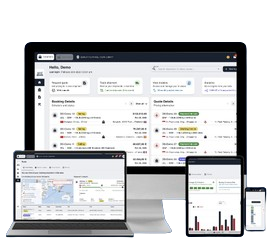
DocShipper Platform
One platform. Your entire supply chain
Sourcing, freight, customs & documents — all centralised, all visible, 24/7.
Conclusion
The Automated Broker Interface remains the mandatory gateway for U.S. import compliance, directly impacting delivery schedules and operational costs. Mastering ABI processes ensures predictable customs clearance and minimizes supply chain disruptions.
Need expert guidance on ABI filing requirements or customs brokerage services? Contact DocShipper for comprehensive import solutions tailored to your business needs.
📚 Quiz
Test Your Knowledge: Automated Broker Interface (ABI)
Q1. What is the primary purpose of the Automated Broker Interface (ABI)?
Q2. A common misconception about ABI is that it is only required for high-value shipments over $1 million. What does the regulation actually state?
Q3. A California importer's ocean shipment arrives at the port of Los Angeles. The customs broker has not yet submitted the ABI entry. What is the filing deadline, and what risk does the importer face if it is missed?
🎯 Your Result
📞 Free Quote in 24hFAQ | Automated Broker Interface (ABI): Definition, Process & Practical Examples
All licensed customs brokers and self-filing importers handling commercial shipments valued over $2,500 must use ABI. Individual consumers and informal entries under this threshold may use simplified procedures.
Yes, through self-filing privileges, but this requires obtaining a customs bond, ACE portal access, and demonstrated knowledge of customs regulations. Most businesses use licensed brokers to ensure compliance and efficiency.
Late filings incur liquidated damages ranging from $100-1,000 depending on entry value and delay duration. Cargo may also be transferred to general order status, accruing additional storage fees.
ABI is the transmission protocol within ACE's broader trade processing ecosystem. All ABI messages route through ACE infrastructure, which provides centralized data validation, account management, and reporting functions.
Required documents include commercial invoices, packing lists, bills of lading, and any permits or certificates specific to regulated commodities. These are submitted electronically or retained for CBP inspection upon request.
Automated validations occur within minutes. Full release authorization typically processes in 2-6 hours for standard entries without holds. Complex shipments requiring manual review may take 24-48 hours.
Customs brokers typically charge $75-150 per entry for ABI transmission services, plus additional fees for classification research, permit procurement, or examination attendance. Volume discounts apply for frequent importers.
Yes, through Post Summary Corrections (PSC) filed within 15 days of release for most data elements. Duty-related changes require formal protests filed within 180 days of liquidation.
ABI operates at all CBP-designated ports including seaports, airports, and land border crossings. System functionality is identical regardless of entry location, though local examination procedures may vary.
ABI employs 256-bit encryption, multi-factor authentication, and IP whitelisting. All transactions are logged with digital signatures and timestamps for audit compliance. CBP conducts regular security assessments of broker systems.
The system automatically flags entries requiring FDA, USDA, EPA, or other agency clearances. Permit numbers must be included in ABI transmission, and cargo remains on hold until all partner government agencies issue release notifications.
Customs brokers must pass the federal licensing exam covering ABI procedures. Broker employees receive in-house training on specific software platforms. CBP offers ACE training webinars and documentation for self-filers.
Need Help with
Logistics or Sourcing ?
First, we secure the right products from the right suppliers at the right price by managing the sourcing process from start to finish. Then, we simplify your shipping experience - from pickup to final delivery - ensuring any product, anywhere, is delivered at highly competitive prices.


Fill the Form
Prefer email? Send us your inquiry, and we’ll get back to you as soon as possible.
Contact us