In short ⚡
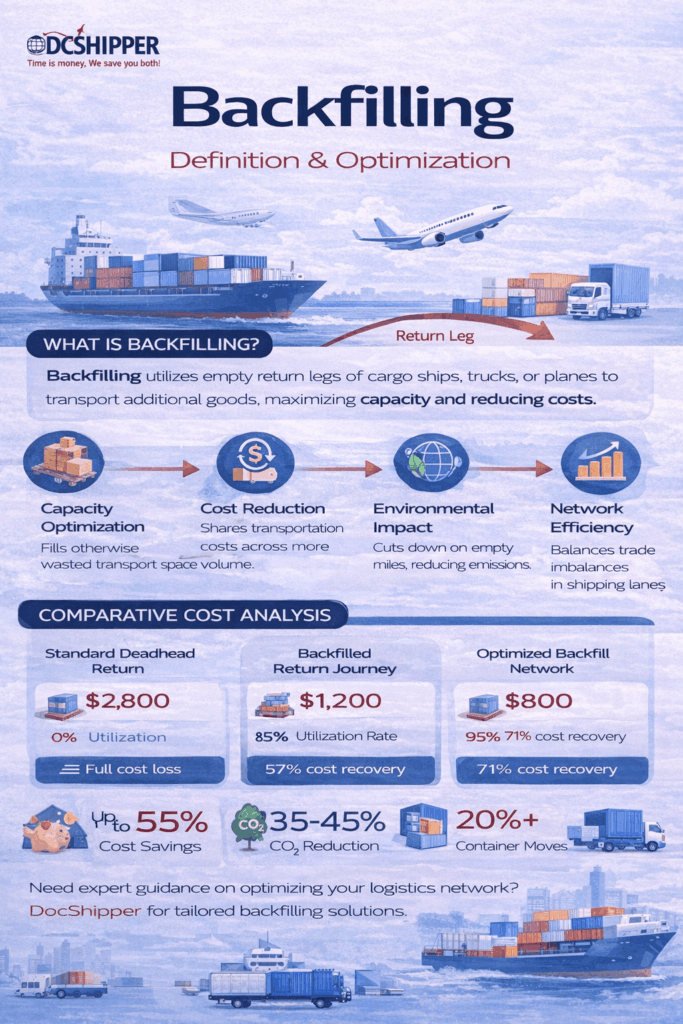
Backfilling is a logistics optimization strategy that involves utilizing empty cargo space on return trips or repositioning movements to transport additional goods, thereby maximizing vehicle capacity utilization and reducing transportation costs. This practice transforms otherwise unproductive deadhead journeys into revenue-generating or cost-saving opportunities within supply chain operations.Introduction
Every year, millions of containers, trucks, and vessels return empty after delivering goods, representing a massive inefficiency in global logistics. This phenomenon, known as deadheading, costs the industry billions while contributing unnecessarily to carbon emissions.
Backfilling addresses this challenge by strategically filling empty return capacity with cargo. In international trade, where transportation represents 30-40% of total logistics costs, this optimization technique has become essential for competitive operations.
Key characteristics of backfilling include:
- Capacity optimization: Utilizes otherwise wasted transport space on return journeys
- Cost reduction: Distributes fixed transportation costs across more cargo volume
- Environmental benefit: Reduces empty miles and associated carbon footprint
- Network efficiency: Balances directional trade imbalances in shipping lanes
- Revenue generation: Creates additional income streams from repositioning movements
In-Depth Analysis & Expertise
The mechanics of backfilling operate at multiple levels within the supply chain. At its core, the strategy requires sophisticated load planning systems that identify available capacity on return routes and match it with compatible cargo requirements.
From a legal and contractual perspective, backfilling introduces complexity. Carrier liability remains identical whether cargo travels on primary or backfill legs. Insurance coverage, customs documentation, and regulatory compliance must meet the same standards. The European Union’s customs regulations apply equally to backfilled cargo as to primary shipments.
Operational challenges include coordinating timing between outbound and return shipments, managing different cargo types with varying handling requirements, and ensuring equipment suitability. A refrigerated container used for pharmaceutical exports cannot backfill with non-temperature-controlled goods without proper cleaning and reconfiguration.
The financial calculation involves marginal cost analysis. Since the vehicle must return regardless, only incremental costs (additional fuel due to weight, handling, documentation) are considered against revenue. This creates pricing flexibility that can undercut dedicated shipments while remaining profitable.
Technology enablers have revolutionized backfilling efficiency. Digital freight platforms now use artificial intelligence to match available capacity with cargo in real-time, reducing the coordination burden that previously made backfilling viable only for large-scale operations.
At DocShipper, we systematically analyze backfilling opportunities across our client shipments, identifying cost-saving possibilities that reduce overall transportation expenses by 15-30% on applicable routes. Our network visibility allows us to coordinate multi-client backfill arrangements that individual shippers cannot access independently.
Concrete Examples & Data
Industry data reveals the significant impact of backfilling strategies. According to maritime shipping analysis, approximately 20% of global container movements involve empty repositioning, representing over 60 million TEU annually that could potentially be optimized through backfilling.
Comparative Cost Analysis
| Scenario | Cost per Container | Utilization Rate | Cost Efficiency |
|---|---|---|---|
| Standard Deadhead Return | $2,800 | 0% | Full cost loss |
| Backfilled Return Journey | $1,200 | 85% | 57% cost recovery |
| Optimized Backfill Network | $800 | 95% | 71% cost recovery |
Real-World Use Case: European Automotive Parts
A German automotive manufacturer exports finished vehicles to the United States using specialized car carriers. Historically, these vessels returned empty, incurring repositioning costs of approximately $450,000 per voyage.
By implementing a backfilling strategy, the carrier now loads American agricultural machinery and construction equipment for European markets on return journeys. This arrangement generates $280,000 in additional revenue per trip while the cargo owners benefit from rates 40% below standard transatlantic shipping costs.
The arrangement required modifications to loading equipment and coordination with U.S. export regulations, but the annual savings exceed $6.7 million across the carrier’s fleet of 24 vessels on this route.
Key Performance Indicators for Backfilling
- Capacity utilization rate: Industry leaders achieve 75-85% on backfill legs versus 15-25% industry average
- Cost recovery ratio: Successful programs recover 50-70% of return journey costs
- Carbon reduction: Backfilling reduces per-unit CO2 emissions by 35-45% compared to separate shipments
- Network balance: Optimized operations maintain directional balance within 10-15% variance
- Revenue enhancement: Carriers report 8-12% revenue increases from systematic backfilling programs
Regional trade imbalances create natural backfilling opportunities. The Asia-Europe route historically moves three times more cargo eastbound than westbound, creating persistent empty container repositioning needs. Backfilling addresses this structural imbalance by matching low-cost westbound capacity with European exports to Asian markets.
Conclusion
Backfilling represents a fundamental shift from viewing return journeys as unavoidable costs to recognizing them as strategic opportunities. As global trade continues expanding and sustainability pressures intensify, optimizing every transport movement becomes not just economically advantageous but operationally essential.
Need assistance optimizing your logistics network through backfilling strategies? Contact DocShipper for a customized analysis of your transportation flows and cost-reduction opportunities.
📚 Quiz
Test Your Knowledge: Backfilling
1. What is the primary definition of backfilling in logistics?
2. A shipper assumes that backfilled cargo requires less documentation than a standard primary shipment. Is this correct?
3. A mid-sized European exporter wants to ship industrial components to the US at a reduced rate. The carrier has available capacity on a vessel returning from a US automotive delivery. Which approach best describes leveraging backfilling in this scenario?
🎯 Your Result
📞 Free Personalized QuoteFAQ | Backfilling: Definition, Calculation & Concrete Examples
Most non-perishable, non-hazardous cargo works well for backfilling. Ideal candidates include industrial components, consumer goods, raw materials, and agricultural products. Cargo with flexible delivery timelines offers greatest compatibility with backfill scheduling requirements.
Backfilled cargo may experience slightly extended transit times (typically 2-5 days) due to coordination requirements and potential routing adjustments. However, this trade-off often proves acceptable given the 30-50% cost savings compared to dedicated shipments.
No. While historically limited to major players, digital freight platforms now enable small and medium shippers to access backfilling opportunities. Consolidation services combine multiple smaller shipments to fill available return capacity economically.
Backfilled cargo requires identical documentation as primary shipments: commercial invoices, packing lists, bills of lading, and customs declarations. The only operational difference lies in internal carrier routing designations, which remain transparent to shippers.
Yes, but with limitations. Reefer containers can backfill if the return cargo requires similar temperature ranges. However, transitioning between vastly different temperature requirements or between reefer and dry cargo necessitates thorough cleaning and may not be cost-effective.
Backfill pricing uses marginal cost methodology, covering only incremental expenses (additional fuel, handling, documentation) since the vehicle returns regardless. This typically results in rates 35-60% below standard freight charges, varying by route and demand.
Primary risks include scheduling coordination challenges, potential cargo compatibility issues, and occasional capacity unavailability during peak return periods. Proper planning and working with experienced logistics partners mitigate these concerns effectively.
Yes, though less commonly than ocean or ground transport. Airlines backfill passenger aircraft cargo holds and position empty freighters with opportunistic loads. However, aviation's tighter scheduling and weight restrictions limit backfilling flexibility compared to maritime shipping.
Backfilling directly reduces carbon emissions by eliminating empty return journeys. Each backfilled container prevents approximately 2.5 tons of CO2 emissions compared to separate dedicated shipments, supporting corporate environmental commitments and regulatory compliance.
Absolutely. Backfilling complements consolidation, intermodal transportation, and route optimization strategies. Integrated approaches often achieve 40-55% total logistics cost reductions compared to standard shipping methods, creating significant competitive advantages.
Digital freight marketplaces like Freightos, Flexport, and carrier-specific platforms use AI algorithms to match available backfill capacity with compatible cargo. These systems analyze routes, timing, cargo characteristics, and pricing in real-time to optimize matching efficiency.
For established logistics relationships, backfilling can be arranged within 48-72 hours. New arrangements requiring carrier vetting, rate negotiations, and documentation setup typically require 1-2 weeks. Ongoing programs operate with minimal lead time once frameworks are established.
Need Help with
Logistics or Sourcing ?
First, we secure the right products from the right suppliers at the right price by managing the sourcing process from start to finish. Then, we simplify your shipping experience - from pickup to final delivery - ensuring any product, anywhere, is delivered at highly competitive prices.


Fill the Form
Prefer email? Send us your inquiry, and we’ll get back to you as soon as possible.
Contact us