In short ⚡
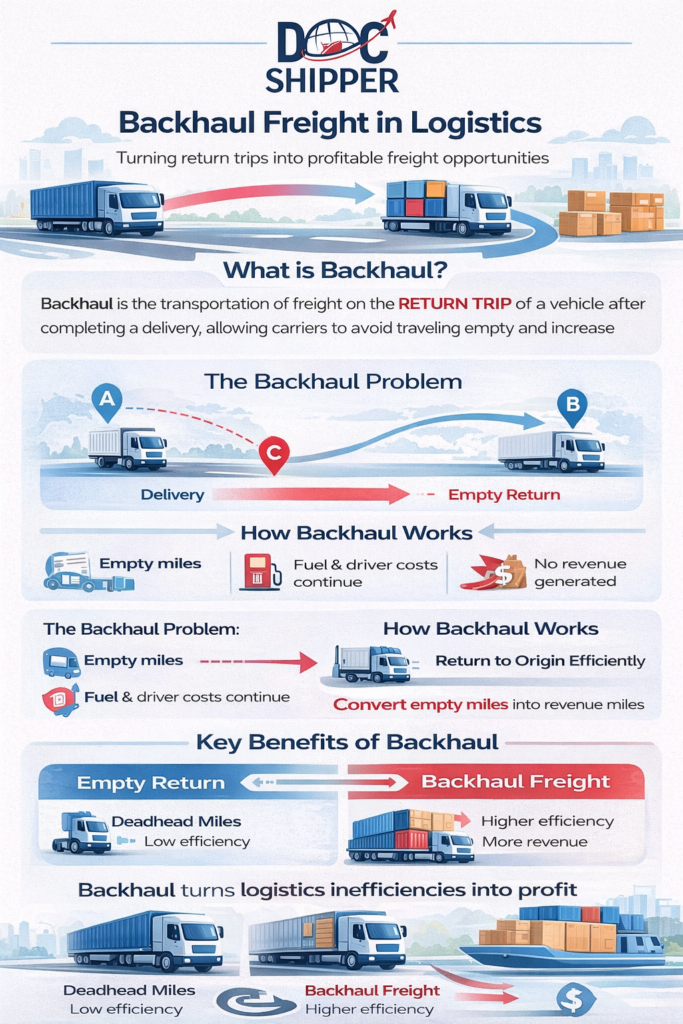
Backhaul refers to the transportation of goods on the return journey of a vehicle after its primary delivery. This logistics practice optimizes fleet utilization by filling empty cargo space, reducing operational costs and improving environmental sustainability in international shipping operations.Introduction
Empty trucks returning to their origin point represent one of the most significant inefficiencies in modern logistics. Studies show that nearly 20-30% of commercial vehicles travel empty after completing deliveries, wasting fuel, time, and capacity. This problem becomes even more critical in international freight, where distances are longer and costs are higher.
Backhaul addresses this challenge directly. By strategically planning return loads, companies transform wasted trips into revenue-generating opportunities. This concept is essential for importers, exporters, and freight forwarders seeking to optimize their supply chain economics.
Key characteristics of backhaul operations include:
- Cost reduction: Shared transportation expenses lower per-unit shipping costs
- Asset utilization: Maximizes vehicle capacity on both outbound and return journeys
- Environmental impact: Reduces carbon emissions by minimizing empty miles
- Network efficiency: Creates balanced freight flows between trading partners
- Competitive pricing: Enables carriers to offer discounted rates on return routes
Backhaul Mechanics & Logistics Expertise
Understanding backhaul requires grasping the fundamental economics of freight transportation. When a carrier completes a delivery from Point A to Point B, the vehicle must return to its origin or proceed to the next assignment. Without backhaul cargo, this return journey generates zero revenue while incurring full operational costs—fuel, driver wages, vehicle depreciation, and insurance.
Strategic backhaul planning involves matching return capacity with available freight demand. This requires sophisticated logistics coordination, real-time cargo visibility, and established networks of shippers and receivers. At DocShipper, we systematically analyze route patterns to identify backhaul opportunities for our clients, reducing their overall transportation expenditure by 15-40%.
The legal framework governing backhaul operations varies by jurisdiction. In the European Union, cabotage regulations permit limited domestic transport by foreign carriers, creating backhaul opportunities across borders. The EU Regulation 2020/1055 establishes clear rules for road transport operations, including provisions that facilitate efficient backhaul arrangements while preventing market distortion.
Contractual considerations for backhaul differ from standard freight agreements. Backhaul rates are typically 20-50% lower than standard rates because carriers prioritize filling capacity over maximizing per-load revenue. However, service levels may vary—backhaul shipments often have more flexible delivery windows and may be subject to rerouting if higher-paying primary loads become available.
The operational complexity increases with international backhaul. Cross-border movements require customs clearance at both origin and destination, proper documentation for each leg of the journey, and compliance with varying national regulations. Temperature-controlled goods, hazardous materials, and oversized cargo present additional challenges that limit backhaul flexibility.
Technology platforms have revolutionized backhaul coordination. Digital freight matching systems connect shippers with available capacity in real-time, dramatically reducing empty miles. These platforms aggregate demand, provide instant pricing, and automate booking processes—transforming backhaul from opportunistic to systematic optimization.
Concrete Examples & Performance Data
Real-world backhaul scenarios demonstrate the practical value of this logistics strategy. Consider the following comparative analysis of transportation costs with and without backhaul optimization:
| Scenario | Distance | Standard Cost | With Backhaul | Savings |
|---|---|---|---|---|
| Hamburg to Milan (full truckload) | 1,200 km | €1,800 | €1,200 | 33% |
| Rotterdam to Barcelona (container) | 1,650 km | €2,400 | €1,550 | 35% |
| Paris to Warsaw (partial load) | 1,550 km | €2,100 | €1,450 | 31% |
| London to Munich (express) | 1,100 km | €1,650 | €1,150 | 30% |
Use Case: Automotive Parts Distribution
A German automotive supplier ships components from Stuttgart to an assembly plant in Toulouse, France. The primary delivery costs €2,200 for a full truckload covering 850 kilometers. By coordinating with a French wine distributor needing transport back to Germany, the carrier secures a backhaul load paying €1,100. The total revenue of €3,300 for the round trip significantly exceeds the €2,800 cost of operating both legs, creating profitability where a simple return journey would generate loss.
Environmental Impact Metrics:
- CO2 reduction: Backhaul optimization reduces carbon emissions by 25-35% per transported ton
- Fuel efficiency: Loaded return journeys improve overall fleet fuel economy by 18-28%
- Empty miles: Strategic backhaul planning decreases deadhead percentage from 28% to below 12%
- Resource utilization: Vehicle capacity utilization increases from 65% to 88% on average
- Network density: Established backhaul routes create 40% more freight movement opportunities
Industry data reveals that companies implementing systematic backhaul programs achieve measurable operational improvements. A 2023 logistics sector study documented average cost reductions of 22% for participants utilizing digital freight matching platforms. Transit time variability increased by only 8-12 hours, an acceptable trade-off for most non-time-critical shipments.
DocShipper Platform
Optimize Your Global Logistics with Cutting-Edge Solutions
Enhance efficiency, cut costs, and gain 24/7 visibility 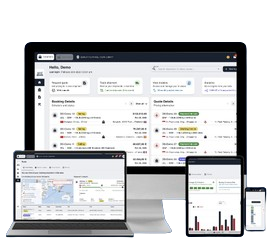 over your entire supply chain.
- Cut your shipping costs and maximize your margins
- Manage sourcing, freight, & customs on one platform
- Get real-time tracking and analytics
Conclusion
Backhaul represents a fundamental strategy for optimizing logistics costs and environmental performance in international trade. By transforming empty return journeys into revenue-generating opportunities, businesses reduce transportation expenses while contributing to more sustainable supply chains.
Need assistance optimizing your backhaul opportunities? Contact DocShipper for expert guidance on reducing your international shipping costs.
📚 Quiz
Test Your Knowledge: Backhaul
Q1 — What does "backhaul" mean in logistics?
Q2 — What is the key difference between "backhaul" and "deadhead"?
Q3 — A shipper needs to transport fragile, temperature-controlled pharmaceuticals with a guaranteed next-day delivery. Should they use a backhaul service?
🎯 Your Result
📞 Free Quote in 24hFAQ | Backhaul: Definition, Calculation & Concrete Examples
Deadhead refers to an empty return trip with no cargo, while backhaul specifically describes a return journey carrying freight. Backhaul generates revenue; deadhead represents pure cost without income.
Backhaul rates typically range from 20% to 50% lower than standard freight rates, depending on route density, cargo type, and timing flexibility. High-demand return routes may offer smaller discounts.
Yes, but with limitations. Backhaul shipments generally have more flexible delivery windows. For urgent freight requiring guaranteed delivery times, standard dedicated services are more appropriate despite higher costs.
Most non-perishable, non-hazardous goods work well for backhaul. Industrial components, consumer products, packaged foods, and raw materials are ideal. Temperature-controlled and hazardous materials require specialized backhaul arrangements.
Backhaul arrangements typically use modified freight contracts with adjusted service levels and pricing. Terms should clearly specify delivery windows, potential rerouting conditions, and liability provisions for any delays.
Digital freight platforms aggregate available capacity and shipping demand in real-time, automatically matching backhaul opportunities based on route, timing, cargo type, and equipment requirements. This technology dramatically increases matching efficiency.
Primary risks include delivery delays if higher-paying primary loads take priority, potential cargo damage from mixed-load handling, and limited carrier accountability for time-sensitive deliveries. Proper contract terms mitigate these concerns.
Yes. Full Container Load (FCL) backhaul is more common due to simpler logistics, but Less than Container Load (LCL) backhaul exists through consolidation services that combine multiple smaller shipments on return routes.
Each leg of a backhaul journey requires separate customs clearance and documentation. The return cargo undergoes standard import procedures at its destination, independent of the outbound shipment's customs status.
Standard international shipping documents apply: commercial invoice, packing list, bill of lading, and any required certificates. Backhaul doesn't change documentation requirements, though administrative processes may differ slightly.
Yes. While backhaul inherently offers discounted pricing, rates remain negotiable based on cargo volume, frequency, route popularity, and seasonal demand. Long-term contracts typically secure better backhaul pricing than spot market arrangements.
Small shippers access backhaul through freight forwarders, digital freight platforms, or third-party logistics providers who aggregate demand and negotiate with carriers. These intermediaries provide backhaul access without requiring large shipping volumes.
Need Help with
Logistics or Sourcing ?
First, we secure the right products from the right suppliers at the right price by managing the sourcing process from start to finish. Then, we simplify your shipping experience - from pickup to final delivery - ensuring any product, anywhere, is delivered at highly competitive prices.


Fill the Form
Prefer email? Send us your inquiry, and we’ll get back to you as soon as possible.
Contact us