In short ⚡
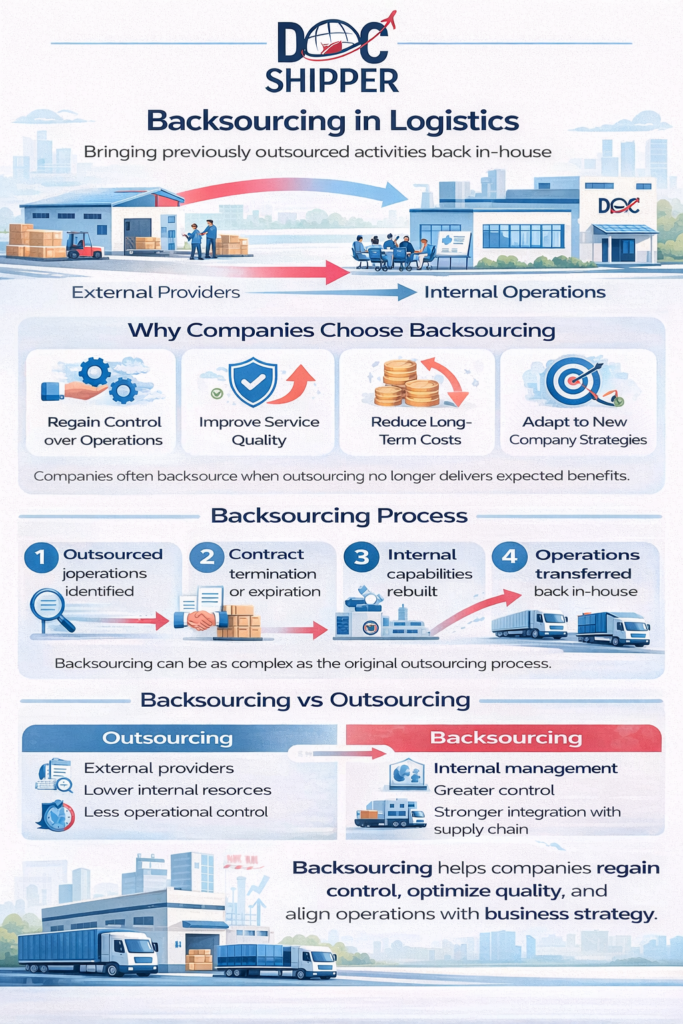
Backsourcing is the strategic decision to bring previously outsourced business operations back in-house. This reverse logistics approach allows companies to regain direct control over critical functions like manufacturing, IT services, or supply chain management, often driven by quality concerns, cost fluctuations, or the need for greater operational flexibility.
Introduction
Many businesses face a critical dilemma: what happens when outsourcing partnerships fail to deliver expected results? Rising costs, quality issues, and loss of intellectual property control are pushing companies to reconsider their sourcing strategies.
Backsourcing represents a fundamental shift in international trade and logistics. As global supply chains become increasingly complex, companies must balance efficiency with control, cost savings with quality assurance.
Key characteristics of backsourcing include:
- Strategic reversal of previous outsourcing decisions based on performance metrics
- Operational reintegration requiring significant capital investment and workforce development
- Risk mitigation by reducing dependency on external suppliers or third-party logistics providers
- Quality enhancement through direct oversight of production and service delivery processes
- Intellectual property protection by maintaining proprietary processes within organizational boundaries
Strategic Implications & Expertise
Backsourcing decisions stem from multiple operational and strategic factors. Companies must evaluate whether the benefits of bringing functions in-house outweigh the initial cost savings of outsourcing.
The transition complexity requires careful planning. Organizations must rebuild internal capabilities, recruit specialized talent, and invest in infrastructure previously managed by external partners. This process typically spans 12 to 24 months depending on operational scope.
Cost dynamics play a crucial role. While offshore labor rates initially appear attractive, hidden costs emerge: communication barriers, quality control issues, shipping delays, and intellectual property risks. According to the World Trade Organization, these hidden costs can increase total outsourcing expenses by 15-30%.
Supply chain resilience has become paramount. Recent global disruptions exposed vulnerabilities in extended supply chains. Companies now prioritize operational continuity over marginal cost reductions, particularly for critical components or services.
Regulatory compliance considerations influence backsourcing decisions. Industries facing strict data protection laws, environmental regulations, or labor standards find in-house operations easier to monitor and control.
At DocShipper, we guide companies through backsourcing transitions, managing the logistics of equipment repatriation, inventory transfers, and establishing domestic supply networks to ensure seamless operational continuity.
Concrete Examples & Data
Real-world backsourcing cases demonstrate both challenges and opportunities. Understanding these scenarios helps businesses make informed decisions.
Manufacturing Sector Case Study
A European electronics manufacturer outsourced production to Southeast Asia in 2015, achieving 35% cost reduction. By 2020, quality defects increased to 8%, and shipping delays averaged 6 weeks. After backsourcing to a domestic facility:
| Metric | Outsourced (2020) | Backsourced (2022) | Change |
|---|---|---|---|
| Defect Rate | 8.0% | 1.2% | -85% |
| Lead Time | 42 days | 8 days | -81% |
| Production Cost | €12/unit | €16/unit | +33% |
| Total Landed Cost | €18/unit | €17/unit | -6% |
| Customer Satisfaction | 72% | 91% | +26% |
This case illustrates how total landed cost calculations reveal the true economics of sourcing decisions. While production costs increased, eliminating shipping expenses, quality failures, and inventory holding costs resulted in overall savings.
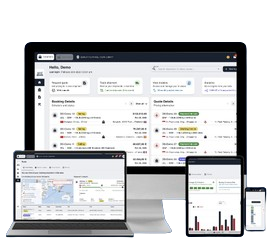
DocShipper Platform
One platform. Your entire supply chain
Sourcing, freight, customs & documents — all centralised, all visible, 24/7.
IT Services Backsourcing Scenario
A North American financial institution outsourced customer support to an offshore provider in 2018. After experiencing data security concerns and declining customer satisfaction scores (dropping from 4.2 to 3.1 stars), they backsourced operations in 2021:
- Response time improvement: Average resolution dropped from 48 hours to 6 hours
- Security compliance: Achieved 100% regulatory adherence versus 78% under outsourcing
- Employee retention: Turnover decreased from 45% annually to 12%
- Cost structure: Operating expenses increased 22%, but customer lifetime value rose 38%
- Brand reputation: Net Promoter Score improved from -12 to +34
These examples demonstrate that backsourcing decisions must consider qualitative factors beyond simple cost comparisons. Customer experience, brand protection, and operational agility often justify higher direct costs.
Conclusion
Backsourcing represents a strategic response to evolving business environments where control, quality, and resilience outweigh pure cost optimization. Companies must conduct comprehensive analyses considering total landed costs, quality metrics, and long-term strategic positioning.
Need expert guidance on evaluating sourcing strategies or managing logistics transitions? Contact DocShipper for tailored solutions that align with your operational goals.
📚 Quiz
Test Your Knowledge: Backsourcing
Q1 — What is the core definition of backsourcing?
Q2 — A company is evaluating whether to backsource its manufacturing. It notices that offshore production costs are lower per unit, but overall expenses remain high. What does this most likely indicate?
Q3 — A North American financial institution backsourced its customer support after security concerns and falling satisfaction scores. Which outcome best reflects what typically happens after a successful backsourcing transition?
🎯 Your Result
📞 Free Quote in 24hFAQ | Backsourcing: Definition, Process & Real-World Examples
Common triggers include rising offshore labor costs, quality control failures, intellectual property concerns, supply chain disruptions, regulatory compliance issues, and changing customer expectations for faster delivery and personalized service.
Most backsourcing initiatives require 12 to 24 months for complete transition, including facility setup, equipment procurement, workforce training, supplier relationship development, and operational stabilization before achieving full capacity.
Direct labor costs typically increase, but total landed costs often decrease when factoring in shipping, quality failures, inventory holding, communication overhead, and intellectual property protection. Comprehensive cost modeling is essential for accurate comparison.
Manufacturing, technology services, customer support, pharmaceutical production, and aerospace components show highest backsourcing rates due to quality requirements, regulatory pressures, intellectual property sensitivity, and supply chain resilience needs.
Yes, hybrid models are common. Companies often backsource critical components or high-value processes while maintaining outsourcing for commodity items or non-core functions, creating balanced risk management and cost optimization.
Key risks include underestimating transition costs, difficulty recruiting skilled talent, capital investment requirements, potential service disruptions during transition, and possibility that in-house operations may not achieve projected efficiency levels.
Backsourcing can reduce carbon footprint by eliminating long-distance shipping, improve labor standards through direct oversight, and enhance circular economy practices through better control of materials and waste management processes.
Advanced automation technologies enable companies to offset higher domestic labor costs through productivity gains. Robotics, AI-driven quality control, and digital process optimization make backsourcing economically viable in high-cost regions.
Success metrics include total cost of ownership reduction, quality improvement rates, customer satisfaction scores, time-to-market acceleration, regulatory compliance levels, employee retention rates, and overall operational flexibility enhancement.
Backsourcing typically enhances resilience by reducing dependency on distant suppliers, shortening supply chains, improving visibility and control, enabling faster response to disruptions, and creating redundancy in critical operational capabilities.
Many countries offer tax credits, grants, workforce training subsidies, infrastructure support, and regulatory streamlining to encourage reshoring. Programs vary by region but commonly target manufacturing, technology, and strategic industries.
While reducing certain import volumes, backsourcing doesn't eliminate international trade. Companies often shift to importing raw materials rather than finished goods, maintain strategic partnerships for non-core functions, and continue global market expansion.
Need Help with
Logistics or Sourcing ?
First, we secure the right products from the right suppliers at the right price by managing the sourcing process from start to finish. Then, we simplify your shipping experience - from pickup to final delivery - ensuring any product, anywhere, is delivered at highly competitive prices.


Fill the Form
Prefer email? Send us your inquiry, and we’ll get back to you as soon as possible.
Contact us