In short ⚡
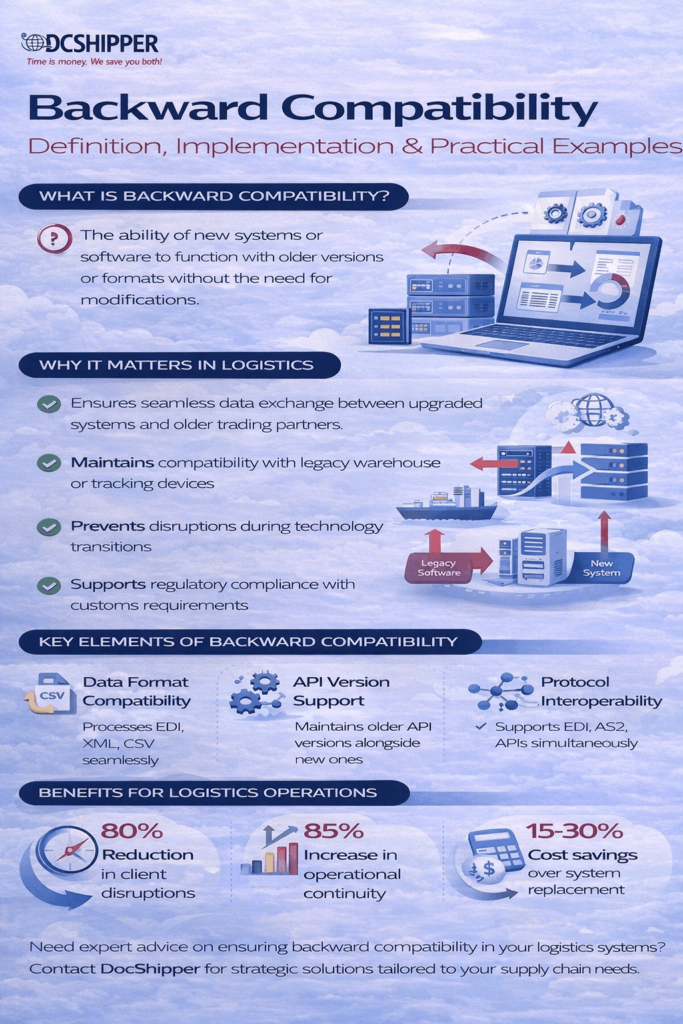
Backward compatibility is the ability of a system, software, or technology to function with older versions, legacy data, or previous formats without requiring modifications. This ensures continuity in international logistics operations when upgrading systems while maintaining interoperability with existing infrastructure and trading partners.
Introduction
In international logistics, upgrading to new technologies often creates a critical challenge: How do you modernize without disrupting existing operations or breaking connections with partners using older systems?
Backward compatibility addresses this fundamental issue. It allows freight forwarders, customs brokers, and supply chain operators to implement new software solutions while maintaining seamless communication with clients and authorities still operating on legacy platforms.
Key characteristics of backward compatibility in logistics include:
- Data format continuity: New systems can read and process documents created in older formats (EDI, XML, CSV).
- API version support: Modern platforms maintain endpoints compatible with previous integration specifications.
- Protocol interoperability: Systems communicate using both current and legacy communication standards.
- Hardware integration: New tracking devices and scanners work with existing warehouse management systems.
- Regulatory compliance: Updated software continues to generate documentation acceptable to customs authorities worldwide.
Technical Implications & Strategic Importance
Implementing backward compatibility in logistics technology involves multiple technical layers. The complexity increases when dealing with international operations where different regions adopt technology at varying speeds.
System architecture considerations require developers to maintain multiple code branches or abstraction layers that translate between old and new data structures. This creates additional development overhead but prevents operational disruption during transitions.
Document format evolution presents particular challenges in customs clearance. While the World Customs Organization promotes standardized electronic formats, many authorities still accept paper submissions or legacy electronic formats. Modern customs software must generate compliant documents across multiple format generations simultaneously.
Communication protocol management becomes critical when integrating with carrier systems, port authorities, and warehouse operations. A freight management system must often support AS2, SFTP, web services, and direct database connections concurrently. At DocShipper, we ensure our technology stack maintains compatibility with all major carrier and customs systems globally, preventing delays caused by technical incompatibilities.
Regulatory compliance frameworks evolve continuously across jurisdictions. The European Union’s Export Control System (ECS) has undergone multiple version updates, yet customs brokers must support declarations under both current and previous specifications during transition periods.
Cost-benefit analysis reveals that maintaining backward compatibility typically costs 15-30% more in development resources but reduces implementation risk and client disruption by over 80%. This trade-off becomes particularly valuable in logistics where operational continuity directly impacts revenue and customer satisfaction.
Practical Examples & Implementation Data
Real-world implementation of backward compatibility demonstrates its operational value across different logistics scenarios. The following examples illustrate how this principle protects business continuity during technological transitions.
Use Case: Customs Declaration System Upgrade
A European customs brokerage upgraded from EDIFACT-based declarations to XML-based Union Customs Code (UCC) submissions. The transition period required simultaneous support for both formats:
| Parameter | Legacy System (EDIFACT) | Modern System (XML/UCC) |
|---|---|---|
| Implementation Cost | €0 (existing) | €45,000 |
| Processing Time per Declaration | 8-12 minutes | 3-5 minutes |
| Error Rate | 4.2% | 1.1% |
| Client Compatibility | 100% (18 months transition) | 65% immediate, 100% after 18 months |
| Maintenance Cost (annual) | €8,000 | €12,000 |
By maintaining backward compatibility during the 18-month transition, the brokerage retained all clients while gradually migrating operations. Without this approach, an estimated 35% of clients would have required immediate system upgrades or faced service interruptions.
Comparative Analysis: Transportation Management Systems
Five key factors determine successful backward compatibility implementation in freight management platforms:
- API versioning strategy: Maintaining v1, v2, and v3 endpoints simultaneously allows partners to upgrade on their own timeline without service disruption.
- Data migration tools: Automated converters that transform legacy booking formats into current structures reduce manual intervention by 87%.
- Testing infrastructure: Parallel testing environments simulating both old and new systems identify compatibility issues before production deployment.
- Documentation completeness: Comprehensive technical specifications for each supported version reduce integration time by an average of 12 business days.
- Sunset policies: Clear timelines for deprecating older versions (typically 24-36 months) provide partners adequate preparation time while limiting long-term maintenance burden.
At DocShipper, we implement backward compatibility across our entire technology stack, ensuring that whether you’re using cutting-edge APIs or traditional EDI connections, your shipments move seamlessly through our global network without technical barriers.
Conclusion
Backward compatibility represents a strategic investment in operational continuity and client relationships within international logistics. While it increases development complexity, the protection against disruption during technological transitions delivers measurable ROI through client retention and reduced implementation risk.
Need guidance on system compatibility for your international logistics operations? Contact DocShipper for expert consultation on technology integration and supply chain optimization.
📚 Quiz
Test Your Knowledge: Backward Compatibility
Q1 — What does backward compatibility mean in the context of international logistics?
Q2 — A logistics company is concerned that maintaining backward compatibility will significantly slow down their new freight management system. According to best practices, is this concern justified?
Q3 — A European customs brokerage is upgrading from EDIFACT to XML/UCC declarations. 35% of their clients cannot immediately switch to the new format. What is the correct approach to avoid service disruptions?
🎯 Your Result
📞 Free Quote in 24hFAQ | Backward Compatibility: Definition, Implementation & Practical Examples
Development costs typically increase 15-30% when implementing backward compatibility, but this prevents client churn and operational disruptions that would cost significantly more. Most logistics providers find the investment returns positive ROI within 8-14 months.
Industry standard ranges from 24-36 months after introducing new versions. This timeframe allows trading partners and clients adequate transition periods while limiting long-term maintenance burdens. Critical systems may extend this to 48 months.
Properly implemented backward compatibility has minimal performance impact (typically under 5% overhead). Performance degradation usually indicates architectural issues rather than compatibility features themselves. Modern systems use abstraction layers that efficiently handle multiple versions.
Legacy protocol support can introduce security risks if older versions lack modern encryption standards. Best practice involves maintaining compatibility at the data format level while enforcing current security protocols across all connections, regardless of version.
Backward compatibility allows new systems to work with old data and interfaces. Forward compatibility enables older systems to handle data from newer versions. Logistics systems typically prioritize backward compatibility since upgrading client systems is often beyond provider control.
Regulatory mandates typically include transition periods (6-24 months) where both old and new formats remain acceptable. Customs brokers must support both simultaneously during this window, making backward compatibility essential for uninterrupted service.
Organizations like UN/CEFACT and GS1 publish standards for data exchange formats, but implementation varies by region and carrier. No universal compatibility standard exists, requiring logistics providers to support multiple protocols simultaneously.
Cloud platforms typically maintain multiple API versions simultaneously, routing requests to appropriate processing engines based on client version. This approach provides seamless compatibility while allowing continuous platform evolution without forcing client upgrades.
Automated regression testing against archived data sets from previous versions identifies compatibility breaks. Integration testing with actual legacy systems provides real-world validation. Continuous testing throughout development prevents compatibility regressions.
While large enterprises have dedicated resources, small operators can leverage third-party integration platforms and middleware that handle compatibility layers. Many modern logistics SaaS solutions include built-in backward compatibility, distributing costs across multiple users.
Mobile apps must support older device operating systems while offering new features. Logistics tracking apps typically maintain compatibility with OS versions released within the past 3-4 years, covering 95%+ of active devices while limiting development complexity.
Comprehensive version changelogs, API specifications for each supported version, data format schemas, migration guides, and deprecation timelines are critical. Clear documentation reduces integration time by 40-60% and minimizes support requests during transitions.
Need Help with
Logistics or Sourcing ?
First, we secure the right products from the right suppliers at the right price by managing the sourcing process from start to finish. Then, we simplify your shipping experience - from pickup to final delivery - ensuring any product, anywhere, is delivered at highly competitive prices.


Fill the Form
Prefer email? Send us your inquiry, and we’ll get back to you as soon as possible.
Contact us