


In short ⚡
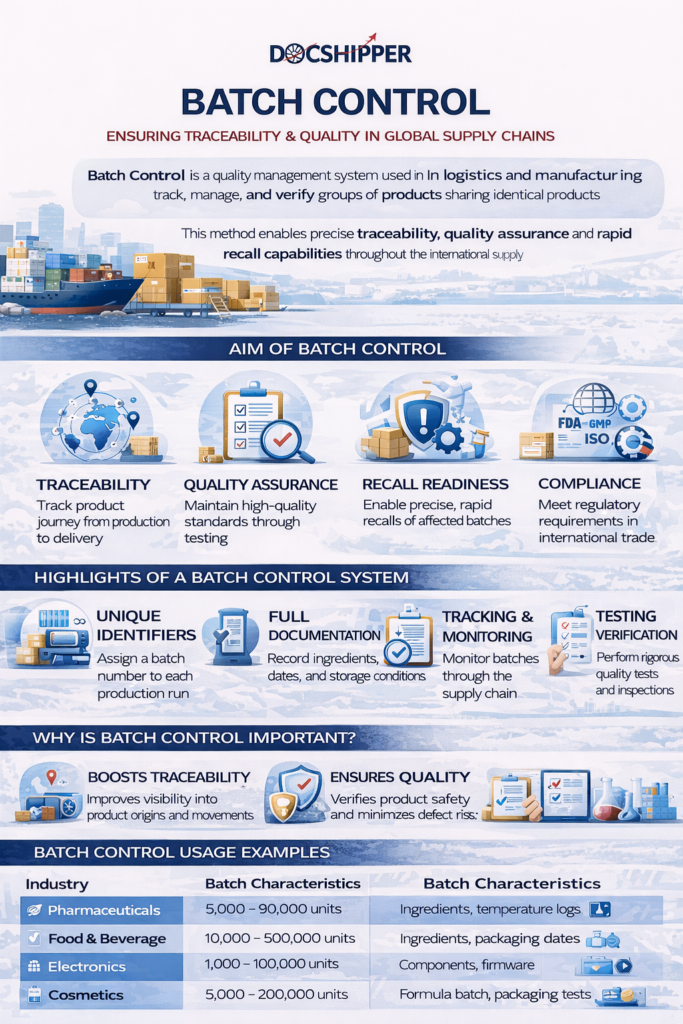
Batch control is a quality management system used in logistics and manufacturing to track, manage, and verify groups of products sharing identical production characteristics. This method enables precise traceability, quality assurance, and rapid recall capabilities throughout the international supply chain.Introduction
Every year, thousands of shipments face customs delays or quality disputes due to inadequate product traceability. When a pharmaceutical batch fails inspection or a food product requires recall, the ability to identify and isolate affected units becomes critical.
Batch control systems solve this challenge by creating unique identifiers for product groups. This approach is essential for international trade compliance, quality management, and consumer safety.
Key characteristics of effective batch control include:
- Unique batch identification for every production run
- Complete documentation of manufacturing dates, ingredients, and conditions
- Traceability mechanisms linking batches to suppliers and customers
- Quality verification protocols for testing and certification
- Regulatory compliance with international standards (FDA, EU GMP, ISO 22000)
Understanding Batch Control Systems
Batch control operates through systematic documentation and tracking of production groups. Each batch number serves as a unique identifier containing encoded information about production date, facility location, and manufacturing conditions.
The implementation requires three fundamental components. First, batch creation protocols establish when and how to group products. Manufacturing facilities typically define batches based on production runs, time periods, or equipment cycles. Second, documentation systems record all relevant data including raw material sources, processing parameters, and quality test results. Third, tracking mechanisms maintain visibility throughout distribution networks.
Regulatory frameworks impose strict requirements on batch control systems. The FDA’s Current Good Manufacturing Practices mandate comprehensive batch records for food and pharmaceutical products. European Union regulations require similar documentation under GMP standards.
Modern batch control systems integrate with warehouse management software and enterprise resource planning platforms. This integration enables real-time visibility across supply chains. Barcode scanning, RFID technology, and blockchain solutions enhance accuracy and security.
At DocShipper, we implement batch verification procedures at every inspection point to ensure compliance with destination country requirements and prevent costly customs holds.
The financial implications of batch control failures are substantial. Product recalls cost companies an average of $10 million in direct expenses. Inadequate traceability systems amplify these costs through extended recall durations and broader product scope. Effective batch management minimizes exposure by enabling precise identification of affected units.
Practical Applications & Data
Batch control applications vary significantly across industries. Understanding these differences helps businesses implement appropriate systems for their specific contexts.
| Industry | Batch Size | Retention Period | Critical Parameters |
|---|---|---|---|
| Pharmaceuticals | 5,000-50,000 units | Product life + 1 year | Temperature, humidity, API concentration |
| Food & Beverage | 10,000-500,000 units | 2-5 years | Ingredients, processing time, temperature |
| Electronics | 1,000-100,000 units | Warranty period + 2 years | Component sourcing, firmware version |
| Cosmetics | 5,000-200,000 units | 3 years minimum | Formula batch, packaging date, stability tests |
Use Case: Pharmaceutical Import Scenario
A European pharmaceutical importer receives 50,000 units of medication from an Indian manufacturer. The shipment contains five production batches manufactured over two weeks. Each batch includes:
- Batch number: IN-2024-03-15-A through IN-2024-03-29-E
- Manufacturing records: Temperature logs, mixing times, quality test results
- Certificate of Analysis: Third-party laboratory verification for each batch
- Stability data: Shelf-life validation under specified storage conditions
- Supplier documentation: API source certificates and purity analyses
During customs clearance, authorities request batch-specific documentation. The importer provides complete records for batch IN-2024-03-22-C, which undergoes random sampling. Testing reveals acceptable quality parameters, allowing release of all five batches.
Six months later, routine market surveillance identifies a minor labeling error affecting batch IN-2024-03-22-C only. The batch control system enables precise recall of 10,000 affected units while leaving 40,000 unaffected units in distribution. Total recall cost: $180,000. Without batch control, the entire 50,000-unit shipment would require recall at an estimated cost of $850,000.
This scenario demonstrates how granular batch tracking reduces financial exposure and maintains supply chain continuity. DocShipper’s quality inspection services verify batch documentation accuracy before shipment, preventing such issues from reaching destination markets.
Conclusion
Batch control systems represent essential infrastructure for quality management and regulatory compliance in international trade. Effective implementation protects businesses from recalls, maintains consumer safety, and ensures smooth customs clearance.
Need assistance implementing batch control protocols for your imports? Contact DocShipper for expert guidance on compliance and quality management systems.
📚 Quiz
Test Your Knowledge: Batch Control
Q1 — What is the primary purpose of a batch control system in logistics and manufacturing?
Q2 — A single batch can include products manufactured on multiple different production dates, as long as they share the same SKU.
Q3 — A European importer receives 50,000 pharmaceutical units across 5 batches. A labeling error is later found in one batch of 10,000 units. With a proper batch control system in place, what is the most likely outcome?
🎯 Your Result
📞 Free Quote in 24hFAQ | Batch Control: Definition, Implementation & Real-World Examples
Batch numbers typically include production date, facility code, and sequential identifier. Regulatory requirements vary by industry, but most systems encode manufacturing location, shift, and equipment used.
Retention periods depend on product type and jurisdiction. Pharmaceuticals require storage for product shelf life plus one year. Food products typically need 2-5 years. Electronics manufacturers often retain records through warranty periods plus two years.
No. A single batch represents products manufactured under identical conditions during a specific timeframe. Multiple production dates indicate separate batches requiring individual tracking numbers and documentation.
Incomplete batch records frequently result in customs detention, additional inspection fees, and shipment delays. Serious deficiencies may lead to rejection and return to origin. Complete documentation before shipping prevents these costly scenarios.
The terms are often used interchangeably, though some industries distinguish them. "Batch" typically refers to manufacturing groups, while "lot" may describe distribution or packaging groups. Functionality remains essentially identical.
Regulations mandate batch tracking but don't specify digital systems. However, manual record-keeping becomes impractical for large-scale operations. Most modern compliance frameworks expect electronic systems with audit trail capabilities.
Batch systems enable targeted recalls affecting only specific production groups rather than entire product lines. This precision reduces recall scope by 60-80% on average, significantly lowering costs and market disruption.
Reusing batch numbers creates traceability confusion and violates most regulatory frameworks. Each batch requires a permanently unique identifier. Systems should prevent accidental duplication through automated validation.
Customs inspectors cross-reference batch numbers against shipping documents, certificates of analysis, and manufacturer declarations. Random sampling may occur for laboratory testing. Discrepancies trigger detailed investigations and potential shipment holds.
Small operations may implement basic systems for $5,000-$15,000 including software and training. Enterprise solutions with full integration cost $50,000-$200,000. However, recall prevention savings typically justify investment within the first year.
Modern WMS platforms track batch numbers alongside SKUs, enabling FIFO/FEFO inventory rotation, expiration date management, and automated quarantine of recalled batches. Integration ensures consistent data across supply chain systems.
Staff require training on batch number assignment, documentation procedures, system data entry, and recall protocols. Pharmaceutical and food industries mandate annual refresher training. Documentation of all training activities is essential for regulatory audits.
Need Help with
Logistics or Sourcing ?
First, we secure the right products from the right suppliers at the right price by managing the sourcing process from start to finish. Then, we simplify your shipping experience - from pickup to final delivery - ensuring any product, anywhere, is delivered at highly competitive prices.


Fill the Form
Prefer email? Send us your inquiry, and we’ll get back to you as soon as possible.
Contact us




