


In short ⚡
The DOT (Department of Transportation) is the U.S. federal agency responsible for regulating and overseeing the safe transportation of goods and passengers across all modes—road, rail, air, and maritime. Established in 1966, DOT enforces compliance standards for hazardous materials, vehicle safety, and cross-border logistics operations.
Introduction
Why do shipments get blocked at U.S. borders despite proper documentation? Often, the culprit is non-compliance with DOT regulations. For businesses involved in international logistics, understanding DOT requirements isn’t optional—it’s mission-critical.
The Department of Transportation governs everything from hazardous materials labeling to vehicle weight limits. Ignoring these rules triggers penalties ranging from shipment delays to criminal liability. Whether you’re shipping lithium batteries or agricultural equipment, DOT compliance determines whether your cargo moves smoothly or sits in customs purgatory.
Key aspects every importer and exporter must know:
- Hazmat classification: DOT assigns nine classes to dangerous goods, each with specific packaging and labeling rules
- Carrier responsibilities: Trucking companies must comply with Hours of Service (HOS) regulations to prevent driver fatigue
- Cross-border coordination: DOT works with Transport Canada and Mexican authorities to harmonize North American logistics standards
- Safety inspections: Commercial vehicles undergo periodic Federal Motor Carrier Safety Administration (FMCSA) audits
- Environmental standards: Emission regulations for freight vehicles affect fleet management and route planning
DOT Regulatory Framework & Compliance Requirements
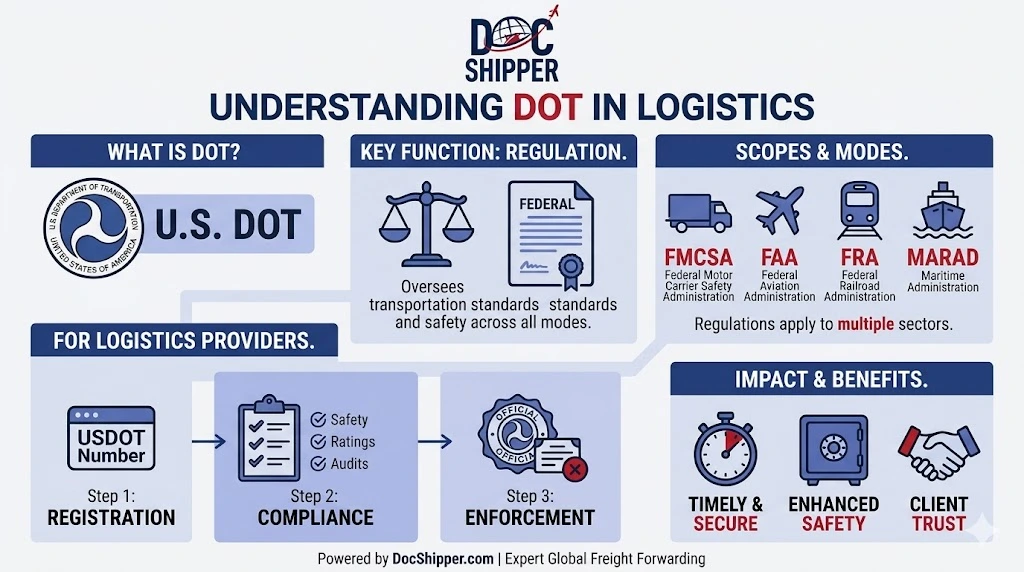
The DOT operates through specialized agencies, each targeting different transportation sectors. The Federal Motor Carrier Safety Administration (FMCSA) regulates commercial trucking, including interstate freight movement. The Pipeline and Hazardous Materials Safety Administration (PHMSA) enforces rules for transporting dangerous goods by any mode.
For hazardous materials, DOT mandates the Hazardous Materials Regulations (HMR) codified in 49 CFR Parts 171-180. These rules require shippers to classify substances, select appropriate packaging, and affix specific labels. A lithium-ion battery shipment, for instance, must display Class 9 hazard labels and include an emergency response telephone number on shipping papers.
Commercial drivers face strict regulations under the Hours of Service (HOS) framework. Drivers cannot exceed 11 hours of driving within a 14-hour workday and must take mandatory 30-minute breaks. Electronic Logging Devices (ELDs) now automatically track compliance, eliminating paper logbooks. Violations trigger roadside inspections and fines up to $16,000 per occurrence.
Cross-border shipments require additional documentation. The DOT Number—a unique identifier for commercial carriers—must appear on vehicle sides. For USMCA (formerly NAFTA) compliance, carriers need FMCSA operating authority and proof of insurance meeting minimum liability thresholds ($750,000 for general freight, $5 million for hazmat).
The Compliance, Safety, Accountability (CSA) program assigns safety scores to carriers based on roadside inspections, crash history, and violation records. Poor scores restrict operating privileges and increase insurance premiums. At DocShipper, we vet carrier partners’ CSA scores monthly to ensure shipments move with reliable, compliant operators.
Concrete Examples & Industry Data
Understanding DOT regulations becomes clearer through real-world applications. Consider a manufacturer exporting industrial chemicals from Houston to Toronto. The shipment contains corrosive liquids (UN1760), requiring:
| Requirement | DOT Standard | Cost Impact |
|---|---|---|
| UN-rated packaging | 49 CFR 173.202 (Packing Group II) | $45-$120 per container |
| Hazmat endorsement driver | Background check + TSA clearance | $86.50 per driver (every 5 years) |
| Shipping papers | Emergency contact, UN number, proper shipping name | Administrative time: 15-30 min per shipment |
| Vehicle placarding | 4 sides with Class 8 corrosive labels | $25-$50 per placard set |
| Insurance minimum | $5M liability for hazmat | Premium increase: 40-60% over standard freight |
According to FMCSA data, 12.3% of all roadside inspections in 2023 resulted in out-of-service orders, primarily for HOS violations and unsafe vehicle conditions. For international shippers, this translates to delivery delays averaging 18-36 hours per incident.
Another common scenario involves e-commerce businesses importing consumer electronics containing lithium batteries. DOT classifies these as Class 9 miscellaneous dangerous goods. Amazon FBA sellers must ensure:
- Battery watt-hour rating: Exceeding 100Wh requires Section II packaging (limited quantity exemption unavailable)
- State of charge limit: Batteries cannot exceed 30% charge during air transport per IATA regulations, which DOT enforces for U.S. flights
- Documentation accuracy: Missing UN3481 designation triggers automatic cargo holds at Memphis or Louisville air hubs
- Carrier acceptance: Only 62% of LTL carriers accept lithium battery shipments without surcharges, according to 2024 industry surveys
At DocShipper, we’ve observed that proactive DOT compliance reduces clearance times by an average of 40%. Our logistics coordinators pre-audit documentation against PHMSA standards before goods leave origin warehouses, preventing costly rejections at U.S. entry points.
Conclusion
DOT compliance forms the backbone of reliable U.S. logistics operations. From hazmat classification to driver hour restrictions, these regulations protect supply chain integrity while imposing real operational costs on non-compliant shippers.
Need expert guidance navigating DOT requirements for your shipments? Contact DocShipper for compliance audits and carrier vetting services that keep your goods moving smoothly across North American borders.
📚 Quiz
Test Your Knowledge: DOT Regulations
What is the primary role of the U.S. Department of Transportation (DOT)?
Which statement correctly describes DOT hazardous materials regulations?
A manufacturer is shipping lithium-ion batteries from Texas to an Amazon FBA warehouse. Which DOT requirement applies?
🎯 Your Result
📞 Free Quote in 24hFAQ | DOT (Department of Transportation): Definition, Regulations & Compliance Examples
A DOT Number is a unique identifier assigned by FMCSA to commercial motor carriers operating in interstate commerce. Companies transporting goods across state lines, carrying hazardous materials in quantities requiring placards, or operating vehicles with a gross weight over 10,001 pounds must obtain this registration. The number remains active as long as the carrier maintains compliance and updates their information biennially.
DOT uses nine hazard classes aligned with UN Model Regulations, covering explosives, gases, flammable liquids, and others. IATA (International Air Transport Association) adopts the same UN framework but adds stricter packaging and quantity limits for air transport. For example, DOT allows larger quantities of lithium batteries in ground shipments compared to IATA's air transport restrictions. Shippers must comply with both when goods move multimodally.
Drivers face fines up to $2,923 per HOS violation, while carriers incur penalties up to $16,031 per offense. Severe or repeated violations trigger vehicle out-of-service orders, preventing movement until drivers complete mandatory rest periods. FMCSA also assigns CSA points that damage safety ratings and increase insurance premiums. Criminal charges apply if falsified logbooks contribute to crashes causing injury or death.
Yes, when shipments contain hazardous materials. Small packages must still meet DOT classification, packaging, and labeling requirements. Limited Quantity (LQ) exemptions reduce some requirements for smaller hazmat volumes, but shippers must mark packages correctly and provide proper shipping descriptions. Courier services like FedEx and UPS enforce DOT rules strictly, rejecting non-compliant parcels at origin facilities.
Through bilateral agreements, DOT harmonizes standards with Transport Canada and Mexico's SCT. The USMCA requires mutual recognition of safety certifications, allowing pre-cleared carriers to cross borders with reduced inspections. However, each country retains sovereignty over enforcement. Mexican carriers entering the U.S. must obtain FMCSA operating authority and prove insurance coverage meeting American minimums, while U.S. carriers need comparable authorizations from Mexican regulators.
Inspectors verify driver's commercial license (CDL), medical examiner's certificate, Electronic Logging Device (ELD) records, vehicle registration, insurance proof, and hazmat shipping papers if applicable. For international shipments, they examine customs documentation and USMCA certificates of origin. Inspections follow the North American Standard Inspection Program, with Level 1 (full) inspections taking 30-60 minutes and checking 37 vehicle components.
No, but the Bipartisan Infrastructure Law (2021) grants electric trucks a 2,000-pound weight tolerance above the standard 80,000-pound federal limit. This accommodates heavier battery systems without penalizing payload capacity. However, state bridge formula laws still apply, and carriers must distribute weight properly across axles. DOT continues evaluating whether further exemptions are needed as electric commercial vehicles proliferate.
DOT inspections focus on vehicle safety and driver compliance (brakes, tires, HOS logs), while USMCA customs checks verify trade documentation (commercial invoices, certificates of origin, duty payments). Both occur at border crossings but involve different agencies—FMCSA/DOT handles transportation safety, while CBP (Customs and Border Protection) manages trade compliance. Shipments must satisfy both to enter the U.S. successfully.
Carriers must update their MCS-150 form (company safety profile) every 24 months. FMCSA sends renewal reminders, but the responsibility lies with the carrier. Failure to update results in DOT Number deactivation, prohibiting legal operation. New entrant carriers undergo additional scrutiny during their first 18 months, with safety audits determining permanent operating authority eligibility.
Mexican and Canadian carriers can obtain provisional or permanent FMCSA operating authority through established application processes. They must designate a U.S. process agent, prove adequate insurance, and pass safety fitness reviews. Cabotage restrictions prohibit foreign carriers from transporting goods between two U.S. points (domestic hauls). Cross-border carriers typically partner with American trucking companies for inland distribution to comply with these limitations.
FMCSA conducts random audits based on carrier size, commodity type, and safety rating trends. Red flags include multiple roadside violations, crash involvement, or consumer complaints filed through the National Consumer Complaint Database. New entrant carriers automatically receive audits within 12 months of beginning operations. High-risk commodities like hazardous materials or passenger transport trigger more frequent reviews compared to general freight operations.
The Federal Highway Administration (FHWA) sets emission standards aligned with EPA regulations. Commercial vehicles must meet current Clean Air Act requirements, with newer diesel engines using selective catalytic reduction (SCR) systems. DOT funds state programs that incentivize fleet upgrades to cleaner technologies. Non-compliant vehicles face state-level penalties and potential registration denials, though enforcement varies significantly across jurisdictions.
Need Help with
Logistics or Sourcing ?
First, we secure the right products from the right suppliers at the right price by managing the sourcing process from start to finish. Then, we simplify your shipping experience - from pickup to final delivery - ensuring any product, anywhere, is delivered at highly competitive prices.


Fill the Form
Prefer email? Send us your inquiry, and we’ll get back to you as soon as possible.
Contact us




