In short ⚡
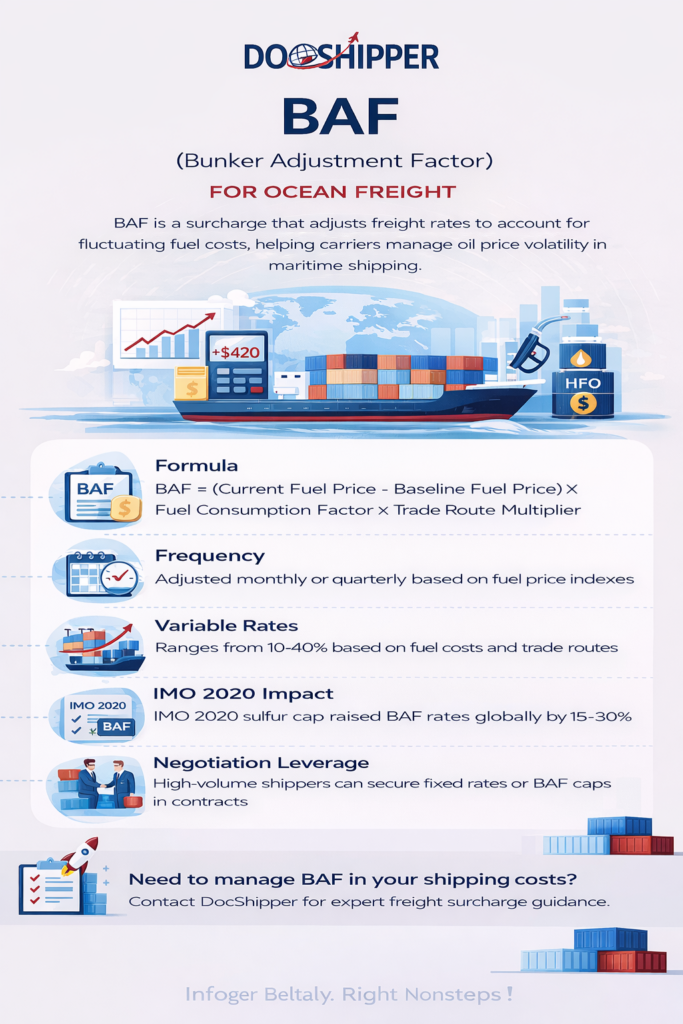
BAF (Bunker Adjustment Factor) is a surcharge applied by shipping carriers to compensate for fuel price fluctuations in maritime transport. This variable fee adjusts freight rates based on current bunker fuel costs, protecting carriers from volatile oil markets while ensuring pricing transparency for shippers and importers.
Introduction
Many importers and exporters are surprised when their shipping invoice includes unexpected surcharges beyond the base freight rate. The Bunker Adjustment Factor represents one of the most common yet misunderstood components of international shipping costs.
Fuel costs account for 50-60% of a container ship’s operational expenses. When crude oil prices fluctuate dramatically, carriers cannot absorb these variations without adjusting their pricing structure. BAF emerged as the industry’s solution to this volatility.
Understanding BAF is essential for accurate budgeting in international logistics:
- Cost predictability: BAF changes monthly or quarterly, impacting landed costs significantly
- Contract negotiations: Some agreements include BAF caps or fixed rates for budget stability
- Route variations: Different trade lanes apply different BAF percentages based on fuel consumption
- Environmental regulations: IMO 2020 sulfur cap increased low-sulfur fuel costs, raising BAF rates globally
- Transparency requirements: Carriers must justify BAF calculations based on published fuel indices
BAF Mechanism & Technical Expertise
The Bunker Adjustment Factor operates as a percentage or flat fee added to the base ocean freight rate. Carriers calculate BAF using recognized fuel price indices, typically the World Scale Index or regional bunker fuel prices from major ports like Rotterdam, Singapore, or Houston.
Most shipping lines publish their BAF formulas quarterly. The calculation considers the average fuel consumption per TEU (Twenty-foot Equivalent Unit) on specific routes, multiplied by the difference between current fuel prices and a baseline reference price established in the freight contract.
Since January 2020, the IMO 2020 regulation mandated a maximum 0.5% sulfur content in marine fuel (down from 3.5%). This environmental measure forced carriers to switch to more expensive Very Low Sulfur Fuel Oil (VLSFO) or install scrubber systems. Consequently, BAF rates increased by 15-30% across major trade routes. The European Union’s official maritime authority provides detailed compliance guidelines at ec.europa.eu/transport.
The BAF structure varies by carrier alliance. The 2M Alliance (Maersk and MSC), THE Alliance, and Ocean Alliance each apply different calculation methods. Some use a sliding scale percentage (ranging from 5% to 40% of base freight), while others charge a fixed dollar amount per container based on size and route distance.
Legal framework: BAF is contractually binding and must be disclosed in the Service Contract or Tariff. The U.S. Federal Maritime Commission requires carriers to file BAF changes 30 days in advance for transparency. Shippers can challenge unjustified BAF increases through formal complaints if carriers cannot demonstrate correlation with actual fuel cost movements.
At DocShipper, we systematically review BAF clauses in carrier contracts to ensure our clients understand the full cost structure before shipment. Our procurement team monitors monthly fuel indices to anticipate BAF adjustments and advise on optimal booking windows when surcharges are lower.
Concrete Examples & Calculation Data
To illustrate how BAF impacts real shipments, consider a 40-foot container from Shanghai to Rotterdam. If the base freight rate is $2,000 and the carrier applies a 25% BAF, the surcharge adds $500, bringing the total ocean freight to $2,500 before other fees.
| Route | Base Freight (40′) | BAF Rate | BAF Amount | Total Freight |
|---|---|---|---|---|
| Shanghai → Rotterdam | $2,000 | 25% | $500 | $2,500 |
| Los Angeles → Hamburg | $3,500 | 18% | $630 | $4,130 |
| Singapore → New York | $4,200 | 22% | $924 | $5,124 |
| Dubai → London | $1,800 | 30% | $540 | $2,340 |
Use Case: Electronics Importer
A European electronics retailer imports 100 containers annually from Shenzhen. With an average base freight of $2,200 per 40-foot container and a quarterly BAF averaging 23%, the annual BAF cost totals $50,600. By negotiating a BAF cap at 20% in their annual contract, they saved $6,600 yearly despite fuel price increases.
Key Data Points for Shippers:
- Volatility range: BAF can fluctuate between 10% and 40% within a single year on major routes
- IMO 2020 impact: Average BAF increased by $250-$400 per FEU (Forty-foot Equivalent Unit) post-regulation
- Seasonal patterns: BAF typically peaks in Q4 due to increased shipping demand and winter fuel premiums
- Regional differences: Asia-Europe routes average 22-28% BAF, while transpacific routes range 15-25%
- Negotiation leverage: High-volume shippers (50+ containers/month) can secure fixed BAF rates for 6-12 months
Conclusion
The Bunker Adjustment Factor remains an unavoidable component of international shipping costs, directly tied to global fuel market dynamics and environmental regulations. Understanding its calculation and negotiating favorable terms can significantly reduce logistics expenses for regular importers and exporters.
Need assistance navigating BAF complexities or optimizing your shipping contracts? Contact DocShipper for expert guidance on managing freight surcharges and securing competitive rates.
DocShipper Platform
Cut logistics costs. Not corners.
See exactly where your logistics costs are bleeding — and how to fix it. Book your expert demo.
📚 Quiz
Test Your Knowledge: BAF (Bunker Adjustment Factor)
Q1 — What is the primary purpose of the Bunker Adjustment Factor (BAF)?
Q2 — A shipper believes BAF only applies to Full Container Load (FCL) shipments. Is this correct?
Q3 — A European retailer ships 100 containers/year from Shenzhen at a $2,200 base rate with a 23% BAF. They negotiate a BAF cap at 20%. How much do they save annually?
🎯 Your Result
📞 Free Quote in 24hFAQ | BAF (Bunker Adjustment Factor): Definition, Calculation & Real Examples
BAF (Bunker Adjustment Factor) covers fuel cost variations, while CAF (Currency Adjustment Factor) compensates for exchange rate fluctuations. Both are surcharges but address different cost variables in shipping.
Most major carriers adjust BAF monthly or quarterly based on published fuel indices. Some update it more frequently during extreme market volatility. Check your carrier's tariff schedule for specific revision dates.
Yes, high-volume shippers often negotiate BAF caps or fixed rates for 6-12 months. This provides budget certainty but may result in slightly higher base rates to offset carrier risk.
Yes, BAF applies to Full Container Load (FCL) and Less than Container Load (LCL) shipments. For LCL, it's typically calculated per cubic meter or weight measurement rather than per container.
The 2020 sulfur cap regulation forced carriers to use more expensive low-sulfur fuel, increasing BAF by 15-30% on average across major routes. Some carriers introduced a separate "Low Sulfur Surcharge" (LSS) instead.
No, BAF is usually higher for 40-foot containers than 20-foot containers because larger containers consume more fuel per unit. High-cube and specialized containers may have different BAF calculations.
Yes, if the BAF wasn't disclosed in your contract or exceeds agreed terms, you can dispute it. Carriers must justify BAF based on verifiable fuel indices. Contact your carrier's customer service with documentation.
No, calculation methods vary by carrier and alliance. Some use percentage-based formulas, others apply flat dollar amounts per container. Always request the specific BAF formula from your carrier before booking.
Air freight uses a similar surcharge called Fuel Surcharge (FSC) rather than BAF. FSC typically represents a higher percentage of base rates due to aviation fuel's greater cost volatility.
Monitor major fuel price indices like Singapore bunker fuel prices or Platts assessments. Carriers typically adjust BAF 4-6 weeks after significant fuel price movements. Industry publications provide monthly forecasts.
Reputable freight forwarders include estimated BAF in their all-in quotes. However, since BAF can change between quote and shipment, always confirm if the rate is "BAF included" or subject to adjustment at sailing date.
BAF specifically applies to ocean freight. Inland trucking or rail transport may have separate fuel surcharges, but these are distinct from maritime BAF and calculated using domestic fuel indices.
Need Help with
Logistics or Sourcing ?
First, we secure the right products from the right suppliers at the right price by managing the sourcing process from start to finish. Then, we simplify your shipping experience - from pickup to final delivery - ensuring any product, anywhere, is delivered at highly competitive prices.


Fill the Form
Prefer email? Send us your inquiry, and we’ll get back to you as soon as possible.
Contact us