


In short ⚡
A Balance Sheet is a financial statement that presents a company's assets, liabilities, and equity at a specific point in time. It follows the fundamental accounting equation: Assets = Liabilities + Equity. This document provides a snapshot of financial health, enabling stakeholders to assess liquidity, solvency, and capital structure in international trade operations.
Introduction
Many importers and exporters struggle to evaluate the financial stability of their trading partners. Without proper financial assessment, companies risk engaging with undercapitalized suppliers or unreliable buyers. The balance sheet solves this problem by revealing the true financial position of any business entity.
In international logistics, understanding balance sheets becomes critical when selecting freight forwarders, customs brokers, or establishing credit terms. A strong balance sheet indicates operational capacity and payment reliability.
Key characteristics of an effective balance sheet include:
- Temporal precision: Reflects financial status at a specific date, not over a period
- Dual verification: Both sides must always balance mathematically
- Categorized classification: Assets and liabilities organized by liquidity and maturity
- Equity transparency: Shows retained earnings and shareholder contributions
- Comparative analysis: Most valuable when reviewed across multiple periods
Balance Sheet Fundamentals & Expert Insights
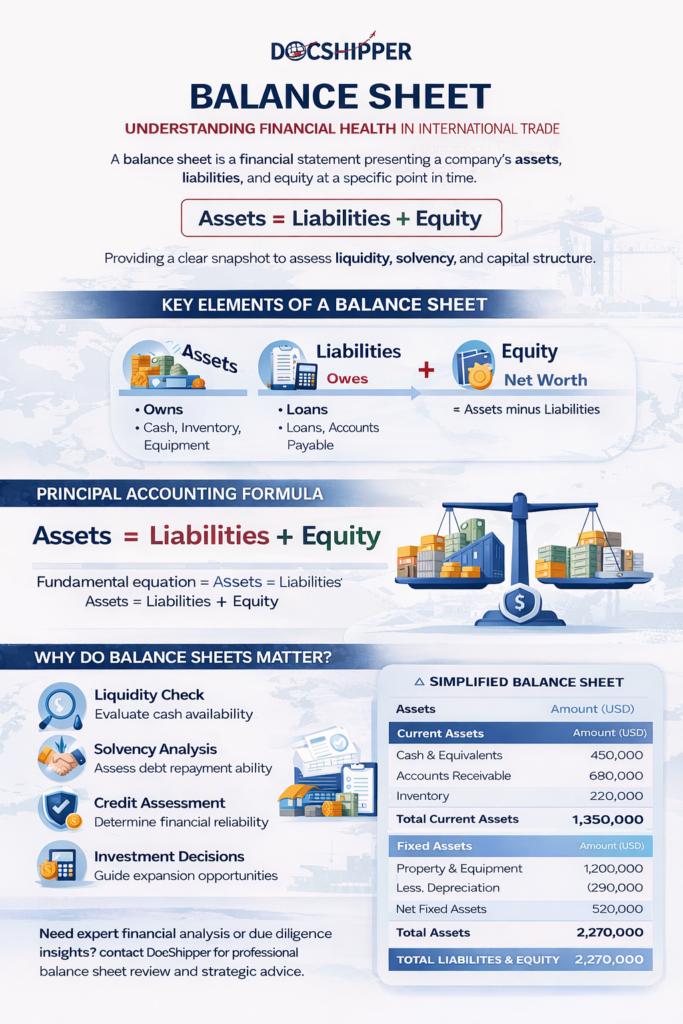
The balance sheet operates on the accounting equation principle, which states that total assets must equal the sum of liabilities and equity. This mathematical relationship ensures complete financial accountability. Assets represent what the company owns, liabilities show what it owes, and equity reflects the residual ownership interest.
Current assets include cash, accounts receivable, and inventory—resources convertible to cash within one year. For logistics companies, inventory management directly impacts this section. High inventory levels may indicate strong sales capacity or poor turnover efficiency.
Fixed assets encompass long-term investments like warehouses, vehicles, and equipment. Freight forwarders with substantial fixed assets demonstrate infrastructure commitment. Depreciation systematically reduces these values, reflecting asset consumption over time.
Liabilities classification separates short-term obligations (payable within 12 months) from long-term debt. The current ratio (current assets ÷ current liabilities) reveals liquidity strength. Ratios below 1.0 signal potential cash flow problems, critical when evaluating payment terms with international suppliers.
Shareholders’ equity represents the net worth after subtracting liabilities from assets. Retained earnings show cumulative profits reinvested in the business. Negative equity indicates insolvency risk—a red flag when selecting logistics partners.
According to International Financial Reporting Standards (IFRS), balance sheets must follow standardized presentation formats to ensure global comparability. This standardization enables cross-border financial analysis essential for international trade decisions.
At DocShipper, we systematically review supplier balance sheets before establishing partnerships, ensuring our clients work only with financially stable entities capable of fulfilling long-term commitments.
Practical Examples & Financial Data
Consider a mid-sized freight forwarding company with the following simplified balance sheet structure:
| Assets | Amount (USD) | Liabilities & Equity | Amount (USD) |
|---|---|---|---|
| Current Assets | Current Liabilities | ||
| Cash & Equivalents | 450,000 | Accounts Payable | 320,000 |
| Accounts Receivable | 680,000 | Short-term Debt | 150,000 |
| Inventory | 220,000 | Total Current Liabilities | 470,000 |
| Total Current Assets | 1,350,000 | Long-term Debt | 800,000 |
| Fixed Assets | Shareholders’ Equity | ||
| Property & Equipment | 1,200,000 | Share Capital | 500,000 |
| Less: Depreciation | (280,000) | Retained Earnings | 500,000 |
| Net Fixed Assets | 920,000 | Total Equity | 1,000,000 |
| TOTAL ASSETS | 2,270,000 | TOTAL LIABILITIES & EQUITY | 2,270,000 |
Financial ratio analysis from this balance sheet:
- Current Ratio: 1,350,000 ÷ 470,000 = 2.87 (strong liquidity position)
- Debt-to-Equity Ratio: 1,270,000 ÷ 1,000,000 = 1.27 (moderate leverage)
- Working Capital: 1,350,000 – 470,000 = $880,000 (healthy operational buffer)
- Asset Turnover Context: High receivables suggest 60-90 day payment terms common in freight forwarding
- Equity Strength: 44% equity ratio indicates sustainable capital structure
Use Case Scenario: An importer evaluating two potential logistics partners discovers Company A has a current ratio of 0.8 while Company B shows 2.5. Despite Company A offering 10% lower rates, Company B’s superior liquidity position reduces payment default risk, making it the safer choice for establishing credit terms on international shipments valued over $500,000.
Industry benchmarks show successful freight forwarders maintain current ratios between 1.5 and 3.0, with debt-to-equity ratios below 2.0. Companies exceeding these thresholds face heightened bankruptcy risk during economic downturns or supply chain disruptions.
Conclusion
The balance sheet remains the cornerstone document for assessing financial stability in international trade partnerships. Understanding its structure enables informed decisions about supplier selection, credit terms, and risk management.
Need expert guidance on financial due diligence for your logistics partners? Contact DocShipper for comprehensive supplier vetting and trade finance solutions.
DocShipper Platform
One platform. Your entire supply chain
Sourcing, freight, customs & documents — all centralised, all visible, 24/7.
📚 Quiz
Test Your Knowledge: Balance Sheet
Q1. What does a balance sheet fundamentally represent?
Q2. A freight forwarding company shows a current ratio of 0.8. What does this signal about its financial health?
Q3. You are an importer evaluating two logistics partners for a $500,000 shipment. Company A offers rates 10% lower but has negative shareholders' equity. Company B charges more but shows a current ratio of 2.5. Which is the sounder choice based on balance sheet analysis?
🎯 Your Result
📞 Free Quote in 24hFAQ | Balance Sheet: Definition, Structure & Practical Examples
A balance sheet shows financial position at a specific date, while an income statement reports performance over a period. The balance sheet is a snapshot; the income statement is a movie of operations.
Publicly traded companies must produce quarterly and annual balance sheets. Private firms typically prepare them annually for tax purposes, though monthly internal statements support better financial management in logistics operations.
Negative equity means liabilities exceed assets, signaling insolvency risk. This condition often results from accumulated losses and represents a critical warning sign when evaluating business partners in international trade.
Yes. While IFRS provides international standards, U.S. companies follow GAAP. Presentation formats vary, though the fundamental accounting equation remains universal. Always verify which standards apply when analyzing foreign partners.
Freight forwarders should maintain current ratios between 1.5 and 3.0. Ratios below 1.2 suggest liquidity stress, while ratios above 4.0 may indicate inefficient asset utilization or excessive cash holdings.
Inventory appears as a current asset. Companies using FIFO (First-In-First-Out) versus LIFO (Last-In-First-Out) methods report different values during inflation, directly impacting total assets and working capital calculations.
Depreciation reduces fixed asset values over time, reflecting wear and obsolescence. Accumulated depreciation appears as a contra-asset account, providing insight into asset age and potential replacement needs in logistics infrastructure.
Intangible assets like customer relationships, software systems, and brand value don't appear on traditional balance sheets but significantly impact company valuation. Goodwill from acquisitions represents one exception appearing in the assets section.
Request audited financial statements from certified public accountants. Cross-reference balance sheet data with cash flow statements and income statements. Significant discrepancies or unqualified audit opinions warrant further investigation.
Working capital equals current assets minus current liabilities. It measures short-term financial health and operational liquidity. Logistics companies need positive working capital to cover daily expenses between receiving payment and paying suppliers.
Only committed liabilities appear on balance sheets. Contingent liabilities like pending lawsuits or guarantee obligations are disclosed in footnotes. Review these notes carefully when assessing total risk exposure in international partnerships.
Companies with foreign assets or liabilities must revalue them at current exchange rates on each balance sheet date. Translation gains or losses flow through equity or income statements, affecting reported financial position in international operations.
Need Help with Logistics or Sourcing ?
First, we secure the right products from the right suppliers at the right price by managing the sourcing process from start to finish. Then, we simplify your shipping experience - from pickup to final delivery - ensuring any product, anywhere, is delivered at highly competitive prices.


Fill the Form
Prefer email? Send us your inquiry, and we’ll get back to you as soon as possible.
Contact us


