In short ⚡
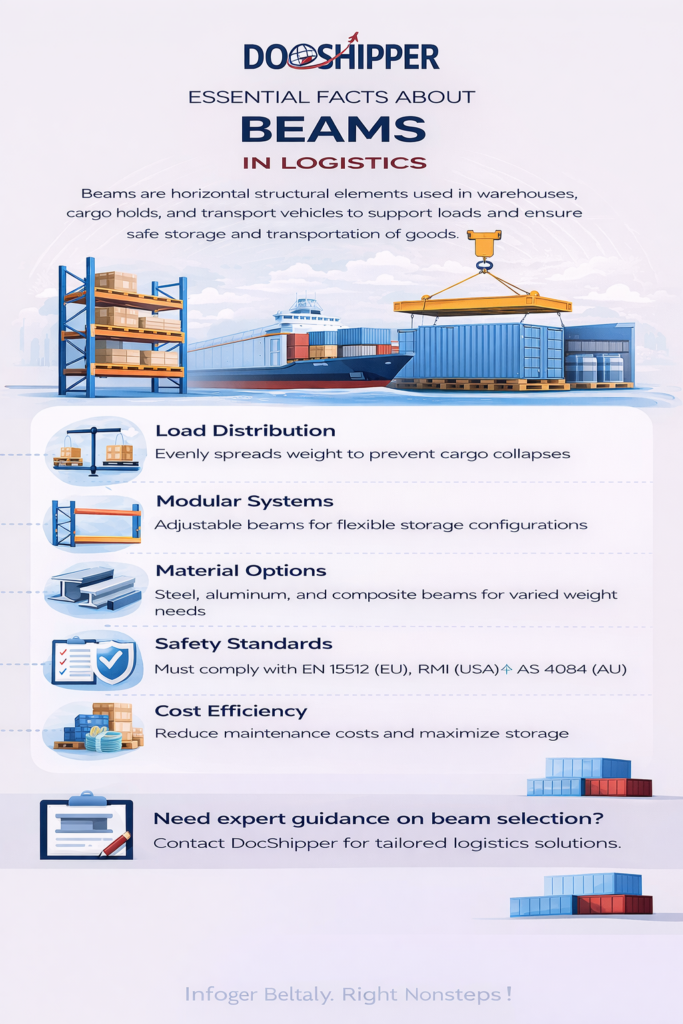
A beam is a horizontal structural element used in warehouses, cargo holds, and transport vehicles to support loads, distribute weight, and maintain structural integrity. In logistics, beams are critical components of pallet racking systems, container reinforcement, and load-bearing frameworks that ensure safe storage and transportation of goods across global supply chains.
Introduction
Many logistics professionals underestimate the critical role beams play in preventing cargo damage, structural failures, and costly delays. A single miscalculated beam specification can compromise an entire warehouse racking system or container shipment.
In international freight operations, beams function as the backbone of storage infrastructure and transport reinforcement. They directly impact loading capacity, safety compliance, and operational efficiency across warehouses, vessels, and intermodal containers.
- Load distribution: Beams transfer weight from stored goods to vertical supports, preventing collapse.
- Modular flexibility: Adjustable beam systems allow rapid reconfiguration for different cargo types.
- Material variety: Steel, aluminum, and composite beams serve distinct weight and corrosion requirements.
- Safety standards: Beams must comply with EN 15512 (Europe), RMI (USA), and AS 4084 (Australia) regulations.
- Cost efficiency: Proper beam selection reduces maintenance cycles and maximizes storage density.
Technical Specifications & Structural Applications
Beam engineering in logistics involves precise calculations of bending moment capacity, deflection limits, and fatigue resistance. The most common types include box beams (hollow rectangular profiles) and step beams (with integrated safety locking mechanisms).
In pallet racking systems, beams connect to upright frames through safety clips or bolt-through connections. The OSHA Standard 1910.176 mandates that all storage beams must support at least 1.67 times the maximum intended load to account for dynamic forces during loading operations.
Container reinforcement beams—often called spreader beams or lashing beams—secure cargo during maritime transport. These components must withstand accelerations up to 2G in rough seas while preventing load shifts that could breach the Container Safety Convention (CSC) standards.
Material selection follows strict criteria. Hot-rolled steel beams (grade S275 or S355) dominate heavy-duty applications, offering tensile strengths between 430-510 MPa. Cold-formed steel provides cost advantages for lighter loads, while galvanized finishes protect against corrosion in humid or coastal environments.
At DocShipper, we conduct structural audits of client warehouses to verify beam load ratings match actual inventory weight profiles, preventing compliance violations and insurance claim denials.
Practical Examples & Load Data
Understanding beam performance requires analyzing real-world scenarios. The following comparison illustrates capacity differences across common beam profiles used in 2.7-meter span configurations:
| Beam Type | Profile Dimensions | Max Load (kg/pair) | Deflection @ Max Load | Typical Application |
|---|---|---|---|---|
| Box Beam 80x50mm | 80mm height × 50mm width | 1,800 | L/180 (15mm) | Light retail goods |
| Step Beam 100x50mm | 100mm height × 50mm width | 2,600 | L/200 (13.5mm) | General palletized cargo |
| Box Beam 120x60mm | 120mm height × 60mm width | 4,200 | L/220 (12.3mm) | Industrial machinery parts |
| Heavy-Duty 140x65mm | 140mm height × 65mm width | 6,500 | L/250 (10.8mm) | Steel coils, automotive |
Case Study: A European automotive supplier switched from 100mm to 120mm beams after DocShipper’s load analysis revealed their actual pallet weights (averaging 1,450 kg) exceeded the original 2,600 kg beam pair capacity when accounting for forklift impact forces. The upgrade eliminated 23 beam failures over 18 months, saving €47,000 in damaged inventory and downtime.
Container lashing calculation: For a 40-foot high-cube container carrying 22 tons of machinery, spreader beams must resist lateral forces of 0.4G (8.8 tons) per the IMO Cargo Securing Manual. This requires minimum beam section modulus of 180 cm³ for steel grade S355.
- Span-to-depth ratio: Optimal ratios range from 20:1 (light loads) to 12:1 (heavy industrial).
- Safety factor: European standards mandate 1.5× for static loads, 2.0× for dynamic operations.
- Inspection frequency: Annual visual checks, biennial load testing for beams exceeding 3-ton capacity.
- Corrosion allowance: Marine environments require 2mm additional thickness or protective coatings.
- Thermal expansion: Steel beams expand 0.12mm per meter per 10°C—critical for outdoor storage.
Conclusion
Beams form the structural foundation of modern logistics infrastructure, directly influencing storage capacity, cargo safety, and regulatory compliance. Proper specification and maintenance prevent catastrophic failures while optimizing warehouse space utilization.
Need expert guidance on beam selection for your warehouse or container projects? Contact DocShipper for a comprehensive structural assessment tailored to your cargo profiles and operational requirements.
DocShipper Platform
One platform. Your entire supply chain
Sourcing, freight, customs & documents — all centralised, all visible, 24/7.

📚 Quiz
Test Your Knowledge: Beam
Q1 — What is the primary function of a beam in a logistics context?
Q2 — According to OSHA Standard 1910.176, what is the minimum load a storage beam must support relative to its maximum intended load?
Q3 — A warehouse stores pallets averaging 1,450 kg each. The current racking uses Step Beams 100x50mm (max load: 2,600 kg/pair). Why might this be insufficient?
🎯 Your Result
📞 Free Quote in 24hFAQ | Beam: Definition, Types & Practical Examples in Logistics
Box beams feature hollow rectangular profiles offering higher load capacity per weight unit. Step beams include integrated front lips that prevent pallets from sliding off, providing additional safety in high-turnover environments. Step beams typically cost 15-20% more but reduce product damage risks.
Multiply your heaviest pallet weight by 1.67 (safety factor), add 200 kg for forklift impact forces, then divide by two (beams per level). For example: (1,500 kg × 1.67 + 200) ÷ 2 = 1,353 kg minimum capacity per beam. Always verify with structural engineering calculations.
Deflection occurs when loads bend beams downward. Safe limits follow the L/200 rule (span length divided by 200). A 2,700mm beam should deflect no more than 13.5mm. Excessive deflection indicates overloading, material fatigue, or improper installation—immediate replacement is required.
Mixing beam types within a single bay is prohibited under EN 15512 standards due to uneven load distribution risks. However, different bays can use different beam specifications if each maintains consistent vertical load paths and proper upright frame compatibility.
OSHA and EN 15635 recommend weekly visual inspections by warehouse staff for obvious damage, plus annual professional inspections documenting load capacities, corrosion, and connection integrity. High-throughput facilities may require quarterly expert assessments.
Critical indicators include visible bending beyond specification limits, rust perforation exceeding 10% of material thickness, cracked welds, loose safety clips, impact damage from forklifts, and unusual creaking sounds during loading. Any of these conditions mandate immediate unloading and beam replacement.
Yes. Temperatures below -20°C reduce steel ductility, requiring impact-tested materials meeting Charpy V-notch standards. Beams must use low-temperature steel grades (e.g., S275J2) and avoid painted finishes that crack under thermal cycling. Galvanized or powder-coated options perform better.
Properly maintained steel beams last 20-30 years in controlled environments. Corrosive or high-impact conditions reduce lifespan to 10-15 years. Aluminum beams offer 15-25 year lifespans with lower maintenance but higher initial costs. Regular inspections and protective coatings extend usable life significantly.
High-seismic regions (zones 3-4) require beams with enhanced ductility and special connections per FEMA 460 guidelines. Additional bracing, thicker gauge materials, and bolted connections replace clip-in systems. Expect 30-40% capacity reductions when applying seismic load factors to standard beam ratings.
Reuse is permissible only after professional inspection confirms no structural damage, corrosion below 5% thickness loss, and compatibility with new upright frames. Beams older than 15 years or showing any deformation should be replaced. Documentation of original load ratings is essential for compliance.
Heavy-duty beams (120mm+ profiles) cost 40-70% more than standard 100mm beams but provide 60-150% greater load capacity. The investment pays off when storing high-density goods, as it reduces required racking levels and overall system costs while improving safety margins.
Spreader beams are shorter (typically 2-6 meters), use higher-grade steel (S355 minimum), and feature integrated lifting eyes or lashing points. They must withstand dynamic ocean forces and meet ISO 3874 standards for container securing, requiring 2.5× safety factors versus 1.67× for static warehouse applications.
Need Help with
Logistics or Sourcing ?
First, we secure the right products from the right suppliers at the right price by managing the sourcing process from start to finish. Then, we simplify your shipping experience - from pickup to final delivery - ensuring any product, anywhere, is delivered at highly competitive prices.


Fill the Form
Prefer email? Send us your inquiry, and we’ll get back to you as soon as possible.
Contact us