


In short ⚡
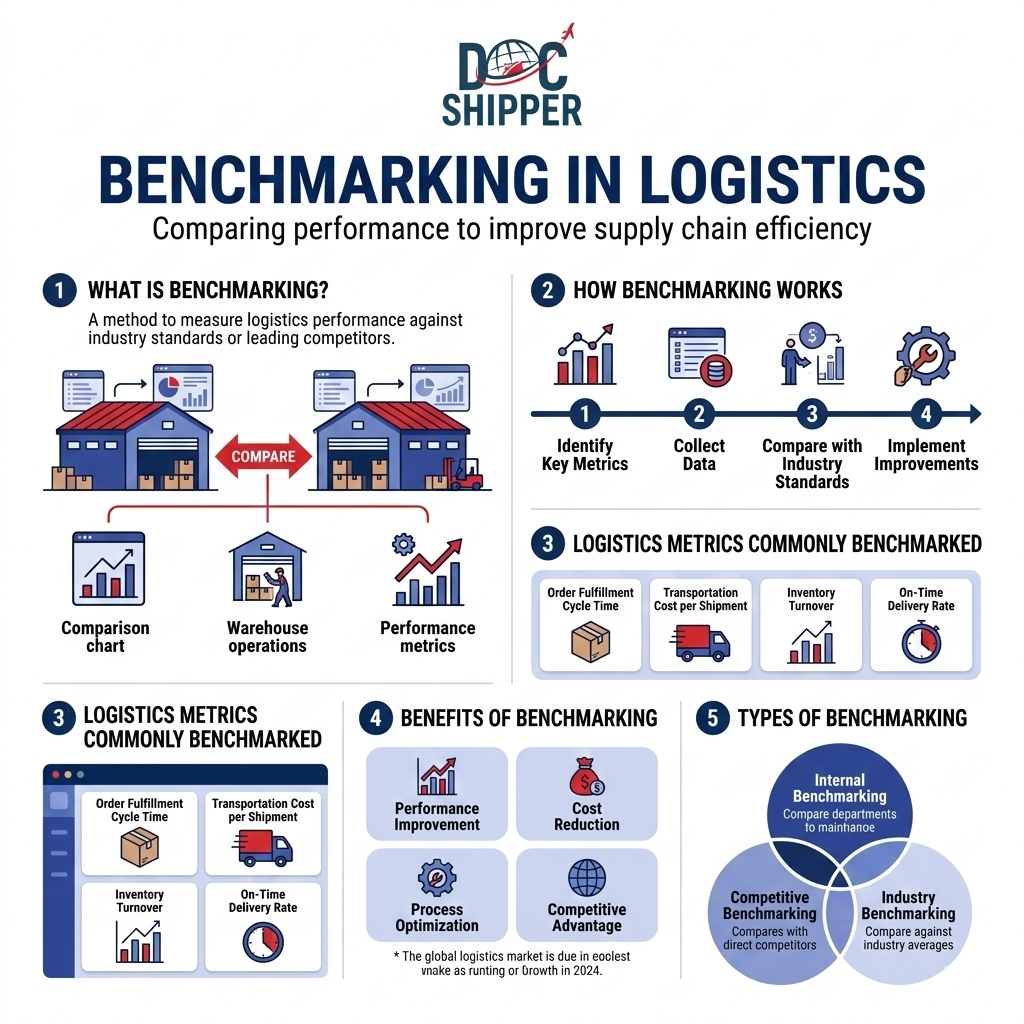
Benchmarking is a systematic process of comparing an organization's performance, processes, or practices against industry leaders or competitors to identify gaps and implement improvements. This strategic tool enables businesses to enhance operational efficiency, reduce costs, and maintain competitive advantage in international logistics and supply chain management.
Introduction
Many logistics companies struggle to understand why competitors deliver faster or operate at lower costs. Without objective comparison metrics, businesses operate blindly, unable to identify critical improvement areas.
In international trade and freight forwarding, benchmarking has become essential for survival. Companies face constant pressure to optimize transit times, reduce warehousing costs, and improve customs clearance efficiency.
Key characteristics of effective benchmarking include:
- Quantitative measurement – Using concrete KPIs like cost per shipment, delivery time, or error rates
- Competitive intelligence – Analyzing market leaders’ practices without industrial espionage
- Process orientation – Focusing on workflows rather than isolated metrics
- Continuous improvement – Establishing ongoing monitoring cycles, not one-time assessments
- Actionable insights – Converting data into implementable operational changes
Benchmarking Methodology & Strategic Framework
The benchmarking process follows a structured approach beginning with objective selection. Companies must identify specific areas requiring improvement—whether transit time reduction, customs compliance rates, or warehousing efficiency. Clear objectives prevent wasted resources on irrelevant comparisons.
Data collection methods vary by benchmarking type. Internal benchmarking compares different departments or regional offices within the same organization. Competitive benchmarking analyzes direct competitors’ performance. Functional benchmarking examines similar processes in different industries. Generic benchmarking studies best practices regardless of sector.
The performance gap analysis phase quantifies differences between current operations and benchmark standards. This involves calculating variance percentages, identifying root causes, and prioritizing improvement opportunities based on impact and feasibility.
Implementation planning transforms insights into action. Companies develop roadmaps with specific milestones, resource allocations, and accountability structures. At DocShipper, we systematically benchmark our customs clearance times against industry standards to ensure clients receive optimal processing speeds across all jurisdictions.
According to the U.S. Department of Commerce, companies engaging in regular benchmarking activities report 15-25% higher operational efficiency compared to those relying solely on internal assessments. The monitoring and adjustment phase ensures sustained improvement through quarterly reviews and metric recalibration as market conditions evolve.
Practical Applications & Performance Data
Real-world benchmarking delivers measurable results across logistics operations. Consider these comparative scenarios:
| Metric | Industry Average | Top Performers | Improvement Potential |
|---|---|---|---|
| Ocean freight cost per TEU (Asia-Europe) | $2,800 | $2,200 | 21% cost reduction |
| Customs clearance time (EU) | 48 hours | 18 hours | 62% time savings |
| Warehouse order accuracy | 96.5% | 99.7% | 3.2% error reduction |
| Documentation error rate | 8.2% | 2.1% | 74% defect elimination |
| On-time delivery rate | 87% | 96% | 10% reliability gain |
Case Study: Air Freight Optimization
A European electronics importer benchmarked their air freight operations against three competitors. Analysis revealed their average cost per kilogram from Shenzhen to Frankfurt was $8.50, while top performers achieved $6.80. Investigation uncovered inefficient consolidation practices and suboptimal carrier selection. By implementing best-practice consolidation schedules and renegotiating contracts based on benchmark data, they reduced costs by 18% within six months.
Key Performance Indicators for Logistics Benchmarking:
- Cost per shipment – Total logistics expenditure divided by shipment volume
- Transit time variance – Deviation from scheduled delivery dates
- Inventory turnover ratio – Frequency of stock replacement cycles
- Claims ratio – Percentage of shipments requiring damage or loss claims
- Carbon footprint per ton-kilometer – Environmental efficiency measurement
Industry data shows companies conducting quarterly benchmarking reviews achieve 32% faster process improvement cycles compared to annual assessments. The continuous feedback loop enables rapid adaptation to market changes and emerging best practices.
DocShipper Platform
Cut logistics costs. Not corners.
See exactly where your logistics costs are bleeding — and how to fix it. Book your expert demo.

Conclusion
Benchmarking transforms abstract performance goals into measurable, achievable targets by providing objective comparison frameworks. For logistics operations, this systematic approach directly impacts profitability, customer satisfaction, and competitive positioning.
Need expert guidance on optimizing your supply chain performance? Contact DocShipper for customized benchmarking analysis and implementation support.
📚 Quiz
Test Your Knowledge: Benchmarking
Q1 — What is the primary purpose of benchmarking in logistics?
Q2 — A small freight forwarder wants to improve its documentation accuracy. Which benchmarking type is most appropriate?
Q3 — A European importer discovers their air freight cost per kg from Shenzhen to Frankfurt is $8.50, while top performers achieve $6.80. What is the correct next step in the benchmarking process?
🎯 Your Result
📞 Free Quote in 24hFAQ | Benchmarking: Definition, Methods & Practical Examples
Benchmarking focuses on process comparison and performance metrics, while competitive analysis examines market positioning, pricing strategies, and business models. Benchmarking seeks operational improvement; competitive analysis informs strategic decisions.
Leading organizations perform quarterly reviews of critical KPIs and annual comprehensive benchmarking studies. High-volatility sectors like air freight may require monthly monitoring of specific metrics such as fuel surcharges or capacity utilization.
Absolutely. Functional benchmarking allows smaller operators to adopt specific best practices without replicating entire systems. Focus on scalable processes like documentation accuracy, customer communication protocols, or claims management rather than infrastructure-dependent metrics.
Primary errors include comparing incompatible operations, focusing solely on cost metrics while ignoring quality, using outdated data, and failing to account for regional regulatory differences. Effective benchmarking requires contextual alignment and multi-dimensional measurement.
Select companies with similar operational scales, service portfolios, and geographic coverage. Industry associations, trade publications, and professional networks provide valuable partner identification resources. Ensure data confidentiality agreements before sharing sensitive performance information.
Digital platforms enable real-time data collection, automated performance tracking, and predictive analytics. Cloud-based benchmarking tools facilitate secure data sharing among industry participants while maintaining anonymity. AI-driven systems identify performance patterns invisible to manual analysis.
By comparing clearance times, documentation error rates, and compliance scores across different service providers or internal teams, companies identify bottlenecks. Best-practice adoption in areas like HS code accuracy, pre-clearance preparation, and broker communication can reduce clearance times by 40-60%.
Warehouse benchmarking examines picking accuracy, order cycle times, space utilization, labor productivity, and inventory accuracy. Comparing these metrics against industry standards reveals automation opportunities, layout optimization potential, and workforce training needs.
Critical indicators include cost per TEU/FEU, booking-to-departure lead time, container utilization rates, demurrage/detention frequency, and carrier reliability scores. Environmental metrics like carbon emissions per container-mile are increasingly important for sustainability-focused organizations.
Performance comparison across multiple carriers, routes, and service providers reveals dependency risks. Benchmarking alternative logistics pathways enables contingency planning. Companies with diversified, benchmarked supply chains recovered 45% faster from COVID-19 disruptions than single-source operators.
Market-rate benchmarking provides powerful negotiation leverage. Demonstrating that current service costs exceed industry averages by quantified percentages strengthens renegotiation positions. Conversely, recognizing below-market pricing helps retain valuable partnerships through informed appreciation.
Initial improvements often appear within 3-6 months as quick-win opportunities get implemented. Comprehensive process redesigns based on benchmarking insights typically deliver full ROI within 12-18 months. Ongoing benchmarking programs generate compounding returns through continuous optimization cycles.
Need Help with Logistics or Sourcing ?
First, we secure the right products from the right suppliers at the right price by managing the sourcing process from start to finish. Then, we simplify your shipping experience - from pickup to final delivery - ensuring any product, anywhere, is delivered at highly competitive prices.


Fill the Form
Prefer email? Send us your inquiry, and we’ll get back to you as soon as possible.
Contact us


