In short ⚡
The Bill of Lading Port of Discharge is the destination seaport where cargo is officially unloaded from the vessel and transferred to the consignee or onward carrier. This critical field determines customs clearance location, freight calculations, and delivery obligations under international shipping contracts.
Introduction
Many importers confuse the port of discharge with the final delivery destination, leading to unexpected demurrage charges and customs complications. The port of discharge represents where the ocean carrier’s responsibility ends and where import formalities begin.
In international trade, this single data point impacts freight rates, transit times, customs procedures, and liability transfer. Understanding its exact definition prevents costly errors in documentation and logistics planning.
- Legal endpoint of the sea carrier’s obligation under the Bill of Lading contract
- Customs jurisdiction where import duties and inspections occur
- Freight calculation basis for ocean and terminal handling charges
- Demurrage trigger point where free time for container pickup starts
- Documentation requirement for Letters of Credit and trade finance
Technical & Legal Implications
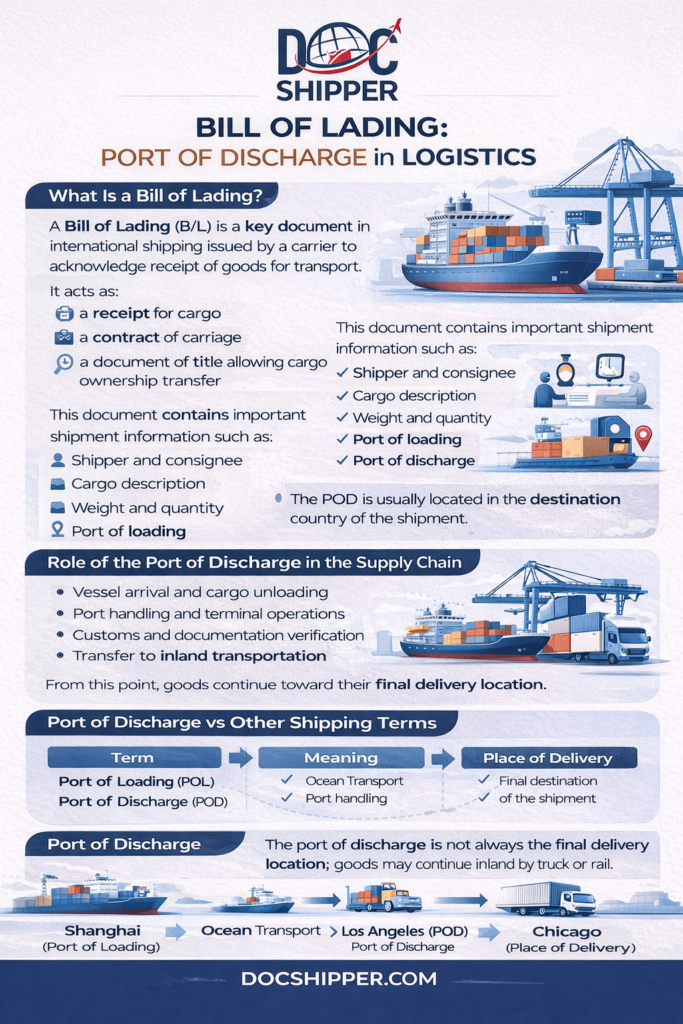
The port of discharge differs fundamentally from the “place of delivery” or “final destination.” Under Incoterms and maritime law, it marks the transition point where cargo moves from vessel to shore-side custody.
The Hague-Visby Rules and Rotterdam Rules define carrier liability as ending at discharge completion. This means damage or loss occurring after container unloading falls outside ocean carrier responsibility. At DocShipper, we systematically verify discharge port accuracy to ensure proper insurance coverage during this critical handover phase.
From a customs perspective, the port of discharge determines jurisdiction. EU regulations require customs declarations at the first EU port of entry, even if cargo continues inland. Misidentifying this port can trigger penalties or shipment holds.
Freight charges are structured around discharge locations. Port congestion surcharges, terminal handling fees, and destination delivery charges all reference the official discharge port. A shipment to Manchester via Felixstowe will show Felixstowe as the discharge port, with inland transport billed separately.
The free time clock begins when the container is available for pickup at the discharge terminal. Importers must arrange customs clearance and drayage before this period expires to avoid per-diem charges. According to World Customs Organization standards, accurate discharge port documentation accelerates clearance processes by 30-40%.
Practical Examples & Data
Understanding how discharge ports function in real scenarios clarifies their operational importance. The following comparison illustrates common routing patterns and their documentation implications.
| Shipment Route | Port of Loading | Port of Discharge | Final Destination | Customs Clearance |
|---|---|---|---|---|
| Shanghai → Rotterdam → Munich | Shanghai | Rotterdam | Munich | Rotterdam (EU entry) |
| Ningbo → Los Angeles → Chicago | Ningbo | Los Angeles | Chicago | Los Angeles (US entry) |
| Hamburg → Felixstowe (Transshipment) → New York | Hamburg | New York | New York | New York (direct) |
| Singapore → Jebel Ali → Antwerp | Singapore | Antwerp | Antwerp | Antwerp (Belgium) |
Use Case: European Import Scenario
A French importer orders machinery from Shenzhen with final delivery to Lyon. The Bill of Lading lists Le Havre as the port of discharge. The ocean carrier’s responsibility ends when the container is unloaded at Le Havre terminal. Customs clearance occurs at Le Havre under French jurisdiction. The importer arranges inland trucking separately to Lyon. Free time is 7 days from container availability at Le Havre. Demurrage charges apply at €80/day after this period.
At DocShipper, we coordinate discharge port operations across 50+ terminals worldwide, ensuring our clients receive real-time notifications when containers become available, preventing unnecessary storage fees.
Key Operational Metrics:
- Average free time: 5-7 days at major European ports, 3-5 days in Asia
- Demurrage costs: $75-150 per container per day depending on port
- Customs clearance time: 24-72 hours at discharge port with proper documentation
- Terminal handling charges: $200-400 per TEU at discharge terminals
- Documentation accuracy impact: 95% clearance success rate with correct discharge port vs. 60% with errors
DocShipper Platform
Cut logistics costs. Not corners.
See exactly where your logistics costs are bleeding — and how to fix it. Book your expert demo.
Conclusion
The Bill of Lading port of discharge serves as the legal and operational pivot point in ocean freight, defining where carrier liability ends and importer responsibility begins. Accurate identification prevents delays, reduces costs, and ensures compliance with international trade regulations.
Need expert guidance on discharge port selection or customs coordination? Contact DocShipper for tailored logistics solutions.
📚 Quizz
Test Your Knowledge: Bill of Lading Port of Discharge
Q1 — What does the "Port of Discharge" on a Bill of Lading officially refer to?
Q2 — A shipment travels from Shanghai to Munich, transiting through Rotterdam. Where does customs clearance take place, and what is listed as the Port of Discharge on the Bill of Lading?
Q3 — A French importer's container arrives at Le Havre (Port of Discharge). The carrier notifies that the container is available for pickup. What event triggers the start of the free time period — and what happens if the importer misses it?
🎯 Your Result
📞 Free Quote in 24hFAQ | Bill of Lading Port of Discharge: Definition, Calculation & Practical Examples
The port of discharge is where the vessel unloads cargo, while the port of destination refers to the final delivery location, which may be inland or at a different coastal terminal reached via transshipment.
Changes require a Bill of Lading amendment or Letter of Indemnity. Unauthorized changes can void insurance coverage and violate Letter of Credit terms, making proper documentation critical.
Typically the consignee (importer) pays destination terminal handling charges, though this depends on the agreed Incoterms. Under DDP terms, the shipper covers these costs.
Customs authorities at the discharge port have jurisdiction over import inspections, duty collection, and clearance procedures. Cargo cannot leave the port area until customs releases it.
Liability depends on when damage occurred. If during unloading while still on vessel tackle, the carrier is responsible. Once on the terminal, liability transfers to the terminal operator or consignee's agent.
Not necessarily. Transshipment scenarios involve discharge at an intermediate hub (e.g., Singapore) before reloading onto another vessel for the final importing country.
Consider proximity to final destination, customs efficiency, terminal infrastructure, free time allowances, inland transport costs, and potential congestion delays when selecting discharge ports.
Free time varies by port and carrier agreement, typically ranging from 3-10 days. This is the period allowed for container pickup before demurrage charges begin accumulating.
In some jurisdictions, Inland Clearance Depots (ICDs) allow customs procedures away from the port, but the discharge port remains the official entry point for documentation purposes.
Essential documents include the original Bill of Lading, commercial invoice, packing list, certificate of origin, and import license if applicable. Customs may request additional certifications depending on cargo type.
Congestion causes vessel waiting times, delayed container availability, and potential demurrage even before free time starts. Monitoring port performance metrics helps anticipate delays.
Frequent errors include confusing discharge port with place of delivery, using outdated port codes, omitting transshipment ports, and mismatching discharge port with customs entry location on import declarations.
Need Help with
Logistics or Sourcing ?
First, we secure the right products from the right suppliers at the right price by managing the sourcing process from start to finish. Then, we simplify your shipping experience - from pickup to final delivery - ensuring any product, anywhere, is delivered at highly competitive prices.


Fill the Form
Prefer email? Send us your inquiry, and we’ll get back to you as soon as possible.
Contact us