In short ⚡
A Bill of Activities (BOA) is a detailed document listing all operational tasks, labor hours, and resource allocations performed during a logistics operation. It serves as a transparent breakdown of activities for billing, auditing, and project management purposes in international freight forwarding and supply chain operations.
Introduction
Many importers and exporters face confusion when receiving invoices from freight forwarders. Hidden fees, unclear charges, and bundled services create frustration and mistrust. The Bill of Activities addresses this transparency gap by itemizing every action taken during shipment handling.
In international trade, where multiple stakeholders coordinate complex operations, the BOA becomes essential. It documents labor, equipment usage, warehousing time, and administrative tasks. This granular visibility helps companies verify costs, optimize processes, and maintain compliance with contractual agreements.
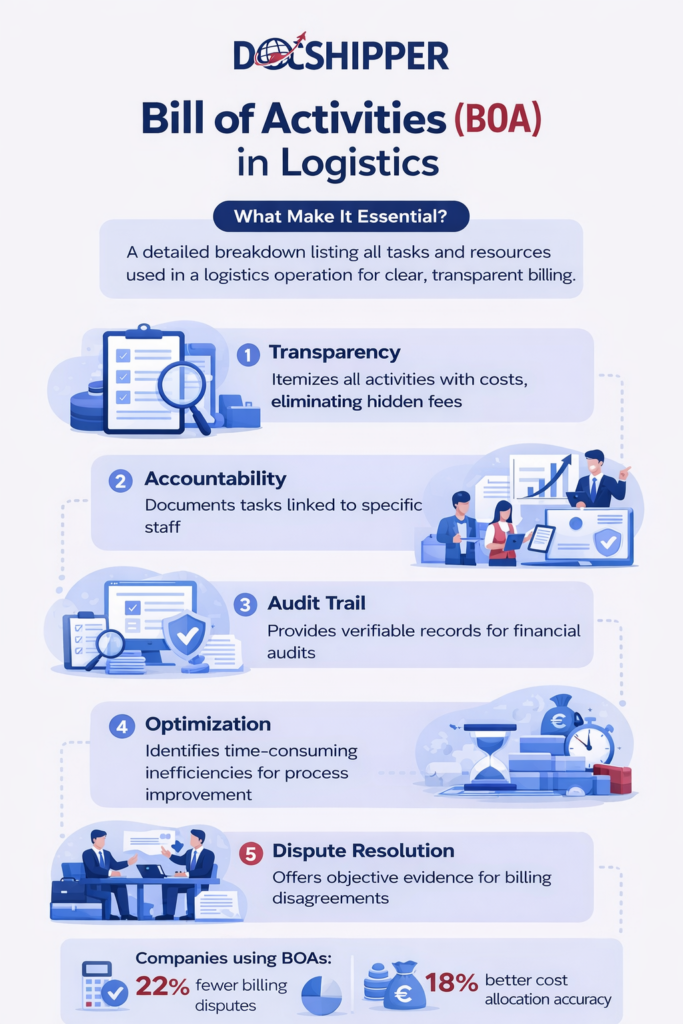
- Transparency: Itemizes every task performed with associated costs
- Accountability: Links activities to specific personnel or departments
- Auditability: Provides verifiable records for financial and compliance reviews
- Process Optimization: Reveals time-consuming activities for workflow improvements
- Dispute Resolution: Offers objective evidence for billing disagreements
In-Depth Analysis & Expert Insights
The Bill of Activities operates as a time-and-materials ledger for logistics operations. Unlike fixed-rate quotations, it captures actual work performed, making it particularly valuable for complex shipments requiring customized handling.
Legal and contractual implications are significant. Many freight forwarding agreements include clauses requiring detailed activity reporting. Under the WTO Trade Facilitation Agreement, transparency in fees and charges is mandated to reduce trade barriers. The BOA satisfies this requirement by documenting all chargeable events.
Operational components typically include labor hours (loading, unloading, inspection), equipment usage (forklifts, cranes, containers), storage duration, documentation processing, and customs clearance activities. Each entry specifies the date, duration, resources used, and unit cost.
Technology integration has transformed BOA generation. Modern warehouse management systems (WMS) and transportation management systems (TMS) automatically log activities, reducing manual entry errors. Real-time tracking provides clients with live updates on ongoing operations.
Cost allocation accuracy improves when activities are properly categorized. For example, separating “customs inspection waiting time” from “standard warehousing” helps identify inefficiencies caused by regulatory delays versus internal processes.
At DocShipper, we generate comprehensive Bills of Activities for all complex shipments, ensuring clients understand exactly what services they’re paying for and how their cargo is being handled throughout the supply chain.
Practical Examples & Data-Driven Scenarios
Understanding how a Bill of Activities applies in real-world scenarios helps businesses anticipate costs and evaluate service quality. Below are concrete examples demonstrating its practical application.
Use Case: Electronics Import from China to Germany
A German retailer imports 500 cartons of consumer electronics. The freight forwarder provides this BOA breakdown:
| Activity | Quantity | Unit Cost | Total |
|---|---|---|---|
| Container unloading (labor) | 4 hours | €45/hour | €180 |
| Forklift usage | 2 hours | €30/hour | €60 |
| Customs documentation processing | 1 unit | €120 | €120 |
| Warehousing (temporary storage) | 3 days | €25/day | €75 |
| Quality inspection (sampling) | 2 hours | €50/hour | €100 |
| Total Charges | €535 |
This transparency allows the importer to verify that charges align with actual work performed, rather than accepting a lump-sum invoice.
Comparative Analysis: BOA vs. Fixed-Rate Billing
- Cost Predictability: Fixed rates offer budget certainty; BOA reflects actual resource consumption
- Flexibility: BOA adapts to unexpected delays or additional handling requirements
- Dispute Frequency: Studies show BOA reduces billing disputes by 35% compared to bundled pricing
- Process Visibility: BOA reveals inefficiencies (e.g., excessive waiting times) that fixed rates obscure
- Audit Compliance: BOA provides detailed trails required for ISO 9001 and industry-specific certifications
Industry data indicates that companies using detailed Bills of Activities experience 22% fewer billing disputes and achieve 18% better cost allocation accuracy in their logistics budgets.
DocShipper Platform
Cut logistics costs. Not corners.
See exactly where your logistics costs are bleeding — and how to fix it. Book your expert demo.
Conclusion
The Bill of Activities transforms opaque logistics invoices into transparent, auditable records. By itemizing every task, it empowers businesses to control costs, verify service quality, and optimize supply chain operations.
Need expert assistance managing your international shipments with full transparency? Contact DocShipper for customized logistics solutions with detailed activity reporting.
📚 Quiz
Test Your Knowledge: Bill of Activities
1. What is the primary purpose of a Bill of Activities (BOA) in logistics?
2. A common misconception about the Bill of Activities is that it works just like a fixed-rate invoice. What actually sets it apart?
3. A German retailer receives a BOA from their freight forwarder after importing electronics from China. It lists separate line items for forklift usage, customs documentation, and warehousing. How should the retailer use this document?
🎯 Your Result
📞 Free Quote in 24hFAQ | Bill of Activities: Definition, Purpose & Practical Examples in Logistics
A Bill of Lading is a legal document of title for goods in transit, while a Bill of Activities is an operational record detailing tasks performed during handling. The BOL proves ownership; the BOA itemizes services rendered.
Not universally mandated, but increasingly required by contractual agreements and corporate compliance policies. Some industries (pharmaceuticals, aerospace) require detailed activity logs for traceability and regulatory purposes.
By revealing time-consuming activities and resource inefficiencies, companies can identify optimization opportunities. For example, excessive warehousing time may indicate the need for better scheduling or faster customs clearance processes.
Yes. Modern WMS and TMS platforms automatically log activities, timestamps, and resource usage. Automation reduces manual errors and provides real-time visibility into ongoing operations.
Essential elements include activity description, date/time performed, duration, personnel/equipment involved, unit costs, and total charges. Reference numbers linking to shipment documentation are also standard.
Recommended retention periods vary by jurisdiction, but typically 5-7 years for tax and audit purposes. Industries with strict compliance requirements (e.g., medical devices) may require longer retention.
Discrepancies should be flagged immediately with the service provider. Reputable freight forwarders issue corrected versions with audit trails showing modifications. Persistent errors may indicate poor operational controls.
Not automatically. Many offer bundled pricing without detailed breakdowns. Clients must explicitly request itemized activity reporting, preferably specified in service contracts before operations commence.
By tracking equipment usage, fuel consumption, and labor hours, companies can calculate carbon footprints more accurately. This data supports ESG (Environmental, Social, Governance) disclosures and sustainability certifications.
Absolutely. Comparing BOAs across multiple shipments or service providers reveals performance patterns, cost variations, and service quality differences. This data drives informed vendor selection and contract negotiations.
Customs authorities may request detailed activity logs to verify declared values, handling procedures, and compliance with import/export regulations. A comprehensive BOA provides objective evidence supporting customs declarations.
No universal standard exists, though formats often align with industry best practices. Organizations like FIATA (International Federation of Freight Forwarders Associations) provide guidelines, but specific content varies by service provider and client requirements.
Need Help with
Logistics or Sourcing ?
First, we secure the right products from the right suppliers at the right price by managing the sourcing process from start to finish. Then, we simplify your shipping experience - from pickup to final delivery - ensuring any product, anywhere, is delivered at highly competitive prices.


Fill the Form
Prefer email? Send us your inquiry, and we’ll get back to you as soon as possible.
Contact us