In short ⚡
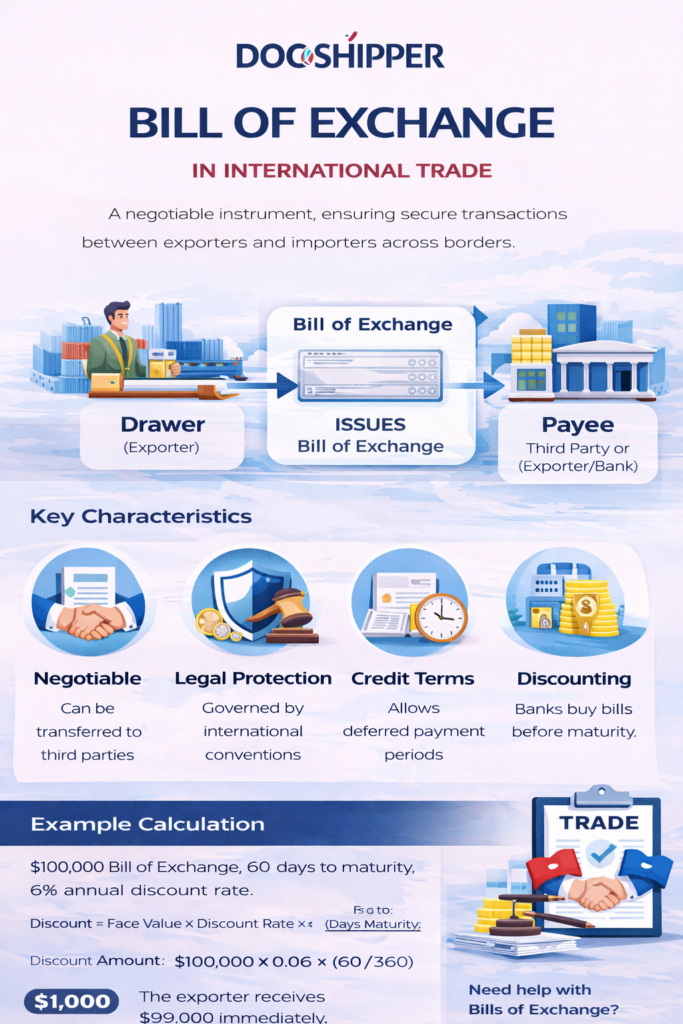
A Bill of Exchange is a written, unconditional order issued by one party (the drawer) directing another party (the drawee) to pay a specified sum of money to a third party (the payee) at a predetermined date. This negotiable instrument serves as a critical payment guarantee in international trade, ensuring transaction security between exporters and importers across different jurisdictions.
Introduction
Many businesses struggle with payment security when trading internationally. The risk of non-payment increases significantly when dealing with unfamiliar partners across borders. How can exporters guarantee they’ll receive payment while importers ensure goods are shipped as agreed?
The Bill of Exchange addresses this challenge directly. It functions as a legally binding payment instrument that protects both parties in cross-border transactions. Unlike simple invoices, it carries enforceable obligations that can be used in court if disputes arise.
Key characteristics include:
- Negotiability: The bill can be transferred to third parties, providing liquidity options for exporters
- Legal enforceability: Governed by international conventions like the Geneva Convention on Bills of Exchange
- Credit extension: Allows deferred payment terms while maintaining security
- Acceptance mechanism: The drawee’s signature creates an unconditional payment obligation
- Discount capability: Banks can purchase bills before maturity, providing immediate cash flow
Legal Framework & Technical Mechanisms
The Bill of Exchange operates under strict legal principles established by international commercial law. Three parties participate in every transaction: the drawer (typically the exporter who creates the bill), the drawee (usually the importer who must pay), and the payee (the party receiving payment, often the drawer themselves or their bank).
The instrument must contain specific mandatory elements to be legally valid. These include an unconditional order to pay, a fixed amount, a specified maturity date, and the signatures of relevant parties. Missing any element can render the bill unenforceable. The acceptance process is crucial: when the drawee signs the bill, they acknowledge the debt and commit to payment at maturity.
Two primary types exist in international trade. A sight bill requires immediate payment upon presentation, offering maximum security for exporters. A time bill (or usance bill) allows payment after a specified period—30, 60, 90, or 180 days—providing importers with working capital flexibility. This deferred payment transforms the bill into a credit instrument.
The endorsement mechanism enables negotiability. By signing the back of the bill, the payee can transfer rights to another party. This creates a chain of liability where all endorsers become jointly responsible for payment if the drawee defaults. Banks often purchase endorsed bills at a discount, providing immediate liquidity to exporters.
Legal protections vary by jurisdiction but generally follow the UNCITRAL Model Law on International Credit Transfers. In case of non-payment, the holder can initiate legal proceedings more rapidly than with standard contracts. The bill serves as prima facie evidence of debt, shifting the burden of proof to the defaulting party.
At DocShipper, we systematically verify that Bills of Exchange contain all mandatory elements and comply with destination country regulations. Our trade finance specialists coordinate with banking partners to ensure smooth acceptance and discount processes, minimizing payment risks for our clients throughout the import-export chain.
Concrete Examples & Trade Data
Understanding how Bills of Exchange function in real-world scenarios clarifies their practical value. Consider a French textile exporter shipping €50,000 worth of fabrics to a Turkish importer. The exporter issues a 90-day time bill, which the Turkish company accepts by signature. The French exporter then presents this accepted bill to their bank, which purchases it at a 5% annual discount rate.
Calculation of discount value:
Discount = Face Value × Discount Rate × (Days to Maturity / 360)
Discount = €50,000 × 0.05 × (90/360) = €625
Amount received immediately: €50,000 – €625 = €49,375
The exporter receives cash flow immediately while the importer gains 90 days to sell the goods and generate revenue before payment is due. The bank assumes the collection risk in exchange for the discount fee.
| Payment Method | Exporter Security | Importer Flexibility | Cost Level | Processing Time |
|---|---|---|---|---|
| Bill of Exchange | High | Medium | Low to Medium | 2-5 days |
| Letter of Credit | Very High | Low | High | 7-14 days |
| Open Account | Low | Very High | Very Low | Immediate |
| Cash in Advance | Maximum | Minimum | Low | Immediate |
Use Case: Electronics Import Scenario
A US retailer orders $120,000 of consumer electronics from a Chinese manufacturer. Given the high value and established relationship, they agree on a 60-day Bill of Exchange. The Chinese exporter draws the bill on the US company, which accepts it. The manufacturer then endorses the bill to their Chinese bank, receiving $118,800 immediately (1% monthly discount rate applied).
Key financial impacts:
- Exporter benefit: Immediate working capital without waiting 60 days
- Importer advantage: Time to receive, inspect, and potentially resell goods before payment
- Bank profit: $1,200 discount fee for assuming collection risk
- Risk mitigation: Legal recourse available if payment defaults occur
- Documentation trail: Clear audit trail for accounting and tax purposes
According to ICC Banking Commission data, Bills of Exchange represent approximately 8-12% of international trade payment instruments globally, with higher usage in emerging markets where Letter of Credit costs may be prohibitive. The average discount rate ranges from 3-7% annually depending on currency, country risk, and relationship strength.
Conclusion
The Bill of Exchange remains a powerful tool for balancing payment security with commercial flexibility in international trade. Its legal framework provides enforceable guarantees while its negotiability offers liquidity options that benefit all parties in the supply chain.
Need expert guidance on trade finance instruments for your import-export operations? Contact DocShipper for tailored solutions that protect your transactions while optimizing cash flow management.
DocShipper Platform
One platform. Your entire supply chain
Sourcing, freight, customs & documents — all centralised, all visible, 24/7.
📚 Quiz
Test Your Knowledge: Bill of Exchange
Q1 — What is a Bill of Exchange?
Q2 — What happens when a drawee refuses to accept a Bill of Exchange?
Q3 — A French exporter issues a 90-day Bill of Exchange for €50,000 and discounts it at a 5% annual rate. How much does the exporter receive immediately?
🎯 Your Result
📞 Free Quote in 24hFAQ | Bill of Exchange: Definition, Calculation & Concrete Examples
A Bill of Exchange involves three parties (drawer, drawee, payee) with the drawer ordering the drawee to pay. A promissory note involves two parties where the maker directly promises to pay the payee. Bills are typically used in trade transactions, while promissory notes serve as direct debt acknowledgments.
Yes, Bills of Exchange function in both domestic and international commerce. However, they're more common in cross-border trade where payment security concerns are heightened. Domestic transactions often use simpler payment methods unless significant credit extension or negotiability is required.
Non-acceptance constitutes dishonor of the bill. The holder must immediately notify all prior endorsers, who become liable for payment. The holder can initiate legal proceedings against the drawer and endorsers. This is why acceptance is crucial before discounting the bill with banks.
Banks calculate discount rates based on several factors: the creditworthiness of the drawee, country risk, currency stability, time to maturity, and the relationship with the exporter. Rates typically range from 3-7% annually, applied proportionally to the remaining term until maturity.
Most countries recognize Bills of Exchange under international conventions like the Geneva Convention (1930) or English common law traditions. However, specific enforcement procedures vary by jurisdiction. Always verify local regulations and consider using governing law clauses specifying favorable jurisdictions.
Essential elements include: the term "Bill of Exchange," an unconditional order to pay, a specific sum of money, the drawee's name, maturity date (or "at sight"), place of payment, payee's name, date and place of issue, and the drawer's signature. Missing elements may invalidate the instrument.
Traditional Bills of Exchange are paper instruments requiring physical signatures. However, electronic Bills of Exchange (eBills) are emerging under frameworks like UNCITRAL's Model Law on Electronic Transferable Records. Adoption varies by country, with some requiring specific legislation to recognize digital equivalents.
Common terms range from 30 to 180 days, with 60 and 90 days being most prevalent. Sight bills require immediate payment upon presentation. Longer terms (120-180 days) are used for high-value capital goods or when importers need extended selling periods before generating revenue.
Each endorser who signs the back of the bill becomes jointly liable for payment. If the drawee defaults, the holder can claim payment from any endorser in the chain. This creates a security mechanism where multiple parties guarantee payment, increasing the bill's creditworthiness and negotiability.
The discount amount (difference between face value and discounted value) is typically treated as interest expense for the exporter and interest income for the bank. Tax treatment varies by jurisdiction, but most countries allow exporters to deduct discount costs as business expenses while banks report it as taxable income.
Once accepted, a Bill of Exchange creates an unconditional obligation that cannot be unilaterally cancelled. Amendments require agreement from all parties with legal interest in the bill. Any material alteration without consent may discharge prior parties from liability. It's safer to issue a new bill for changed terms.
A clean Bill of Exchange stands alone without accompanying shipping documents. A documentary bill is attached to documents of title (like bills of lading), which are released to the drawee only upon acceptance or payment. Documentary bills provide additional security by controlling goods until payment obligations are met.
Need Help with
Logistics or Sourcing ?
First, we secure the right products from the right suppliers at the right price by managing the sourcing process from start to finish. Then, we simplify your shipping experience - from pickup to final delivery - ensuring any product, anywhere, is delivered at highly competitive prices.


Fill the Form
Prefer email? Send us your inquiry, and we’ll get back to you as soon as possible.
Contact us