


In short ⚡
Bill of Lading (B/L) Tracking is the process of monitoring the real-time location and status of cargo shipments using the unique B/L number issued by the carrier. This tracking system enables shippers, consignees, and logistics partners to verify vessel movements, container status, and estimated delivery times throughout the international shipping journey.Introduction
Many importers face uncertainty when their cargo disappears into the ocean freight system. Without proper B/L tracking, businesses cannot forecast inventory arrivals, manage warehouse resources, or communicate accurate timelines to customers.
In international logistics, the Bill of Lading serves as both a receipt and a contract. Its tracking capability transforms this document into a real-time visibility tool. Modern supply chains demand transparency from port of loading to final destination.
Key characteristics of effective B/L tracking include:
- Real-time vessel position updates via AIS (Automatic Identification System)
- Container status notifications (loaded, in transit, discharged, customs cleared)
- Multi-carrier compatibility across major shipping lines
- Integration with port terminal systems for gate-out confirmations
- Historical route data for performance analysis and dispute resolution
Tracking Mechanisms & Expertise
The B/L number functions as the primary identifier in carrier systems. Each shipping line maintains proprietary tracking platforms, though standardization efforts by organizations like BIC (Bureau International des Containers) are improving cross-carrier visibility.
Three tracking layers operate simultaneously in professional logistics:
Vessel-level tracking monitors the mother ship carrying your container. Marine traffic systems use GPS coordinates updated every 2-6 hours. This layer reveals delays caused by weather, port congestion, or route changes.
Container-level tracking provides granular status updates. Modern smart containers equipped with IoT sensors transmit temperature, humidity, and shock data. Standard containers rely on manual scans at each checkpoint: gate-in, loading, transshipment, discharge, and gate-out.
Document-level tracking follows the B/L itself through digital platforms. Electronic B/Ls (eBL) enable instant transfers between parties, eliminating courier delays. Blockchain-based systems like TradeLens create immutable audit trails.
At DocShipper, we monitor all three layers simultaneously, cross-referencing carrier data with port terminal systems to detect discrepancies before they cause delays. Our clients receive proactive alerts when vessels deviate from schedule or containers miss connections.
Regulatory compliance requires accurate tracking records. Customs authorities demand proof of shipment origin and routing. The ISF (Importer Security Filing) in the United States mandates B/L data submission 24 hours before loading. Tracking systems automatically generate compliance reports.
Practical Examples & Data
Understanding tracking performance requires analyzing real-world scenarios. Industry data reveals significant variations in tracking accuracy and update frequency across carriers and trade lanes.
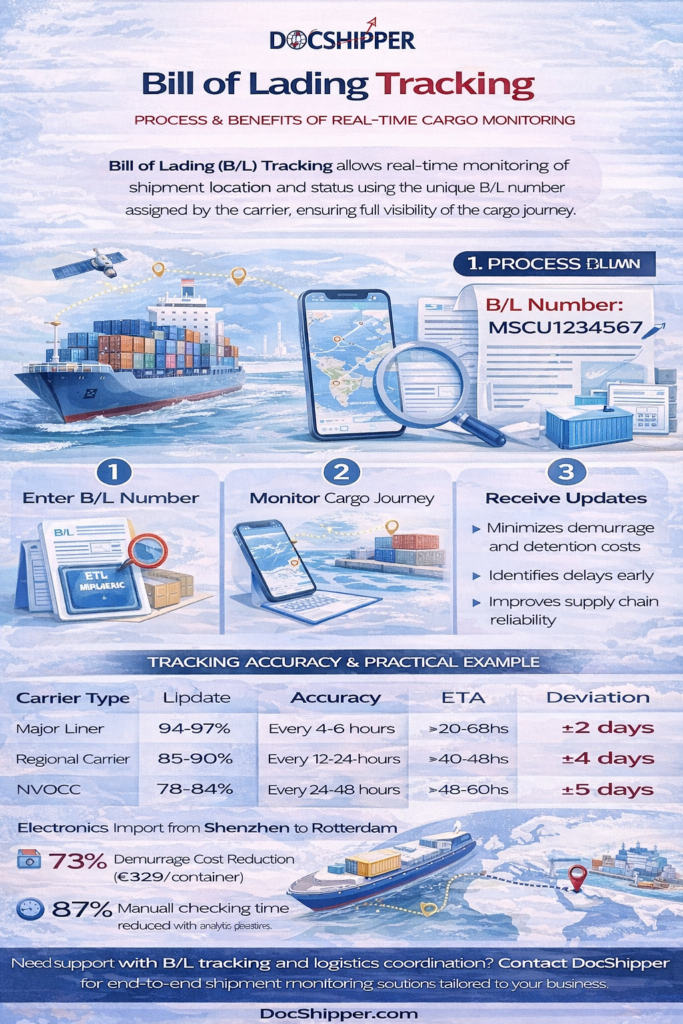
| Carrier Type | Update Frequency | Accuracy Rate | ETA Deviation |
|---|---|---|---|
| Major Liner (Maersk, MSC, CMA CGM) | Every 4-6 hours | 94-97% | ±2 days |
| Regional Carrier | Every 12-24 hours | 85-90% | ±4 days |
| NVOCC (Non-Vessel Operating) | Every 24-48 hours | 78-84% | ±5 days |
Use Case: Electronics Import from Shenzhen to Rotterdam
A European retailer ships 40-foot containers monthly. Without tracking, their average demurrage cost was €450 per container due to missed pickup windows. After implementing systematic B/L tracking with automated alerts, they reduced demurrage by 73% (€329 savings per shipment). The tracking system flagged a vessel delay 5 days before arrival, allowing them to reschedule warehouse staff and avoid overtime costs.
Key tracking milestones in a typical Asia-Europe route include:
- Day 0: Container gate-in at origin port (Shenzhen)
- Day 2: Vessel departure confirmation
- Day 18: Suez Canal transit notification
- Day 28: Discharge at destination port (Rotterdam)
- Day 30: Customs clearance and gate-out authorization
Third-party tracking aggregators like Container Tracking Index (CTI) platforms consolidate data from 150+ carriers. These systems reduce manual checking time by 85% for freight forwarders managing multiple shipments simultaneously.
Conclusion
Effective B/L tracking transforms opaque shipping processes into predictable, manageable operations. Real-time visibility reduces costs, improves customer satisfaction, and enables proactive problem-solving throughout the supply chain.
Need expert support with shipment tracking and logistics coordination? Contact DocShipper for comprehensive freight forwarding solutions tailored to your business needs.
📚 Quizz
Test Your Knowledge: Bill of Lading (B/L) Tracking
Q1 — What does Bill of Lading (B/L) Tracking primarily allow shippers and consignees to do?
Q2 — A common misconception is that B/L tracking and container number tracking provide identical information. What is the key difference?
Q3 — A European retailer imports electronics from Shenzhen monthly. They notice their B/L tracking shows no updates for 48 hours during transit. What is the most appropriate action?
🎯 Your Result
📞 Free Quote in 24hFAQ | Bill of Lading (B/L) Tracking: Definition, Process & Practical Examples
Visit your carrier's website and enter the B/L number in their tracking portal. Most major shipping lines provide real-time updates on vessel position, container status, and estimated arrival times.
The B/L number tracks the entire shipment document and associated cargo, while the container number tracks the physical equipment. One B/L may cover multiple containers in consolidated shipments.
Major carriers update vessel positions every 4-6 hours using AIS data. Container milestone events (loading, discharge, gate-out) update within 2-12 hours depending on port terminal systems.
Yes, third-party platforms like Descartes, project44, and CargoSmart aggregate tracking data from 100+ carriers, providing unified visibility across your entire supply chain.
Contact your freight forwarder or carrier immediately. Gaps in tracking data may indicate system errors, transshipment delays, or customs holds requiring documentation.
Electronic B/Ls (eBL) provide instant status updates and eliminate document courier delays. They integrate directly with carrier systems, reducing tracking discrepancies by approximately 60%.
Major carriers achieve 94-97% accuracy within ±2 days on direct routes. Accuracy decreases on routes with multiple transshipments or in regions with frequent port congestion.
Standard ocean B/L tracking ends at port discharge. For door-to-door visibility, request through B/L services or use freight forwarders who integrate trucking and rail tracking.
Customs authorities require B/L number, vessel name, voyage number, port of loading, and discharge date. Tracking systems automatically generate these compliance reports for ISF and AMS filings.
Most carrier platforms and third-party systems offer email or SMS notifications for key events: vessel departure, arrival, container discharge, and customs release.
Major carriers maintain tracking history for 12-24 months. For longer retention, export tracking reports to your own systems or request archived data directly from the carrier.
Common causes include delayed terminal scans, transshipment errors, equipment substitutions, and system synchronization lags between port operators and carrier databases.
Need Help with Logistics or Sourcing ?
First, we secure the right products from the right suppliers at the right price by managing the sourcing process from start to finish. Then, we simplify your shipping experience - from pickup to final delivery - ensuring any product, anywhere, is delivered at highly competitive prices.


Fill the Form
Prefer email? Send us your inquiry, and we’ll get back to you as soon as possible.
Contact us


