


In short ⚡
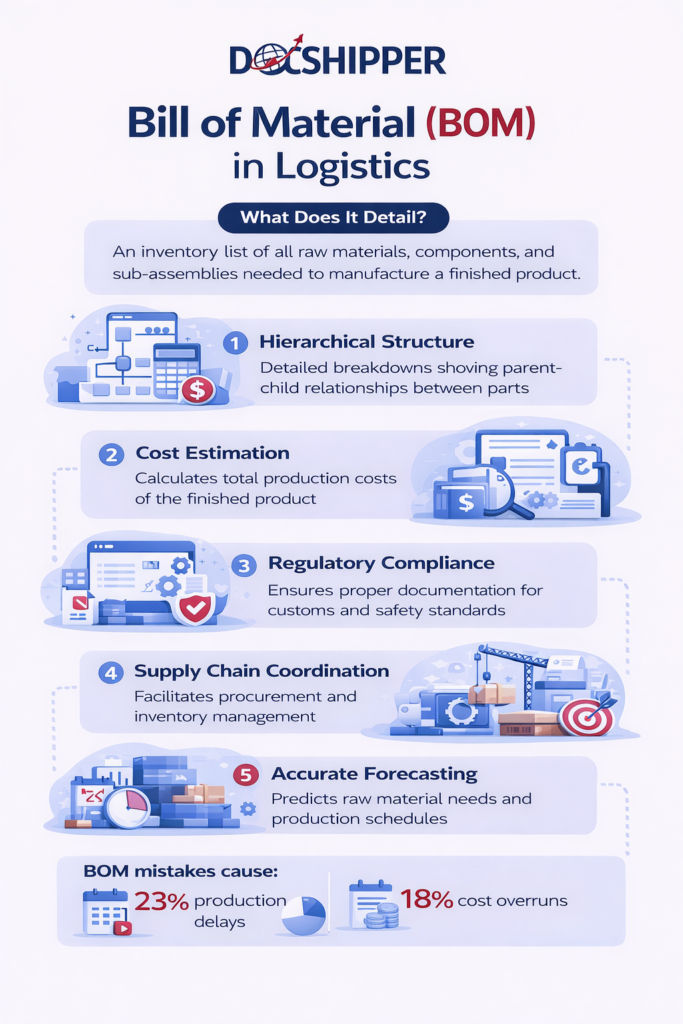
The Bill of Material (BOM) is a comprehensive inventory list detailing all raw materials, components, sub-assemblies, and quantities required to manufacture a finished product. It serves as the master reference for production planning, cost estimation, and supply chain coordination in international trade.
Introduction
Many importers underestimate the BOM’s critical role until production delays or customs issues arise. Without an accurate Bill of Material, manufacturers cannot source components efficiently, buyers cannot verify product specifications, and logistics providers struggle to calculate shipping volumes and customs values.
In international logistics, the BOM bridges engineering, procurement, and compliance. It determines everything from manufacturing lead times to HS code classification. For companies importing assembled goods or managing contract manufacturing abroad, the BOM becomes the foundation of quality control and cost transparency.
Key characteristics of an effective BOM include:
- Hierarchical structure showing parent-child relationships between assemblies and parts
- Part numbers and descriptions with unique identifiers for traceability
- Quantities per unit specifying exact amounts needed for each finished product
- Unit of measure (pieces, kilograms, meters) for procurement accuracy
- Source references indicating approved suppliers or material specifications
In-Depth Analysis & Technical Expertise
The Bill of Material exists in multiple formats depending on its application. The Engineering BOM (EBOM) originates from product design and reflects the theoretical assembly structure. The Manufacturing BOM (MBOM) adapts this for actual production processes, including tooling, fixtures, and work instructions. For international trade, the Costed BOM adds pricing data to enable landed cost calculations.
BOM levels determine complexity. A single-level BOM lists only immediate components without sub-assemblies. A multi-level BOM shows the complete hierarchy, revealing how sub-assemblies contain their own component lists. This distinction matters for customs valuation, as some countries require itemized breakdowns for duty assessment.
Regulatory compliance depends heavily on BOM accuracy. For products subject to import restrictions—electronics with conflict minerals, textiles with specific fiber content, machinery with dual-use components—the BOM provides the documentation trail. The WTO Customs Valuation Agreement recognizes BOM-based costing as acceptable proof for transaction value verification.
Version control represents a critical challenge. When engineering changes occur mid-production, outdated BOMs cause component mismatches, excess inventory, or compliance failures. Leading manufacturers implement BOM change management systems with revision tracking, effectivity dates, and approval workflows.
At DocShipper, we systematically cross-reference BOMs with supplier quotations and customs declarations to identify discrepancies before shipment. This verification prevents costly delays when actual cargo doesn’t match declared specifications, particularly for products requiring pre-shipment inspection or certification.
Concrete Examples & Data
Consider a furniture importer sourcing office chairs from Vietnam. The simplified BOM reveals cost structure and logistics implications:
| Component | Quantity | Unit Cost (USD) | Extended Cost |
|---|---|---|---|
| Seat cushion (polyurethane foam) | 1 piece | $3.20 | $3.20 |
| Backrest frame (steel tubing) | 1 assembly | $5.80 | $5.80 |
| Hydraulic lift mechanism | 1 unit | $8.50 | $8.50 |
| Caster wheels (nylon) | 5 pieces | $0.45 | $2.25 |
| Armrests (plastic molded) | 2 pieces | $1.90 | $3.80 |
| Total Material Cost | $23.55 |
This BOM enables precise calculations. For a 1,000-unit order, total material cost reaches $23,550. Adding labor ($4.50/unit) and overhead ($2.20/unit) brings the ex-works price to $30.25 per chair. When calculating ocean freight, the BOM’s dimensional data—each chair occupies 0.18 m³—determines container utilization: approximately 150 chairs per 20-foot container.
Use Case: Electronics Manufacturing
A U.S. company imports Bluetooth speakers from China. The BOM lists 47 components, including lithium batteries (UN3481 classification), requiring specialized handling. By analyzing the BOM early, DocShipper identified that battery placement triggered dangerous goods regulations, increasing air freight costs by 35% but avoiding shipment rejection. The BOM also revealed that three components originated from U.S. suppliers, qualifying the product for reduced duties under Section 301 exclusions.
Data-driven insights show that BOM errors cause 23% of production delays in contract manufacturing scenarios. Common mistakes include:
- Incorrect unit conversions (meters vs. feet, kilograms vs. pounds)
- Outdated part numbers after supplier changes
- Missing alternate components for supply chain resilience
- Incomplete material composition data for customs declarations
- Overlooked packaging materials affecting volumetric weight calculations
Conclusion
The Bill of Material transcends simple inventory listing—it’s the operational blueprint connecting product design, manufacturing execution, and international logistics. Accurate BOMs reduce procurement errors, enable precise cost forecasting, and ensure customs compliance across complex supply chains.
Need assistance validating your BOM for international shipments or optimizing component sourcing? Contact DocShipper for expert guidance on logistics documentation and supply chain management.
DocShipper Platform
One platform. Your entire supply chain
Sourcing, freight, customs & documents — all centralised, all visible, 24/7.
📚 Quiz
Test Your Knowledge: Bill of Material (BOM)
Q1 — What is the primary purpose of a Bill of Material (BOM) in manufacturing and international trade?
Q2 — A common misconception is that a BOM and a simple parts list are the same thing. What key feature distinguishes a BOM from a basic parts list?
Q3 — A U.S. importer sources Bluetooth speakers from China. During BOM review, the freight forwarder notices the product contains lithium batteries. What is the most accurate interpretation of this finding?
🎯 Your Result
📞 Free Quote in 24hFAQ | Bill of Material (BOM): Definition, Calculation & Concrete Examples
A parts list simply enumerates components, while a BOM includes hierarchical relationships, quantities per assembly, specifications, and sourcing information. The BOM is structured for manufacturing and procurement workflows.
Multi-level BOMs help demonstrate how sub-assemblies contribute to the final product's value. Customs authorities may require itemized BOMs to verify transaction value, especially for products with components from multiple countries of origin.
Yes, when the BOM reveals components eligible for preferential tariffs under free trade agreements or proves substantial transformation occurred during manufacturing. Detailed material breakdowns support duty drawback claims and origin certifications.
Enterprise Resource Planning (ERP) systems like SAP, Oracle, and specialized Product Lifecycle Management (PLM) tools such as Arena, Fusion 360 Manage, and OpenBOM handle complex BOM structures with version control and change management.
Update BOMs immediately when engineering changes occur, suppliers change, or material specifications alter. For active products, quarterly reviews ensure accuracy. Obsolete BOMs cause production mismatches and compliance risks.
Freight forwarders and customs brokers require BOMs for accurate classification, valuation, and documentation. The BOM helps determine Harmonized System codes, calculate duties, and prepare commercial invoices reflecting actual product composition.
A phantom BOM represents a temporary sub-assembly that doesn't exist in inventory—components are consumed directly during production. This simplifies inventory management but requires careful planning for procurement and lead time calculations.
Accurate BOMs enable precise material requirement planning (MRP), preventing stockouts and excess inventory. Studies show that BOM errors extend manufacturing lead times by 15-30% through component shortages and rework.
Yes, comprehensive BOMs incorporate all materials including packaging, labels, and protective materials. This ensures complete cost accounting and accurate volumetric calculations for freight quotations and container optimization.
BOM flattening converts multi-level hierarchies into single-level lists showing total quantities of each component. This simplifies procurement but loses assembly relationship information critical for manufacturing sequencing.
BOMs establish the baseline for inspection criteria. Quality teams verify incoming components against BOM specifications, ensuring only approved materials enter production. Deviations trigger corrective actions before defects reach finished goods.
While not universally mandatory, customs authorities may request BOMs for complex manufactured goods, products under anti-dumping investigations, or items requiring certification. Proactive BOM preparation accelerates clearance and demonstrates transparency.
Need Help with
Logistics or Sourcing ?
First, we secure the right products from the right suppliers at the right price by managing the sourcing process from start to finish. Then, we simplify your shipping experience - from pickup to final delivery - ensuring any product, anywhere, is delivered at highly competitive prices.


Fill the Form
Prefer email? Send us your inquiry, and we’ll get back to you as soon as possible.
Contact us



:%20Definition%20&%20Guide%20en%202026)