


In short ⚡
Bill of Materials (BOM) Level refers to the hierarchical structure indicating the depth at which a component or assembly appears within a product's manufacturing breakdown. Level 0 represents the finished product, while subsequent levels (1, 2, 3...) identify sub-assemblies and individual parts in descending order of complexity.Introduction
Confusion around BOM levels causes significant delays in international manufacturing and logistics. When suppliers and buyers misinterpret component hierarchy, procurement errors multiply across the supply chain.
Understanding BOM levels is essential for accurate costing, inventory management, and customs documentation in import/export operations. This hierarchical structure determines how products are manufactured, assembled, and ultimately shipped across borders.
- Hierarchical organization: Components arranged from finished product to raw materials
- Cost calculation: Each level impacts landed cost and duty classification
- Lead time management: Lower levels often determine total production timeline
- Quality control: Traceability depends on accurate level identification
- Customs compliance: Tariff codes vary based on assembly stage and component level
Understanding BOM Levels & Technical Framework
The BOM level structure operates as an inverted tree. Level 0 always represents the final sellable product. Each subsequent level breaks down into constituent parts and sub-assemblies.
Level numbering methodology follows strict conventions. When a component appears at multiple levels (common in modular design), its lowest level number determines procurement priority and manufacturing sequence.
Manufacturing Resource Planning (MRP) systems rely on accurate level coding to generate purchase orders and production schedules. A single misclassified component can cascade into material shortages affecting entire production runs.
From a customs perspective, BOM levels influence origin determination. Rules of origin calculations under free trade agreements require precise documentation of where value is added at each assembly level. The World Customs Organization provides harmonized guidelines for multi-level product classification.
Parent-child relationships within the BOM define manufacturing dependencies. A Level 2 component cannot be assembled until all Level 3 components are available. This relationship directly impacts shipping strategies and warehouse staging.
At DocShipper, we analyze BOM structures during sourcing to identify potential bottlenecks. Our procurement specialists verify that supplier quotes reflect the correct component levels, preventing costly misunderstandings during production.
Practical Examples & Calculation Methods
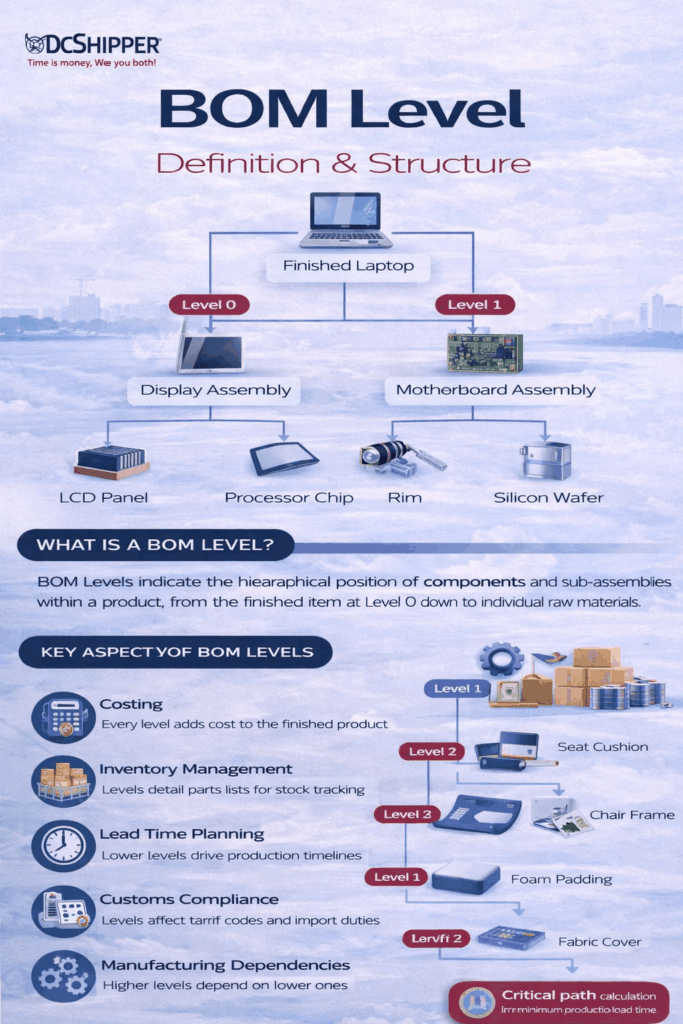
Consider a laptop computer as a practical example. The BOM structure illustrates how levels translate into manufacturing reality:
| BOM Level | Component | Quantity | Lead Time |
|---|---|---|---|
| 0 | Finished Laptop | 1 | — |
| 1 | Display Assembly | 1 | 14 days |
| 1 | Motherboard Assembly | 1 | 21 days |
| 2 | LCD Panel | 1 | 28 days |
| 2 | Processor Chip | 1 | 35 days |
| 3 | Silicon Wafer | 1 | 45 days |
Critical path calculation starts at the lowest level. In this example, the silicon wafer (Level 3) determines minimum production timeline. Any delay at Level 3 automatically impacts all higher levels.
Cost rollup methodology aggregates expenses from bottom to top. If a Level 3 component costs $50, Level 2 assembly adds $30 in labor and overhead, and Level 1 adds $20, the cumulative cost reaches $100 before final assembly.
For customs valuation, transaction value must reflect the appropriate BOM level being imported. Importing a complete motherboard assembly (Level 1) requires different HS codes and duty rates than importing individual chips (Level 2).
Use Case: A furniture manufacturer imports chair components. The seat cushion assembly (Level 1) includes foam padding (Level 2) and fabric cover (Level 2). If foam is sourced domestically but fabric is imported, only the fabric level triggers import duties. Proper BOM documentation prevents overpayment of customs fees.
DocShipper’s logistics coordinators map BOM structures during quotation to identify which levels cross international borders. This analysis optimizes duty costs and ensures compliance with preferential trade agreements.
Conclusion
Mastering BOM levels transforms complex manufacturing into manageable logistics. Accurate level identification prevents costly errors in procurement, customs clearance, and production scheduling.
Need expert guidance on BOM management for your international shipments? Contact DocShipper for specialized support in supply chain optimization.
📚 Quiz
Test Your Knowledge: Bill of Materials (BOM) Level
Q1 — What does "Level 0" represent in a Bill of Materials (BOM) structure?
Q2 — A standardized screw appears at both Level 2 and Level 3 in a multi-level BOM. How does an ERP system typically handle this component for procurement and inventory purposes?
Q3 — A furniture manufacturer imports a seat cushion assembly (Level 1) that contains an imported fabric cover (Level 2) and domestically sourced foam padding (Level 2). Which statement correctly describes the customs duty implication?
🎯 Your Result
📞 Free Quote in 24hFAQ | Bill of Materials (BOM) Level: Definition, Calculation & Practical Examples
BOM level refers to hierarchical depth (0, 1, 2...), while BOM type describes functional purpose (engineering BOM, manufacturing BOM, service BOM). Levels indicate structure; types indicate application.
Customs duties vary based on product classification. A finished assembly (Level 0) may have different tariff rates than individual components (Level 2). Proper documentation of assembly stage is essential for accurate duty calculation.
Yes, standardized parts like screws or connectors often appear at multiple levels. ERP systems typically assign the lowest level number to ensure correct procurement timing and inventory allocation.
Single-level BOMs show only immediate children (one level down). Multi-level BOMs display the complete hierarchy from finished product to raw materials, revealing all parent-child relationships across levels.
Total lead time equals the longest path from lowest-level component to finished product. If a Level 3 part requires 60 days and Level 2 assembly needs 14 days, minimum production time is 74 days.
Absolutely. Cost rollup starts at the lowest level and accumulates upward. Incorrect level assignment causes material cost errors that compound through each assembly stage, distorting final product pricing.
Level 0 represents the finished, sellable product. It is the top of the BOM hierarchy and contains no parent items. All other levels are components or sub-assemblies that comprise this final product.
Work orders are generated based on BOM levels. Lower-level components must be manufactured or procured first. MRP systems schedule production sequences according to level dependencies to prevent assembly delays.
Yes, engineering changes can add or remove levels. Design simplification might reduce levels, while increased modularity adds levels. Each revision requires updated documentation for procurement and customs compliance.
Phantom levels are temporary sub-assemblies that exist logically but not physically in inventory. They streamline manufacturing without creating intermediate stock, appearing in BOM structure but bypassing warehouse transactions.
Each level requires separate inventory tracking. Safety stock calculations, reorder points, and storage locations are determined by component level. Higher levels typically have lower inventory quantities due to shorter shelf life.
While numbering conventions are consistent (0 = finished product), specific level definitions vary by industry and ERP system. International suppliers should align BOM structures during contract negotiation to prevent miscommunication.
Need Help with
Logistics or Sourcing ?
First, we secure the right products from the right suppliers at the right price by managing the sourcing process from start to finish. Then, we simplify your shipping experience - from pickup to final delivery - ensuring any product, anywhere, is delivered at highly competitive prices.


Fill the Form
Prefer email? Send us your inquiry, and we’ll get back to you as soon as possible.
Contact us


