In short ⚡
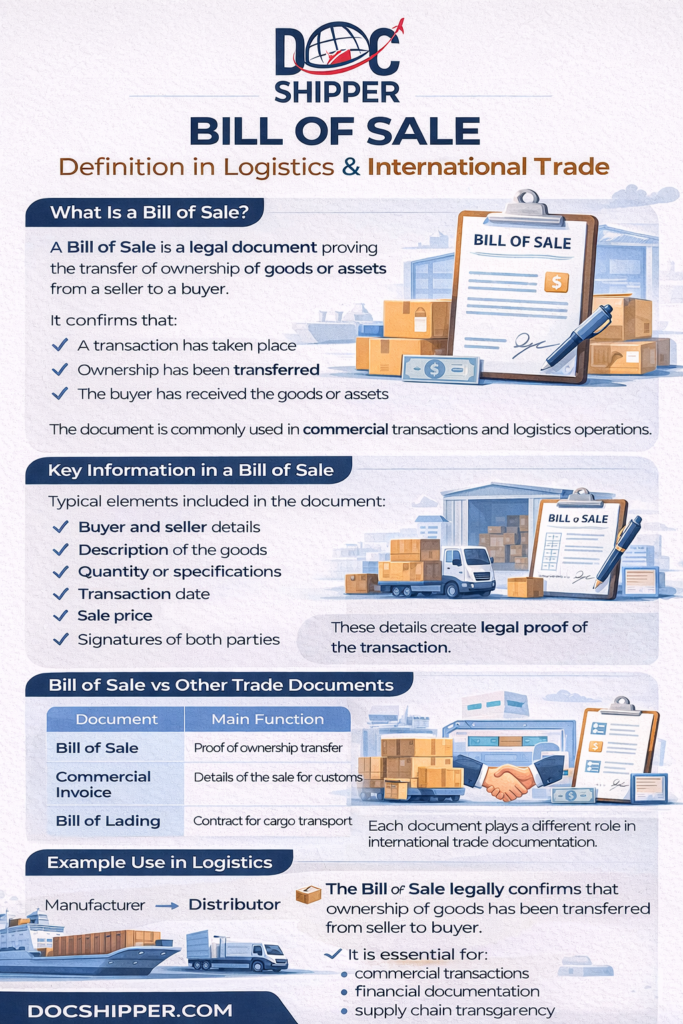
A Bill of Sale is a legal document that transfers ownership of goods from a seller to a buyer. It serves as written proof of the transaction, detailing the item(s) sold, the purchase price, and the parties involved. In international trade, it validates ownership transfer and supports customs clearance processes.
Introduction
Many importers and exporters underestimate the importance of a properly executed Bill of Sale. This oversight can lead to customs delays, ownership disputes, or even legal challenges when goods cross borders.
In international logistics, the Bill of Sale plays a critical role beyond simple proof of purchase. It establishes legal ownership, supports valuation for customs duties, and provides essential documentation for insurance claims and audits.
Key characteristics of a Bill of Sale include:
- Legal transfer of ownership from seller to buyer
- Detailed description of goods or assets being sold
- Transaction value and payment terms documentation
- Signatures of both parties validating the agreement
- Date and location of the transaction for legal reference
Legal Framework & Operational Implications
The Bill of Sale functions as a binding contract between buyer and seller. Unlike a commercial invoice, which primarily serves accounting purposes, the Bill of Sale explicitly transfers property rights and can be used as evidence in legal proceedings.
In international trade, this document must align with the Uniform Commercial Code (UCC) in the United States or equivalent commercial laws in other jurisdictions. The European Union recognizes Bills of Sale under the EU Commercial Law Directives, which standardize cross-border transactions.
Three critical elements must appear in every valid Bill of Sale:
Identification of parties: Full legal names and addresses of both seller and buyer must be clearly stated. For corporate entities, include registration numbers and authorized signatories.
Description of goods: Detailed specifications including quantity, quality, model numbers, serial numbers (for equipment), and condition. Ambiguous descriptions can invalidate the document or create disputes.
Consideration clause: The exact purchase price or exchange value must be documented. This figure directly impacts customs valuation and duty calculations at the destination port.
At DocShipper, we systematically verify Bills of Sale during pre-shipment document reviews to ensure compliance with both origin and destination country requirements, preventing costly delays at customs checkpoints.
The document also carries tax implications. In many jurisdictions, Bills of Sale serve as proof for VAT/GST calculations and capital gains reporting. Customs authorities frequently cross-reference the stated value against market prices to detect undervaluation.
For used equipment or machinery, the Bill of Sale becomes even more critical. It must include previous ownership history, maintenance records references, and explicit “as-is” clauses to limit seller liability after transfer.
Practical Applications & Use Cases
Understanding how Bills of Sale function in real-world scenarios clarifies their operational importance. Below are structured examples demonstrating different use cases:
Comparative Analysis: Bill of Sale vs. Similar Documents
| Document Type | Primary Purpose | Ownership Transfer | Legal Weight | Customs Requirement |
|---|---|---|---|---|
| Bill of Sale | Ownership transfer | Yes | High (contract) | Often required |
| Commercial Invoice | Payment request | Implied | Medium (accounting) | Always required |
| Proforma Invoice | Price quotation | No | Low (preliminary) | Not accepted |
| Receipt | Payment confirmation | No | Low (proof only) | Supplementary |
Use Case: Importing Used Manufacturing Equipment
Scenario: A Canadian manufacturer purchases a used CNC machine from a German seller for €45,000.
Bill of Sale requirements:
- Machine specifications: Brand (DMG MORI), Model (NHX 4000), Serial Number (12345-2018)
- Condition statement: “Equipment sold as-is with 12,000 operational hours”
- Purchase price: €45,000 (CAD equivalent at transaction date for customs)
- Seller warranty disclaimer: “No warranties expressed or implied”
- Previous ownership documentation attached as annexes
Customs impact: Canadian Border Services Agency (CBSA) uses the Bill of Sale to determine duty base. Without proper documentation showing fair market value, customs may apply arbitrary valuation, increasing import costs by 15-25%.
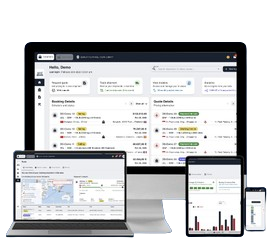
DocShipper Platform
One platform. Your entire supply chain
Sourcing, freight, customs & documents — all centralised, all visible, 24/7.
Data Point: Document Verification Failures
According to industry data, approximately 18% of shipment delays at major EU ports result from incomplete or inconsistent Bills of Sale. The most common deficiencies include:
- Missing serial numbers for high-value equipment (34% of cases)
- Unsigned documents or missing notarization (28%)
- Price discrepancies between Bill of Sale and commercial invoice (22%)
- Inadequate goods description causing HS code classification issues (16%)
At DocShipper, our document preparation service includes cross-verification between Bills of Sale, commercial invoices, and packing lists to eliminate these common errors before shipment departure.
Conclusion
The Bill of Sale remains an indispensable document in international trade, providing legal proof of ownership transfer while supporting customs compliance and financial transparency. Proper preparation prevents delays and protects both parties’ interests.
Need assistance preparing compliant Bills of Sale for your international shipments? Contact DocShipper for expert documentation support tailored to your specific trade requirements.
📚 Quiz
Test Your Knowledge: Bill of Sale
Q1 — What is the primary purpose of a Bill of Sale in international trade?
Q2 — A colleague tells you that a Commercial Invoice and a Bill of Sale serve the same legal purpose. Are they correct?
Q3 — A Canadian company imports a used CNC machine from Germany. The Bill of Sale states €45,000 but the Commercial Invoice shows €38,000. What is the most likely consequence?
🎯 Your Result
📞 Free Quote in 24hFAQ | Bill of Sale: Definition, Calculation & Concrete Examples
No. A Bill of Sale specifically transfers ownership, while an invoice requests payment. Both may be required for international shipments, serving different legal and accounting purposes.
Not always. It's typically required for high-value goods, used equipment, vehicles, or when explicit ownership transfer documentation is needed for customs or legal purposes.
Requirements vary by country and goods type. Vehicles and real estate typically require notarization. For general cargo, notarization adds legal weight but isn't always mandatory.
Yes, if the document includes warranty terms. However, most Bills of Sale for used goods contain "as-is" clauses that explicitly exclude warranties.
Customs authorities may flag the shipment for inspection. Significant discrepancies can trigger valuation disputes, penalties, or delays. Both documents should reflect the same transaction value.
Retain them for at least 7 years for tax purposes. For capital assets or equipment, keep them for the asset's entire lifecycle plus applicable statute of limitations periods.
Many jurisdictions now accept digital Bills of Sale with electronic signatures. However, some customs authorities still require certified paper copies, especially for high-value transactions.
Typically the seller prepares it, but either party can draft the document. Both must sign for it to be valid. Legal review is recommended for high-value transactions.
An absolute Bill of Sale transfers ownership immediately and unconditionally. A conditional Bill of Sale transfers ownership only when specific conditions (like full payment) are met.
Amendments require mutual agreement and signatures from both parties. For significant changes, drafting a new Bill of Sale is often clearer and legally safer.
For zero-value transactions, a declaration letter often suffices. However, a Bill of Sale stating "no consideration" or "gift" provides stronger documentation for customs purposes.
Use the transaction currency agreed upon by both parties. For customs purposes, include the equivalent value in the destination country's currency using the exchange rate on the transaction date.
Need Help with
Logistics or Sourcing ?
First, we secure the right products from the right suppliers at the right price by managing the sourcing process from start to finish. Then, we simplify your shipping experience - from pickup to final delivery - ensuring any product, anywhere, is delivered at highly competitive prices.


Fill the Form
Prefer email? Send us your inquiry, and we’ll get back to you as soon as possible.
Contact us