In short ⚡
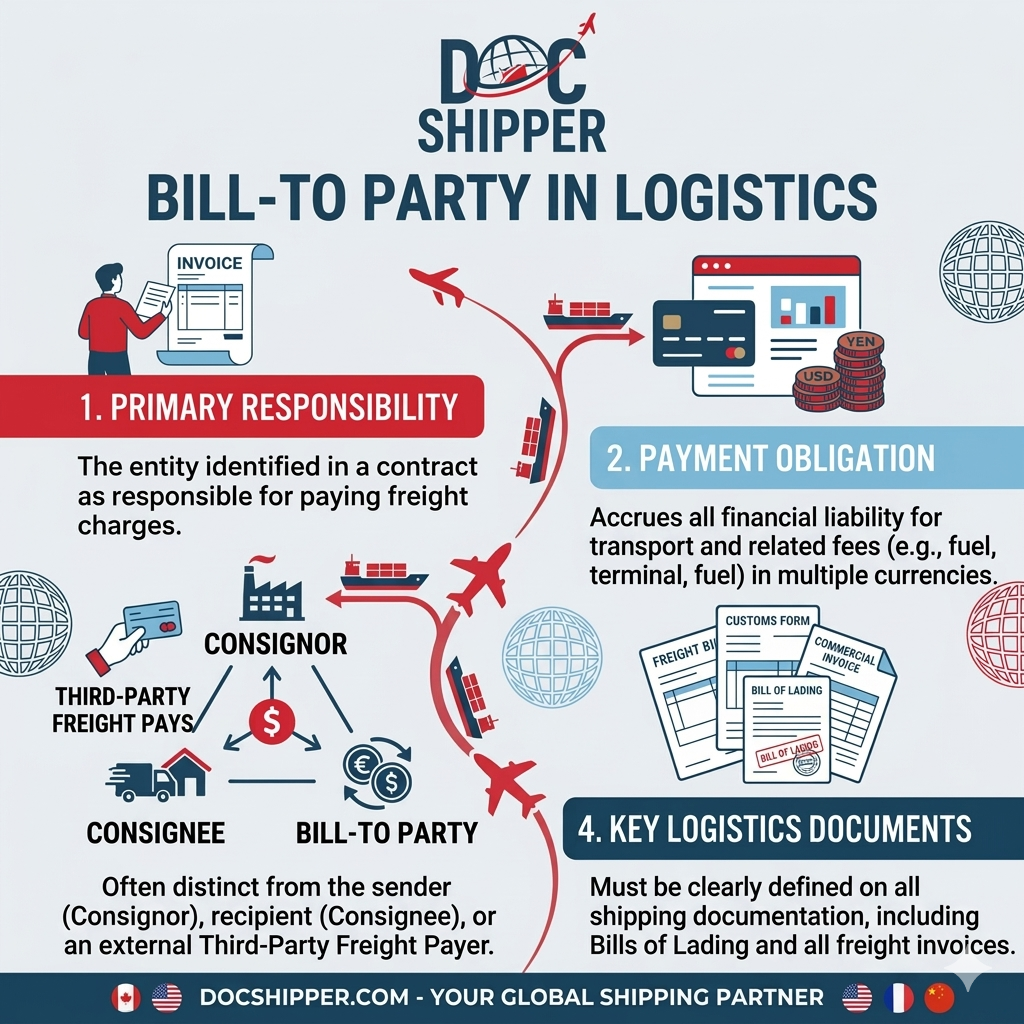
Bill to Party is the legal entity designated to receive and pay the invoice in an international shipment. This party may differ from the consignee or shipper and is explicitly identified on commercial documents to ensure proper billing and customs compliance.Introduction
One of the most common confusions in international logistics involves identifying who actually pays for a shipment. The shipper sends goods, the consignee receives them, but the Bill to Party settles the invoice—and these three entities are not always the same.
Understanding this distinction is critical for accurate customs declarations, proper VAT/tax allocation, and seamless payment processing. Misidentifying the Bill to Party can trigger billing disputes, customs delays, or compliance violations.
Key characteristics of the Bill to Party include:
- Legal invoicing entity: The party legally responsible for payment obligations.
- Distinct from consignee: May be a parent company, third-party buyer, or financial intermediary.
- Customs relevance: Required on commercial invoices and customs declarations for fiscal traceability.
- Tax implications: Determines VAT jurisdiction and importer of record responsibilities.
- Contract flexibility: Enables triangular trade, drop-shipping, and centralized billing structures.
Understanding Bill to Party: Legal & Operational Framework
The Bill to Party serves as the financial anchor in international transactions. Unlike the consignee (who receives goods) or the shipper (who sends them), this entity assumes the contractual obligation to pay for freight, duties, and associated charges.
In triangular trade scenarios, a company in Country A may sell goods manufactured in Country B to a customer in Country C, while billing a headquarters in Country D. Here, the Bill to Party (Country D) differs from all physical parties involved, requiring precise documentation to satisfy customs authorities.
The Incoterms framework indirectly influences Bill to Party designation. Under DDP (Delivered Duty Paid), the seller typically acts as Bill to Party for import duties. Under EXW (Ex Works), the buyer assumes this role. However, contractual arrangements can override these defaults, making explicit identification essential.
From a customs compliance perspective, the European Union’s Union Customs Code (Article 5) requires clear identification of the “debtor” for customs duties—often the Bill to Party. Similarly, U.S. Customs and Border Protection mandates accurate invoicing to prevent undervaluation or misclassification (CBP Invoice Requirements).
VAT treatment varies significantly based on Bill to Party location. An EU-based Bill to Party importing goods from Asia triggers reverse charge mechanisms, while a non-EU entity requires import VAT payment at customs. This distinction affects cash flow and tax recovery timelines.
At DocShipper, we systematically verify Bill to Party details during shipment setup to ensure invoices align with customs declarations, preventing costly delays or penalties at destination ports.
Practical Examples & Scenarios
To clarify how Bill to Party functions in real-world logistics, consider these concrete scenarios:
| Scenario | Shipper | Consignee | Bill to Party | Implication |
|---|---|---|---|---|
| Standard B2B Sale | Factory (China) | Warehouse (Germany) | Warehouse (Germany) | Consignee pays all charges directly |
| Corporate Consolidation | Supplier (Vietnam) | Distribution Center (France) | HQ (Netherlands) | Centralized billing for tax optimization |
| Drop-Shipping | Manufacturer (India) | End Customer (USA) | Retailer (UK) | Retailer handles payment, customer receives goods |
| Third-Party Logistics | Seller (Japan) | 3PL Warehouse (Belgium) | Brand Owner (Switzerland) | Brand retains financial control despite outsourced logistics |
Use Case: Electronics Importer
A French electronics retailer orders 500 laptops from a Taiwanese manufacturer. The goods ship to a fulfillment center in Poland (consignee), but invoices are sent to the retailer’s Paris headquarters (Bill to Party). Polish customs requires proof that the Paris entity is the importer of record for VAT purposes. Without clear Bill to Party documentation, the shipment faces a 7-day hold, delaying market launch.
Cost Implications: Incorrect Bill to Party designation can result in double taxation (import VAT paid by consignee + invoice VAT charged to Bill to Party), creating reconciliation nightmares and cash flow disruptions.
DocShipper’s pre-shipment verification includes cross-referencing Bill to Party details with commercial invoices and packing lists, ensuring customs authorities receive consistent information from the outset.
Conclusion
The Bill to Party is the financial cornerstone of international shipments, determining who pays and how customs authorities assess duties and taxes. Clarity in this designation prevents billing disputes, customs delays, and compliance risks.
Need expert guidance on structuring your shipments for optimal billing and customs compliance? Contact DocShipper for tailored logistics solutions.
📚 Quiz
Test Your Knowledge: Bill to Party
Q1 — What is the primary role of the Bill to Party in an international shipment?
Q2 — A common misconception is that the Bill to Party is always the same as the Importer of Record. Which statement is correct?
Q3 — A UK-based retailer uses drop-shipping: a manufacturer in India ships laptops directly to an end customer in the USA. Who is the Bill to Party?
🎯 Your Result
📞 Free Quote in 24hFAQ | Bill to Party: Definition, Role & Practical Examples in International Trade
Need Help with Logistics or Sourcing ?
First, we secure the right products from the right suppliers at the right price by managing the sourcing process from start to finish. Then, we simplify your shipping experience - from pickup to final delivery - ensuring any product, anywhere, is delivered at highly competitive prices.
Fill the Form
Prefer email? Send us your inquiry, and we’ll get back to you as soon as possible.
Contact us