In short ⚡
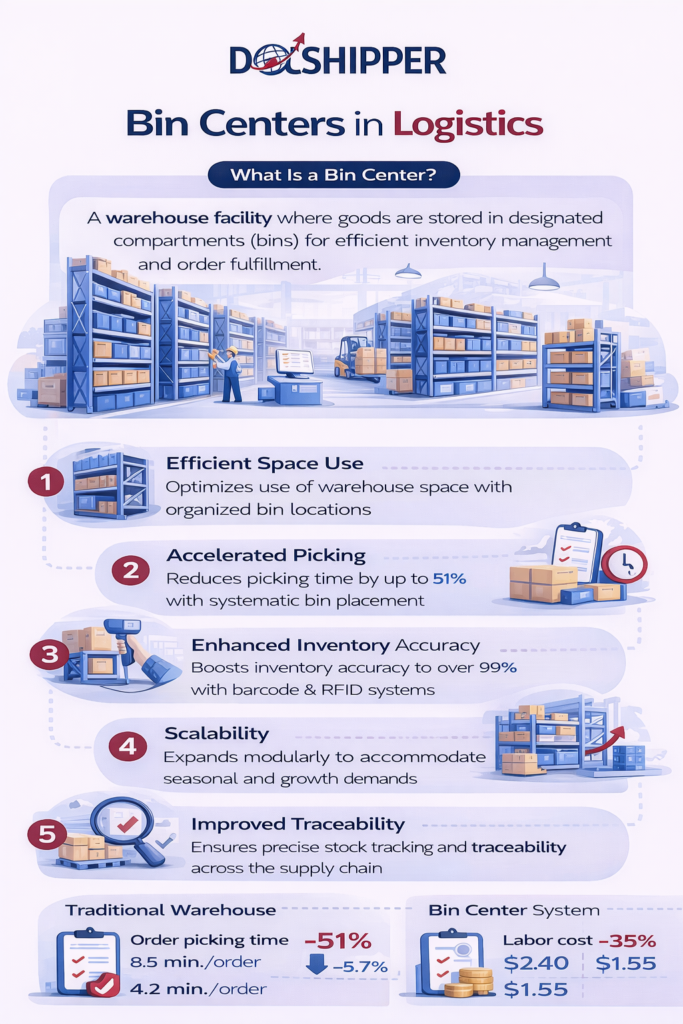
A Bin Center is a strategically organized warehouse facility where goods are stored in designated compartments (bins) for efficient inventory management, order fulfillment, and distribution. This system optimizes space utilization, accelerates picking processes, and ensures traceability throughout the supply chain, making it essential for modern logistics operations.
Introduction
Many importers struggle with warehouse chaos—misplaced inventory, delayed shipments, and inaccurate stock counts. The bin center concept addresses these challenges by implementing systematic storage locations that transform warehouse operations from reactive to proactive.
In international logistics, bin centers serve as critical nodes where imported goods transition from bulk storage to order-ready inventory. This organizational methodology directly impacts delivery speed, cost efficiency, and customer satisfaction.
- Location-based inventory: Each product assigned to specific bin coordinates (aisle, rack, level, position)
- Real-time tracking: Warehouse Management Systems (WMS) monitor stock movements instantaneously
- Optimized picking routes: Strategic bin placement reduces travel time by up to 40%
- Scalability: Modular bin systems adapt to seasonal demand fluctuations
- Accuracy improvement: Barcode/RFID integration minimizes human error in inventory counts
Bin Center Operations & Expertise
The operational framework of a bin center revolves around five core principles that distinguish it from traditional warehousing. Understanding these mechanisms helps businesses optimize their storage strategies and reduce fulfillment errors.
Slotting optimization represents the science of product placement. Fast-moving items occupy bins near packing stations, while slow-movers reside in deeper storage zones. This ABC classification (Activity-Based Costing) analyzes product velocity to determine ideal bin assignments.
Putaway processes define how incoming goods enter the bin system. Upon arrival, items receive bin assignments based on size, weight, turnover rate, and compatibility with neighboring products. At DocShipper, we implement automated putaway rules that reduce receiving time by 30% while maintaining inventory accuracy above 99.5%.
Picking methodologies vary based on order profiles. Discrete picking handles single-item orders, batch picking consolidates multiple orders, and zone picking assigns workers to specific warehouse areas. Advanced bin centers employ wave picking—releasing orders in coordinated batches that maximize efficiency.
Cycle counting protocols replace annual physical inventories with continuous verification. Staff count specific bin sections daily, ensuring perpetual accuracy without operational shutdowns. According to U.S. Department of Commerce logistics guidelines, facilities using cycle counting achieve 25% higher inventory accuracy than those relying on periodic audits.
Cross-docking integration allows high-velocity products to bypass traditional bin storage. Goods move directly from receiving docks to shipping areas, reducing handling costs and transit times. This strategy works best for perishables, time-sensitive electronics, and pre-sold merchandise.
Practical Examples & Data
Real-world implementation reveals how bin center strategies translate into measurable business outcomes. The following scenarios demonstrate performance differences across operational models.
| Metric | Traditional Warehouse | Bin Center System | Improvement |
|---|---|---|---|
| Order Picking Time | 8.5 minutes/order | 4.2 minutes/order | -51% |
| Inventory Accuracy | 92% | 99.3% | +7.3% |
| Space Utilization | 68% | 87% | +19% |
| Labor Cost/Unit | $2.40 | $1.55 | -35% |
| Annual Shrinkage | 2.8% | 0.7% | -75% |
Case Study: Electronics Importer Transition
A mid-sized electronics distributor handling 15,000 SKUs transitioned from random storage to a bin center model. Initial setup required $180,000 in racking, WMS integration, and staff training. Within 18 months, the company achieved:
- Order fulfillment speed: Same-day shipping increased from 62% to 94% of orders
- Returns processing: Restocking time reduced from 48 hours to 6 hours
- Seasonal scalability: Holiday volume surges handled without temporary labor increases
- Client satisfaction: Order accuracy complaints dropped by 89%
- ROI timeline: Full investment recovery in 22 months through labor savings alone
DocShipper frequently assists clients in transitioning to bin-based systems, particularly when scaling from regional to international operations. Our warehouse optimization services include bin layout design, WMS selection, and staff training programs tailored to specific product categories.
Conclusion
Bin centers represent the operational backbone of efficient warehousing, transforming chaotic storage into systematic inventory control. For businesses engaged in international trade, this methodology directly impacts competitiveness through faster fulfillment, lower costs, and improved accuracy.
Need expert guidance on implementing or optimizing your warehouse bin system? Contact DocShipper for a customized logistics assessment.
DocShipper Platform
One platform. Your entire supply chain
Sourcing, freight, customs & documents — all centralised, all visible, 24/7.
📚 Quiz
Test Your Knowledge: Bin Center
Q1 — What best defines a Bin Center in a logistics context?
Q2 — A common misconception about bin centers is that they require a full annual physical inventory shutdown to maintain accuracy. What does a well-run bin center actually use instead?
Q3 — An electronics distributor managing 15,000 SKUs wants to reduce same-day shipping failures and cut order picking time in half. Which approach best leverages bin center principles?
🎯 Your Result
📞 Free Quote in 24hFAQ | Bin Center: Definition, Operations & Practical Examples
A bin center focuses on organized storage using designated compartments, while a distribution center emphasizes rapid product movement and cross-docking. Many modern facilities combine both functions for maximum efficiency.
Optimal bin density ranges from 8-12 bins per square meter for small parts, and 2-4 bins for pallet-sized storage. The ideal ratio depends on product dimensions, turnover rates, and handling equipment capabilities.
Absolutely. Even facilities with 500-1,000 SKUs see 20-30% efficiency gains through basic bin systems. Low-cost solutions include labeled shelving units and simple spreadsheet-based tracking before investing in full WMS platforms.
Minimum requirements include barcode scanners and inventory management software. Advanced systems incorporate RFID tags, automated guided vehicles (AGVs), and AI-powered slotting algorithms for dynamic bin assignment.
Products placed in golden zones (waist-to-shoulder height, near packing areas) are picked 60% faster than those in deep storage or high shelves. Strategic slotting based on order frequency is critical for performance.
Frequent errors include ignoring product velocity data, creating excessively narrow aisles, placing incompatible items together (temperature-sensitive near heat sources), and failing to reserve expansion space for seasonal inventory.
High-performing warehouses review slotting quarterly, adjusting for seasonal trends and product lifecycle changes. Real-time WMS systems enable dynamic re-slotting based on daily order patterns for maximum agility.
Initial investment ranges from $50,000 for basic setups (5,000 sq ft) to $500,000+ for automated facilities. Costs include racking, WMS software ($10,000-$100,000), barcode infrastructure, and staff training programs.
Yes, with proper segregation protocols. Hazmat bins require compliance with OSHA regulations, specialized ventilation, secondary containment, and clear labeling. Separate zones prevent cross-contamination with general inventory.
Modern WMS platforms sync with Shopify, Amazon, and other marketplaces via API connections. Orders automatically trigger bin-based picking lists, update inventory in real-time, and generate shipping labels without manual intervention.
Key performance indicators include picks per hour, order accuracy rate, bin utilization percentage, cycle count variance, and average travel distance per pick. Top-tier facilities track these metrics hourly for continuous optimization.
Temperature-sensitive products require zoned climate systems. Refrigerated bins consume 40% more energy, necessitating insulated partitions and rapid-access doors. Mixed-temperature facilities use vertical stratification—cold zones at lower levels where cool air naturally settles.
Need Help with
Logistics or Sourcing ?
First, we secure the right products from the right suppliers at the right price by managing the sourcing process from start to finish. Then, we simplify your shipping experience - from pickup to final delivery - ensuring any product, anywhere, is delivered at highly competitive prices.


Fill the Form
Prefer email? Send us your inquiry, and we’ll get back to you as soon as possible.
Contact us