


In short ⚡
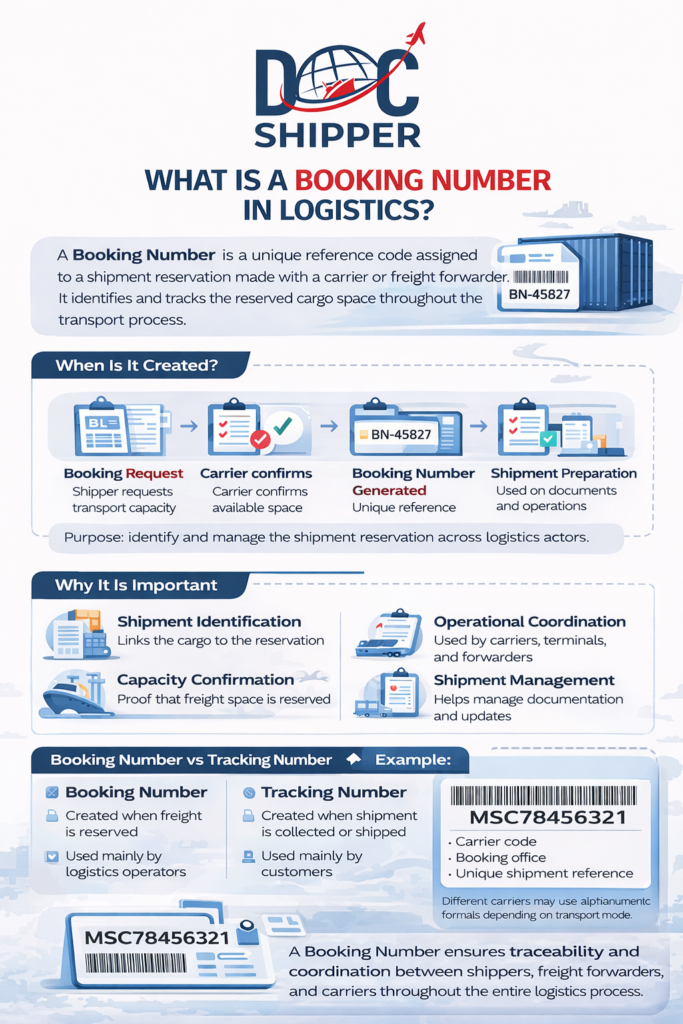
A Booking Number is a unique alphanumeric identifier assigned by a carrier or freight forwarder to a specific shipment reservation. It serves as the primary reference throughout the transportation process, enabling tracking, documentation management, and coordination between all parties involved in international logistics operations.
Introduction
In international trade, confusion often arises between various shipment identifiers—container numbers, bill of lading references, and booking numbers. Missing or incorrectly referenced booking numbers can delay customs clearance, cause documentation mismatches, and disrupt supply chain visibility.
The Booking Number acts as the foundational reference from the moment cargo space is reserved until final delivery. It connects commercial invoices, packing lists, and transport documents into a coherent tracking system.
Key characteristics of a booking number include:
- Unique identification: Each booking receives a distinct code, preventing confusion across multiple shipments.
- Carrier-specific format: Different shipping lines use proprietary numbering systems (e.g., Maersk, MSC, CMA CGM).
- Pre-shipment assignment: Generated when space is reserved, often before cargo is physically loaded.
- Multi-document linkage: Referenced in commercial invoices, packing lists, VGM declarations, and customs filings.
- Digital tracking capability: Enables real-time shipment monitoring through carrier portals and logistics platforms.
In-Depth Understanding & Expert Insights
The booking number originates during the cargo space reservation phase, typically initiated by the shipper or freight forwarder. Once the carrier confirms availability, the system generates this identifier, which becomes the central reference for all subsequent operations.
From a regulatory perspective, customs authorities worldwide require accurate booking references in Advance Manifest Systems (AMS) for ocean freight and Air Waybill (AWB) equivalents for air cargo. The U.S. Customs and Border Protection (CBP), for instance, mandates booking number inclusion in ISF (Importer Security Filing) submissions 24 hours before vessel loading, as outlined in CBP regulations.
The technical structure varies by carrier but generally follows a pattern combining letters and digits (e.g., MAEU123456789 for Maersk, CMDU987654321 for CMA CGM). This alphanumeric sequence encodes information about the booking office, service type, and sequential assignment.
Operational implications extend beyond simple identification. Warehouse operators use booking numbers to match incoming cargo with pre-advised shipments. Customs brokers reference them when filing entries. Port terminals rely on them for container release authorization. Any discrepancy between the booking number on physical cargo and documentation can trigger holds or inspections.
At DocShipper, we systematically verify booking number consistency across all shipping documents before cargo departure. This proactive validation prevents costly delays at destination ports and ensures seamless customs clearance for our clients’ international shipments.
The lifecycle management of a booking number involves several critical stages: initial reservation confirmation, amendment processing (if routing or dates change), container assignment linkage, and final closure upon delivery confirmation. Modern TMS (Transportation Management Systems) automate much of this workflow, but human oversight remains essential for complex multi-modal shipments.
Practical Examples & Industry Data
Understanding booking numbers through real-world scenarios clarifies their practical importance in daily logistics operations.
Comparative Analysis: Booking Number vs. Other Identifiers
| Identifier Type | Assignment Timing | Primary Use | Example Format |
|---|---|---|---|
| Booking Number | At reservation | Shipment coordination & documentation | MAEU123456789 |
| Container Number | Upon container assignment | Physical container tracking | MSCU1234567 |
| Bill of Lading (B/L) | After cargo loading | Legal ownership & receipt proof | MAEU987654321 |
| House B/L (HBL) | By freight forwarder | Forwarder-shipper contract | DSF2024001234 |
| Tracking Number | Varies by carrier | Real-time visibility | Variable formats |
Use Case: Electronics Import from Shenzhen to Rotterdam
A European retailer books 2×40′ HC containers of consumer electronics through a freight forwarder. The carrier (MSC) assigns booking number MSCU2024987654. This number appears on:
- The commercial invoice from the Chinese supplier
- The packing list detailing 1,200 cartons across both containers
- The VGM (Verified Gross Mass) declaration submitted 24 hours before loading
- The Shipper’s Letter of Instruction (SLI) to the forwarder
- The customs pre-clearance filing in the Netherlands
When one container encounters a customs inspection at Rotterdam, the inspector references the booking number to cross-check the pre-filed Entry Summary Declaration (ENS). Because all documents match precisely, the inspection concludes within 4 hours instead of the typical 2-day delay for documentation discrepancies.
DocShipper Platform
Optimize Your Global Logistics with Cutting-Edge Solutions
Enhance efficiency, cut costs, and gain 24/7 visibility 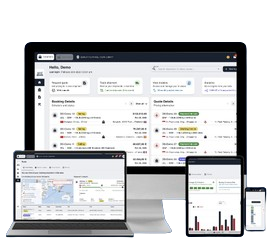 over your entire supply chain.
- Cut your shipping costs and maximize your margins
- Manage sourcing, freight, & customs on one platform
- Get real-time tracking and analytics
Industry Statistics & Operational Impact
According to a 2023 study by the Digital Container Shipping Association (DCSA), documentation errors account for 28% of all shipment delays, with incorrect or missing booking references representing 42% of those errors. The average cost of a single documentation-related delay ranges from $800 to $2,500 depending on cargo value and demurrage rates.
Key operational metrics related to booking number management:
- Booking confirmation time: 15 minutes to 48 hours depending on carrier and season
- Amendment processing: 30% of bookings require at least one modification before sailing
- Documentation matching accuracy: Industry benchmark is 98.5% first-time match rate
- Tracking system integration: 76% of Fortune 500 importers use automated booking number validation
- Customs filing requirements: 100% of ocean shipments to the U.S., EU, and China require booking reference
Conclusion
The booking number serves as the critical identifier that connects all parties and documents throughout the international shipping process. Proper management of this reference prevents delays, reduces costs, and ensures regulatory compliance across global supply chains.
Need expert assistance managing your international shipments and ensuring documentation accuracy? Contact DocShipper for comprehensive logistics support tailored to your business needs.
📚 Quiz
Test Your Knowledge: Booking Number
Q1 — What is a Booking Number in international logistics?
Q2 — A shipper receives their Booking Number from MSC. They assume it is the same as their Bill of Lading number since the digits look identical. Is this correct?
Q3 — A European importer books 2×40' HC containers from Shenzhen to Rotterdam. Which scenario best illustrates the correct use of the Booking Number?
🎯 Your Result
📞 Free Quote in 24hFAQ | Booking Number: Definition, Usage & Practical Examples in Logistics
A booking number is assigned when cargo space is reserved, before physical container allocation. The container number identifies the specific steel box used for transport and is assigned later when equipment is allocated to your shipment.
Yes, a single booking number can reference multiple containers within the same shipment, particularly for FCL (Full Container Load) bookings involving 2 or more containers traveling together on the same vessel.
Booking confirmation typically occurs within 15 minutes to 48 hours, depending on carrier capacity, seasonal demand, and route popularity. Urgent bookings may receive priority processing for an additional fee.
No. The booking number is assigned at reservation, while the bill of lading (B/L) number is issued after cargo loading. Some carriers use the same numeric sequence, but they serve different legal and operational purposes.
Incorrect booking references can trigger customs holds, inspection delays, and additional verification requirements. Corrections require amended filings and may incur penalty fees ranging from $50 to $500 depending on jurisdiction.
Most major carriers offer tracking through booking numbers via their online portals. However, tracking becomes more detailed once the container number and bill of lading are assigned after cargo loading.
Air freight uses Air Waybill (AWB) numbers instead of traditional booking numbers. However, freight forwarders may assign internal booking references for operational tracking before the AWB is issued by the airline.
Contact your freight forwarder or carrier immediately with the booking number and required changes. Amendments are typically possible until cargo cut-off (24-48 hours before vessel departure), though fees may apply.
Yes, LCL (Less than Container Load) shipments receive booking numbers just like FCL. The booking number references your cargo share within a consolidated container managed by the freight forwarder.
While formats vary by carrier, booking numbers typically encode the issuing office location, service type (FCL/LCL), year of booking, and a sequential identifier. The exact structure is proprietary to each shipping line.
No. Booking numbers are unique identifiers within each carrier's system. However, different carriers may coincidentally use similar number sequences, which is why the carrier name must always accompany the booking reference.
Booking validity typically ranges from 7 to 30 days depending on the carrier and route. If cargo is not shipped within this period, the booking expires and a new reservation with a different number is required.
Need Help with
Logistics or Sourcing ?
First, we secure the right products from the right suppliers at the right price by managing the sourcing process from start to finish. Then, we simplify your shipping experience - from pickup to final delivery - ensuring any product, anywhere, is delivered at highly competitive prices.


Fill the Form
Prefer email? Send us your inquiry, and we’ll get back to you as soon as possible.
Contact us




