In short ⚡
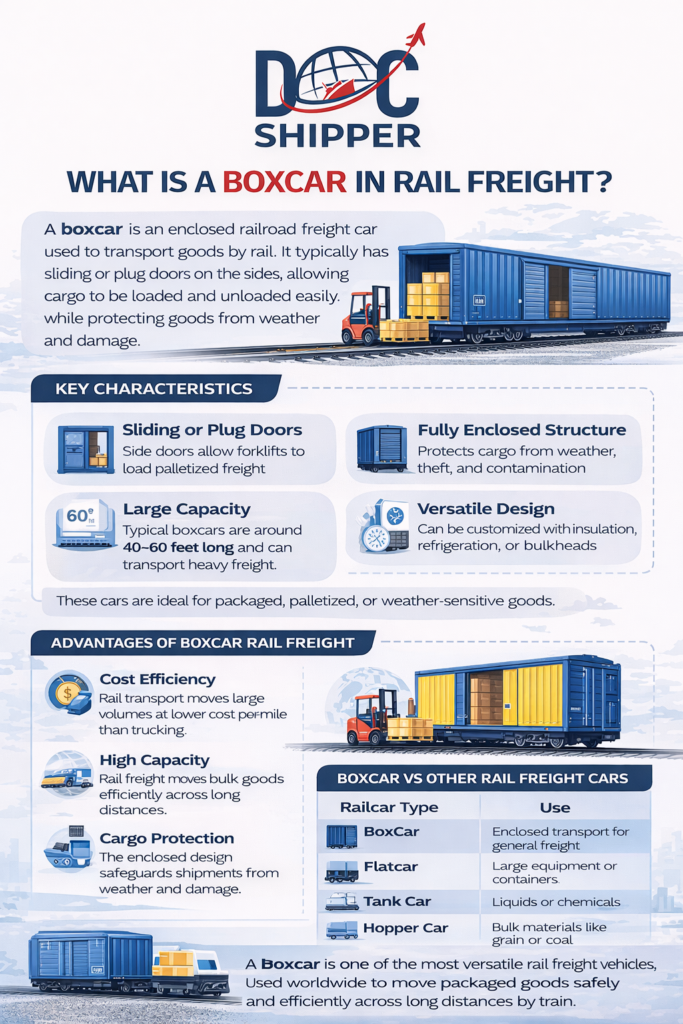
Boxcar is a fully enclosed railroad freight car with sliding doors on the sides, designed to protect cargo from weather and theft during rail transport. It remains one of the most versatile rail freight solutions for general merchandise, palletized goods, and temperature-sensitive products across continental logistics networks.Introduction
Many importers struggle to choose the right rail freight equipment for their cargo. Selecting an inappropriate railcar type can lead to damaged goods, regulatory violations, or unexpected demurrage charges.
The boxcar addresses this challenge by offering a secure, weather-protected environment for diverse cargo types. In international supply chains, boxcars serve as the backbone of overland rail transport, connecting ports to inland distribution centers across North America, Europe, and Asia.
- Complete weather protection through fully enclosed steel construction
- Standard dimensions compatible with intermodal handling equipment
- Sliding side doors enabling efficient loading/unloading operations
- Load capacity typically ranging from 50 to 110 tons depending on specifications
- Versatile application from general merchandise to specialized refrigerated variants
Technical Specifications & Operational Framework
Boxcars operate within strict regulatory frameworks established by organizations like the Association of American Railroads (AAR). These standards ensure interoperability across different rail networks and guarantee structural integrity during transit.
The typical boxcar measures 50 to 60 feet in length, with internal heights of 10 to 11 feet. Interior width standardizes at approximately 9 feet, optimizing compatibility with standard pallet dimensions. Modern boxcars feature cushioned underframes that absorb shock during coupling operations, protecting fragile cargo.
Load distribution remains critical for safe operation. Cargo must be secured to prevent shifting during acceleration, braking, and curve negotiation. Most boxcars incorporate tie-down points and load bars to facilitate proper cargo restraint.
Specialized variants include insulated boxcars for temperature-sensitive goods, equipped boxcars with permanent racks for automotive parts, and high-cube models offering increased cubic capacity. Refrigerated boxcars (reefers) maintain controlled temperatures through mechanical refrigeration units.
Operational considerations involve demurrage policies, loading time allowances, and routing restrictions. At DocShipper, we coordinate boxcar bookings to minimize detention charges and ensure compliance with carrier-specific requirements throughout the rail journey.
Practical Applications & Industry Data
Boxcars handle approximately 15-20% of total rail freight volume in North America, transporting everything from packaged consumer goods to industrial equipment. Their enclosed design makes them ideal for high-value cargo requiring theft protection.
| Cargo Type | Boxcar Variant | Typical Load Capacity | Transit Time (Coast-to-Coast) |
|---|---|---|---|
| Packaged Consumer Goods | Standard Boxcar | 50,000 lbs | 5-7 days |
| Refrigerated Food Products | Refrigerated Boxcar | 40,000 lbs | 4-6 days |
| Automotive Parts | Equipped Boxcar | 60,000 lbs | 5-8 days |
| Paper Products | High-Cube Boxcar | 55,000 lbs | 6-9 days |
Cost efficiency becomes evident in long-distance domestic transport. Rail freight costs approximately $0.03-0.05 per ton-mile, compared to $0.15-0.20 for trucking. For shipments exceeding 500 miles, boxcar transport delivers significant savings.
Environmental benefits position rail as a sustainable alternative. Boxcar transport produces 75% fewer greenhouse gas emissions per ton-mile than truck transport, according to EPA data. Companies pursuing carbon reduction targets increasingly favor rail solutions.
Operational scenario: An electronics manufacturer ships 45,000 lbs of packaged components from Los Angeles to Chicago. Using a standard boxcar costs approximately $3,200 with a 6-day transit time. The enclosed design protects against dust and moisture, eliminating the need for additional packaging costs estimated at $800 for open-top alternatives.
Capacity optimization requires strategic planning. Boxcars operate most economically at 85-95% capacity utilization. At DocShipper, we consolidate shipments when possible to maximize load efficiency and reduce per-unit transportation costs for our clients.
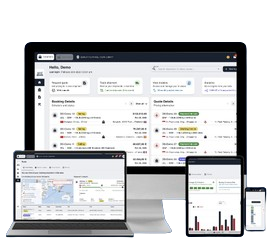
DocShipper Platform
One platform. Your entire supply chain
Sourcing, freight, customs & documents — all centralised, all visible, 24/7.
Conclusion
Boxcars remain indispensable in modern rail logistics, offering secure, cost-effective transport for diverse cargo types across continental distances. Understanding their specifications and operational requirements ensures optimal supply chain performance.
Need assistance coordinating boxcar shipments or optimizing your rail freight strategy? Contact DocShipper for expert guidance tailored to your logistics needs.
📚 Quizz
Test Your Knowledge: Boxcar
Q1 — What is the defining structural characteristic of a boxcar that sets it apart from other railcar types?
Q2 — A shipper assumes that any boxcar can transport temperature-sensitive pharmaceuticals requiring strict cold-chain control. Is this correct?
Q3 — An electronics manufacturer needs to ship 45,000 lbs of packaged components from Los Angeles to Chicago over 6 days at the lowest cost while protecting goods from dust and moisture. Which solution is most appropriate?
🎯 Your Result
📞 Free Quote in 24hFAQ | Boxcar: Definition, Types & Practical Uses in Rail Freight
Boxcars feature fully enclosed construction with sliding side doors, unlike flatcars or gondolas. This design protects cargo from weather, theft, and contamination during transit.
Standard boxcars typically accommodate 50,000 to 70,000 pounds of cargo. High-capacity models can handle up to 110,000 pounds depending on axle configuration and structural specifications.
Most boxcars measure 50-60 feet long, 9-10 feet wide, and 10-11 feet high internally. These dimensions accommodate approximately 24-30 standard pallets depending on configuration.
Yes, refrigerated boxcars (reefers) maintain controlled temperatures from -20°F to 70°F. Insulated boxcars without active refrigeration protect against moderate temperature fluctuations.
Standard loading operations require 2-4 hours depending on cargo type and handling equipment. Railroads typically allow 24-48 hours free time before demurrage charges apply.
Hazardous materials requiring specialized containment, oversized machinery exceeding dimensional limits, and bulk liquids without proper containerization cannot be transported in standard boxcars.
Boxcars typically cost 10-15% less than COFC for equivalent distances. However, containers offer easier intermodal transfer and better compatibility with ocean shipping.
Shippers must provide a bill of lading, cargo manifest, and hazmat declarations if applicable. Customs documentation is required for cross-border movements between the US, Canada, and Mexico.
Modern boxcars equipped with GPS transponders enable real-time tracking through railroad portals. Traditional tracking relies on waybill scanning at rail yards along the route.
Railroads maintain limited liability under the Carmack Amendment, typically $0.50 per pound unless higher declared value is specified. Shippers should secure cargo insurance for high-value goods.
Reserve boxcar capacity 5-10 days before planned shipping date during normal periods. Peak seasons may require 2-3 weeks advance booking to ensure equipment availability.
Yes, cargo must be distributed to maintain proper center of gravity. Heavy items should be placed low and centered, with weight balanced side-to-side to prevent derailment risk.
Need Help with
Logistics or Sourcing ?
First, we secure the right products from the right suppliers at the right price by managing the sourcing process from start to finish. Then, we simplify your shipping experience - from pickup to final delivery - ensuring any product, anywhere, is delivered at highly competitive prices.


Fill the Form
Prefer email? Send us your inquiry, and we’ll get back to you as soon as possible.
Contact us