


In short ⚡
Branding is the strategic process of creating a distinctive identity for a company, product, or service through visual elements, messaging, and customer experience. It encompasses logo design, color schemes, brand voice, values, and the overall perception stakeholders develop. Effective branding differentiates businesses in competitive markets and builds long-term customer loyalty.Introduction
Many businesses confuse branding with mere logo design or visual aesthetics. This misunderstanding leads to inconsistent market presence and missed opportunities for customer connection. In international trade and logistics, branding extends beyond marketing—it directly impacts trust, perceived reliability, and partnership decisions.
For companies like DocShipper operating across borders, branding establishes credibility in diverse markets. A strong brand communicates professionalism, expertise, and consistent service quality regardless of geographic location.
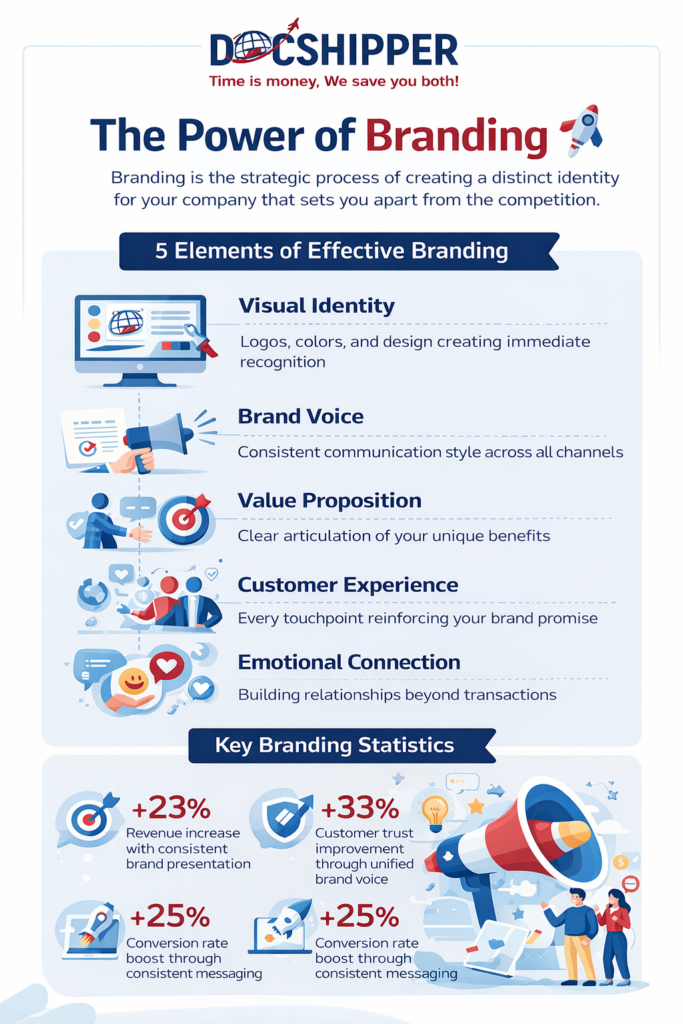
- Visual identity: Logos, colors, typography creating immediate recognition
- Brand voice: Consistent communication style across all channels
- Value proposition: Clear articulation of unique benefits
- Customer experience: Every touchpoint reinforcing brand promise
- Emotional connection: Building relationships beyond transactional interactions
Branding Strategy & Expertise
Successful branding requires strategic alignment between internal culture and external perception. The process begins with brand positioning—defining the specific space your company occupies in customers’ minds relative to competitors.
Brand architecture determines how multiple products or services relate under a corporate umbrella. Companies choose between monolithic branding (single brand for everything), endorsed branding (sub-brands with parent endorsement), or pluralistic branding (independent brands).
The brand equity concept measures financial value derived from consumer perception. According to Interbrand’s methodology, brand equity comprises three dimensions: financial performance, role of brand in purchase decisions, and brand strength in competitive markets.
Touchpoint consistency ensures every customer interaction reinforces core brand attributes. This includes website design, packaging, customer service scripts, social media presence, and physical spaces. Inconsistency erodes trust and dilutes brand recognition.
At DocShipper, we apply branding principles to logistics services by maintaining consistent communication standards across 10+ countries. Our visual identity and service protocols remain uniform whether clients engage us in Paris, Shanghai, or Los Angeles, reinforcing reliability in complex international operations.
Brand storytelling transforms abstract values into memorable narratives. Effective stories humanize businesses, making technical services like freight forwarding relatable. They answer why a company exists beyond profit, creating emotional resonance that pure feature lists cannot achieve.
Concrete Examples & Data
Research demonstrates tangible branding impacts. A 2023 study by Lucidpress found that consistent brand presentation increases revenue by an average of 23%. Companies with strong branding also command premium pricing—consumers pay 13% more for products from brands they trust.
| Branding Element | Impact Metric | Industry Benchmark |
|---|---|---|
| Color consistency | Brand recognition increase | +80% |
| Unified brand voice | Customer trust improvement | +33% |
| Professional logo design | Perceived credibility | +43% |
| Consistent messaging | Conversion rate boost | +25% |
Use Case: Logistics Sector Branding
A mid-sized freight forwarder rebranded in 2022, investing €50,000 in visual identity, website redesign, and messaging framework. Within 18 months, they documented:
- 37% increase in inbound inquiry volume from website traffic
- 22% improvement in quote-to-contract conversion rates
- 15% premium pricing accepted by clients compared to pre-rebrand rates
- 41% reduction in customer acquisition costs through referrals
- Net ROI of 340% within the measurement period
Another data point: B2B buyers engage with 11.4 pieces of content before purchasing decisions. Brands maintaining consistent visual and messaging frameworks across these touchpoints achieve 3.5x higher engagement rates than those with fragmented approaches.
In international logistics specifically, branding influences partner selection. A 2024 survey of procurement managers revealed that 68% prioritize working with logistics providers demonstrating professional branding, associating it with operational reliability and financial stability.
Conclusion
Branding transcends visual design to become a strategic business asset that drives recognition, trust, and financial performance. In logistics and international trade, consistent branding signals professionalism and reliability across complex, multi-touchpoint customer journeys.
Need guidance developing a branding strategy for your logistics operations? Contact DocShipper to discuss how strategic brand positioning can enhance your market presence.
📚 Quiz
Test Your Knowledge: Branding
Q1 — What does branding primarily refer to?
Q2 — A logistics company keeps its logo, colors, and communication style identical across all countries it operates in. Which branding principle does this illustrate?
Q3 — A freight forwarder invests in a full rebrand and, within 18 months, sees a 22% improvement in quote-to-contract conversions and a 340% net ROI. What does this scenario best demonstrate?
🎯 Your Result
📞 Free Quote in 24hFAQ | Branding: Definition, Strategy & Concrete Examples
Branding defines who you are—your identity, values, and promise. Marketing communicates that identity to target audiences through campaigns and promotions. Branding is strategic and long-term; marketing is tactical and campaign-based.
Establishing initial brand recognition typically requires 6-12 months of consistent implementation. Building deep brand equity and market authority usually takes 3-5 years of sustained effort across all customer touchpoints.
Absolutely. Professional branding helps small businesses compete with larger competitors by establishing credibility and differentiation. Even modest branding investments yield measurable improvements in customer perception and conversion rates.
Core elements include logo, color palette, typography, imagery style, brand voice, tagline, and value proposition. These components work together to create consistent recognition across all customer interactions and marketing materials.
Key metrics include brand awareness surveys, net promoter score (NPS), website traffic quality, social media engagement rates, conversion improvements, customer lifetime value increases, and premium pricing acceptance compared to competitors.
Core brand identity should remain consistent, but cultural adaptation may be necessary. Colors, imagery, and messaging may require localization while maintaining recognizable brand architecture. Test cultural appropriateness before full market entry.
Brand architecture defines relationships between parent brands and sub-brands or products. It matters because clear architecture prevents market confusion, enables efficient marketing resource allocation, and protects parent brand equity during product failures.
Complete rebrands typically occur every 7-10 years or during major strategic shifts. Minor refreshes happen every 2-3 years to maintain contemporary relevance. Rebrand only when brand no longer reflects reality or significantly limits growth.
Employees are critical brand ambassadors. Their understanding and embodiment of brand values directly impacts customer experience. Companies with strong internal branding programs see 20-30% higher customer satisfaction scores than those without.
Yes. Strong brands maintain customer loyalty during difficult periods, experiencing 15-20% less revenue decline than weak brands. Trusted brands recover faster post-recession as consumers return to familiar, reliable options first.
Inconsistency across touchpoints is the most common error. When visual identity, messaging, and customer experience vary between channels, recognition erodes and trust diminishes. Consistency requires documented brand guidelines and internal training.
Digital channels multiply brand touchpoints exponentially, requiring more rigorous consistency management. Successful digital branding integrates social media, website experience, email communications, and digital advertising into a cohesive ecosystem reflecting core brand attributes.
Need Help with Logistics or Sourcing ?
First, we secure the right products from the right suppliers at the right price by managing the sourcing process from start to finish. Then, we simplify your shipping experience - from pickup to final delivery - ensuring any product, anywhere, is delivered at highly competitive prices.


Fill the Form
Prefer email? Send us your inquiry, and we’ll get back to you as soon as possible.
Contact us


