


In short ⚡
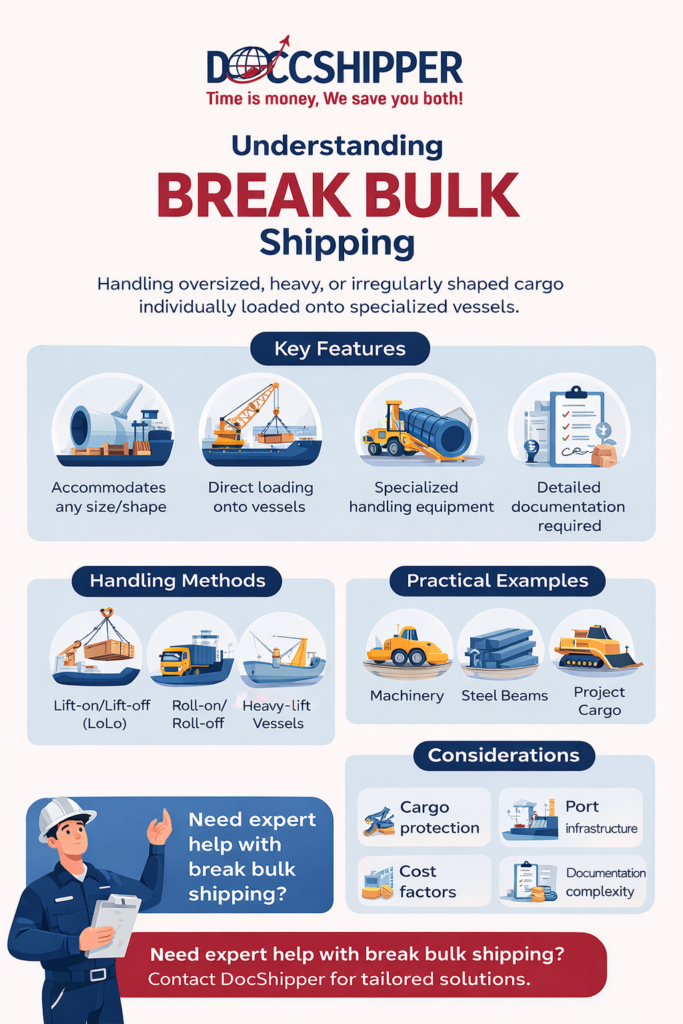
Break bulk refers to cargo that must be loaded individually onto a vessel rather than in containers. This shipping method handles oversized, heavy, or irregularly shaped goods such as machinery, steel beams, or project cargo that cannot fit standard container dimensions.
Introduction
Many shippers struggle to transport oversized industrial equipment or non-standard cargo that exceeds container limits. Break bulk shipping solves this challenge by allowing individual piece handling on specialized vessels.
This method remains essential for construction projects, mining operations, and infrastructure development worldwide. Understanding break bulk logistics prevents costly delays and ensures proper cargo protection.
- Flexibility: Accommodates virtually any cargo size or shape
- Direct loading: Eliminates container packing constraints
- Specialized handling: Uses cranes, forklifts, and custom rigging
- Port infrastructure: Requires adequate terminal facilities and equipment
- Documentation complexity: Demands detailed cargo specifications and handling instructions
Technical Aspects & Handling Methods
Break bulk operations require meticulous planning from origin to destination. Cargo must be secured individually using lashings, dunnage, and specialized equipment to prevent shifting during transit.
The stowage factor calculation determines how much space cargo occupies relative to its weight. This metric directly impacts freight costs and vessel capacity utilization. Unlike containerized shipments, break bulk pricing considers both volume and weight independently.
Loading methods vary by cargo type: lift-on/lift-off (LoLo) uses ship cranes, while roll-on/roll-off (RoRo) accommodates wheeled equipment. Heavy-lift vessels deploy specialized gear for items exceeding 100 tons.
Customs documentation requires precise cargo descriptions including dimensions, weight distribution, and center of gravity. The International Maritime Organization (IMO) mandates specific labeling for hazardous break bulk materials. Reference: IMO Cargo Safety Standards.
At DocShipper, we coordinate with stevedores and terminal operators to ensure proper handling equipment availability, reducing demurrage risks and protecting your cargo throughout the shipping process.
Practical Examples & Cost Comparisons
Consider a construction company shipping three industrial generators from Hamburg to Lagos. Each unit measures 6m × 3m × 3.5m and weighs 22 tons—far exceeding standard 40-foot container capacity.
| Shipping Method | Transit Time | Approximate Cost (per unit) | Handling Complexity |
|---|---|---|---|
| Break Bulk (LoLo) | 18-22 days | $8,500 – $11,000 | High – requires crane operations |
| RoRo (if wheeled) | 16-20 days | $6,200 – $8,500 | Medium – self-rolling capability |
| Charter Vessel | 12-15 days | $45,000+ (total shipment) | Low – dedicated service |
Use Case: A mining company transporting excavator components from Antwerp to Durban. Total cargo: 8 pieces ranging from 5 to 28 tons. Break bulk shipping allowed simultaneous loading of all components, avoiding the need for disassembly that containerization would require. Total transit: 21 days with direct port-to-port service.
Key cost factors:
- Port handling charges: Vary by terminal (typically $150-$400 per ton)
- Lashing and securing: Additional $500-$2,000 per piece depending on complexity
- Insurance premiums: Higher than containerized cargo (1.2%-2.5% of cargo value)
- Demurrage risks: Delays cost $200-$800 per day at most terminals
- Documentation fees: Bill of lading, cargo surveys, customs declarations ($300-$800 total)
Conclusion
Break bulk shipping remains the optimal solution for oversized, heavy, or project cargo that containerization cannot accommodate. Proper planning and experienced logistics partners ensure safe, cost-effective transport.
Need expert guidance on your break bulk shipment? Contact DocShipper for customized logistics solutions tailored to your cargo specifications.
DocShipper Platform
Cut logistics costs. Not corners.
See exactly where your logistics costs are bleeding — and how to fix it. Book your expert demo.

📚 Quiz
Test Your Knowledge: Break Bulk
Q1 — What best defines "break bulk" shipping?
Q2 — A common misconception about break bulk shipping is that it always costs less than containerized freight. What is the reality?
Q3 — A mining company needs to ship eight excavator components ranging from 5 to 28 tons from Antwerp to Durban. Some pieces cannot be disassembled. Which shipping method is most appropriate?
🎯 Your Result
📞 Free Quote in 24hFAQ | Break Bulk: Definition, Handling Methods & Practical Examples
Oversized machinery, construction equipment, steel structures, wind turbine components, locomotives, yachts, and industrial boilers commonly ship as break bulk due to size or weight constraints.
Break bulk loads cargo individually onto vessels without containers, while containerized shipping uses standardized boxes. Break bulk offers flexibility for non-standard dimensions but requires specialized handling equipment.
Primary risks include cargo shifting during transit, weather exposure, handling damage from cranes or forklifts, port congestion delays, and higher theft vulnerability compared to sealed containers.
Cargo is secured using steel lashings, chains, turnbuckles, wooden dunnage, and anti-slip mats. Lashing plans are created based on cargo weight distribution and vessel stability requirements.
Major break bulk hubs include Antwerp, Rotterdam, Hamburg, Houston, Singapore, and Durban. These ports maintain heavy-lift cranes, open storage yards, and experienced stevedore teams.
Essential documents include detailed packing lists, cargo dimensions/weight certificates, bill of lading, commercial invoice, certificate of origin, and handling instructions with center of gravity specifications.
Costs depend on cargo volume (cubic meters), weight (tons), stowage factor, loading/unloading complexity, port charges, and distance. Freight is often quoted per revenue ton (whichever is greater: weight or volume).
Yes, break bulk insurance typically costs more due to higher exposure risks. Policies cover marine perils, handling damage, and theft with premiums ranging from 1.2% to 2.5% of cargo value.
LoLo (Lift-on/Lift-off) uses cranes to load cargo vertically, suitable for static equipment. RoRo (Roll-on/Roll-off) allows wheeled cargo to drive onto vessels via ramps, reducing handling time.
Transit times vary by route but generally range from 15 to 35 days for major trade lanes. Loading/unloading adds 3-7 days depending on cargo complexity and port efficiency.
Demurrage applies when cargo remains at the port terminal beyond free time (typically 5-10 days). Detention charges occur if shipping company equipment is held beyond agreed periods. Both cost $200-$800 daily.
Per cubic meter, break bulk often costs 30-60% more than containerized freight due to specialized handling, lower vessel utilization, and additional securing requirements. However, it remains cost-effective for cargo that cannot be containerized.
Need Help with Logistics or Sourcing ?
First, we secure the right products from the right suppliers at the right price by managing the sourcing process from start to finish. Then, we simplify your shipping experience - from pickup to final delivery - ensuring any product, anywhere, is delivered at highly competitive prices.


Fill the Form
Prefer email? Send us your inquiry, and we’ll get back to you as soon as possible.
Contact us


