In short ⚡
The Break-Even Point is the sales volume at which total revenues equal total costs, resulting in neither profit nor loss. In international logistics, this metric determines the minimum shipment volume or pricing threshold needed to cover fixed and variable expenses, enabling businesses to make informed decisions about market entry, pricing strategies, and operational scalability.
Introduction
Many importers and exporters struggle to determine whether their international trade operations are financially viable. Without understanding their break-even point, companies risk operating at a loss while believing they’re profitable.
In global logistics, the break-even point serves as a critical decision-making tool. It helps businesses evaluate shipping methods, negotiate freight rates, and assess market opportunities with precision.
Key characteristics of break-even analysis in logistics include:
- Cost structure visibility: Separates fixed costs (warehousing, licenses) from variable costs (freight, customs duties)
- Pricing strategy foundation: Establishes minimum viable pricing for products in target markets
- Volume planning: Determines optimal shipment sizes to maximize profitability
- Risk assessment: Identifies financial thresholds before entering new markets
- Operational efficiency: Highlights areas where cost reduction directly impacts profitability
In-Depth Analysis & Expertise
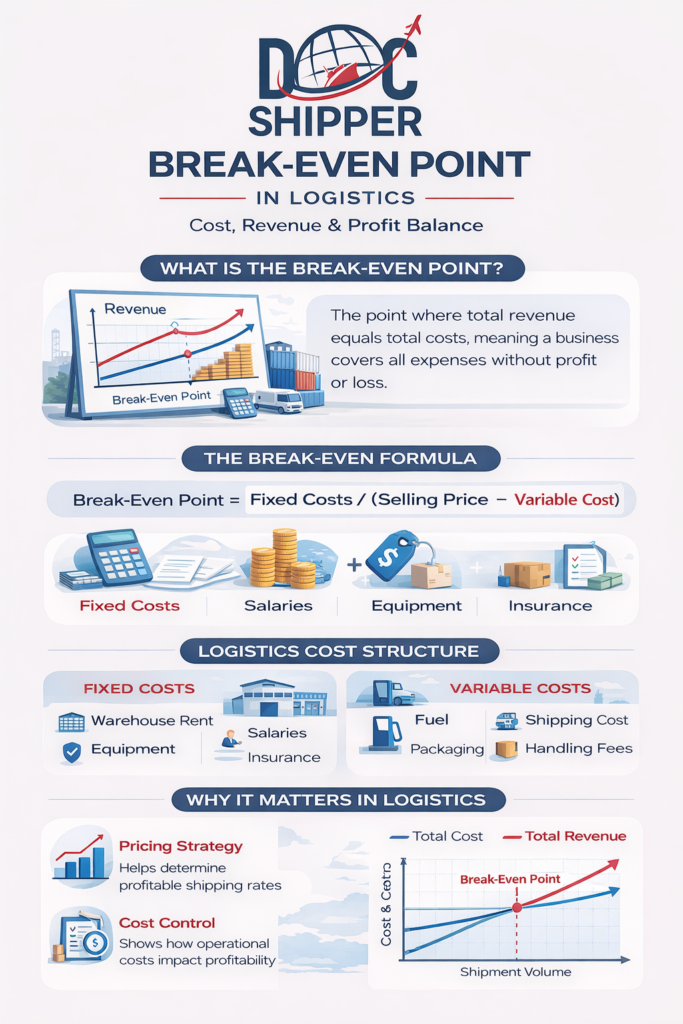
The break-even point calculation follows a straightforward formula: Fixed Costs ÷ (Price per Unit – Variable Cost per Unit). This reveals the exact number of units that must be sold to cover all expenses.
In international logistics, fixed costs include warehouse leases, insurance premiums, compliance certifications, and permanent staff salaries. These remain constant regardless of shipment volume. Variable costs fluctuate with activity: freight charges, customs duties, packaging materials, and handling fees increase proportionally with each shipment.
The contribution margin represents the difference between selling price and variable cost per unit. This metric shows how much each sale contributes toward covering fixed costs. Once fixed costs are covered, every additional unit sold generates pure profit.
For import/export operations, currency fluctuations significantly impact break-even calculations. A 5% currency depreciation can shift the break-even point by hundreds of units, especially for high-volume, low-margin products. Companies must incorporate exchange rate buffers into their analysis.
Regulatory compliance adds complexity to break-even analysis. According to the World Trade Organization, trade facilitation measures can reduce total trade costs by up to 14.3%, directly lowering the break-even threshold for international shipments.
At DocShipper, we systematically calculate break-even points for clients considering new shipping routes or consolidation strategies, ensuring every decision is financially justified before execution.
Concrete Examples & Data
Consider a European electronics importer evaluating two shipping methods from China. The break-even analysis reveals critical differences:
| Cost Component | Air Freight | Sea Freight |
|---|---|---|
| Fixed Costs (Monthly) | €8,000 | €8,000 |
| Variable Cost per Unit | €12 | €6 |
| Selling Price per Unit | €50 | €50 |
| Contribution Margin | €38 | €44 |
| Break-Even Point (Units) | 211 units | 182 units |
Use Case: A textile manufacturer exports garments from Bangladesh to the United States. Fixed costs include warehouse rental (€3,500/month), compliance certifications (€1,200/month), and administrative staff (€4,300/month), totaling €9,000. Variable costs per shipment average €18 (freight, customs, packaging). The selling price is €65 per unit.
Calculation: €9,000 ÷ (€65 – €18) = 191 units. The manufacturer must sell 191 garments monthly to break even. At 192 units, the company begins generating profit. This threshold informs minimum order quantities and pricing negotiations with distributors.
Key insights for logistics optimization:
- Consolidating shipments reduces per-unit variable costs, lowering the break-even point by 15-25%
- Negotiating annual freight contracts can convert variable costs into semi-fixed costs, improving predictability
- Multi-modal transport strategies balance speed and cost, optimizing contribution margins
- Duty drawback programs and free trade agreements directly reduce variable costs, accelerating profitability
- Seasonal demand fluctuations require dynamic break-even analysis adjusted quarterly
Real-world data shows that companies conducting quarterly break-even reviews reduce operational losses by 32% compared to those relying on annual assessments alone. This agility proves essential in volatile freight markets.
DocShipper Platform
Cut logistics costs. Not corners.
See exactly where your logistics costs are bleeding — and how to fix it. Book your expert demo.

Conclusion
The break-even point serves as the financial compass for international logistics operations, transforming abstract costs into actionable thresholds. Mastering this metric enables businesses to price competitively, optimize shipping methods, and enter new markets with confidence.
Need expert guidance on calculating your break-even point for specific trade routes or consolidation strategies? Contact DocShipper for a customized logistics analysis.
📚 Quiz
Test Your Knowledge: Break-Even Point
Q1 — What does the Break-Even Point represent in international logistics?
Q2 — In a break-even calculation, how are customs duties classified?
Q3 — A textile exporter has €9,000 in monthly fixed costs, a selling price of €65/unit, and variable costs of €18/unit. What is the break-even point?
🎯 Your Result
📞 Free Quote in 24hFAQ | Break-Even Point: Definition, Calculation & Concrete Examples
The break-even point identifies the sales volume where costs equal revenue (zero profit). Profit margin measures the percentage of revenue remaining after all costs are deducted. Break-even analysis determines when profitability begins; margin analysis measures its extent.
Quarterly recalculations are recommended for stable markets. In volatile freight environments or when currency fluctuations exceed 5%, monthly reviews become essential. Major operational changes (new warehouses, carrier contracts) require immediate recalculation.
Absolutely. Freight forwarders and customs brokers calculate break-even points based on billable hours, service packages, or client contracts. Fixed costs include office space and software licenses; variable costs include subcontractor fees and documentation expenses.
The business operates at a loss, consuming capital reserves. Sustained below-break-even performance requires immediate action: cost reduction, price increases, or market exit. Short-term losses may be strategic during market entry phases.
Customs duties are variable costs that increase per-unit expenses. Higher duties raise the break-even point by reducing contribution margins. Utilizing free trade agreements or duty suspension schemes lowers variable costs, accelerating profitability.
No. Each market has unique cost structures (local regulations, distribution networks, tax regimes). A product profitable in one country may require higher volumes elsewhere to break even due to differing logistics costs.
Yes. Consolidating shipments reduces per-unit freight costs (variable expenses), lowering the break-even threshold. However, consolidation may increase fixed warehousing costs, requiring careful analysis to ensure net benefit.
Seasonal peaks allow spreading fixed costs across higher volumes, temporarily lowering per-unit break-even points. Off-peak periods require adjusting strategies—reducing fixed costs or accepting short-term losses to maintain market presence.
Packaging is a variable cost that directly affects contribution margins. Premium packaging increases per-unit costs, raising the break-even point. Optimizing packaging dimensions reduces freight costs, lowering the threshold.
Cargo insurance is typically variable, calculated as a percentage of shipment value. Warehouse insurance is fixed. Accurate categorization ensures precise break-even calculations and informed risk management decisions.
It establishes the minimum viable price (covering all costs). Prices above this threshold generate profit; below it causes losses. Break-even analysis reveals how much pricing flexibility exists before profitability disappears.
Yes. Operating near break-even means minimal profit cushion for unexpected expenses. If payment terms extend beyond cost settlement periods, cash flow gaps emerge even at break-even sales volumes, requiring working capital reserves.
Need Help with
Logistics or Sourcing ?
First, we secure the right products from the right suppliers at the right price by managing the sourcing process from start to finish. Then, we simplify your shipping experience - from pickup to final delivery - ensuring any product, anywhere, is delivered at highly competitive prices.


Fill the Form
Prefer email? Send us your inquiry, and we’ll get back to you as soon as possible.
Contact us