In short ⚡
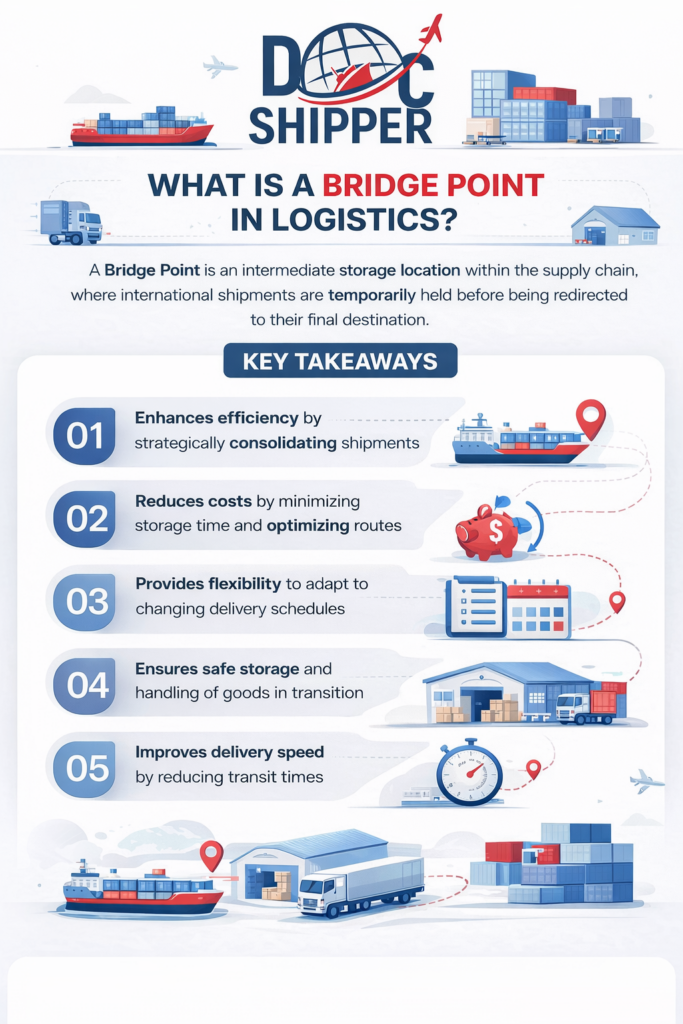
Bridge Point is a strategic intermediate location in the supply chain where cargo is temporarily consolidated, sorted, or transferred between transportation modes before reaching its final destination. It optimizes routing, reduces costs, and improves delivery efficiency in international trade operations.
Introduction
Many importers struggle with inefficient routing, unexpected delays, and inflated shipping costs due to poorly optimized logistics networks. The concept of a bridge point addresses these challenges by creating strategic hubs that streamline cargo movement across continents.
In global trade, bridge points serve as critical nodes where shipments converge before being redistributed. They enable companies to leverage economies of scale, reduce transit times, and maintain flexibility in complex supply chains.
- Cost optimization through cargo consolidation and deconsolidation
- Modal flexibility enabling seamless transitions between ocean, air, rail, and road transport
- Customs efficiency by centralizing clearance procedures in strategic locations
- Inventory management providing temporary storage near key markets
- Risk mitigation by diversifying routing options and reducing dependency on single corridors
Technical Mechanisms & Strategic Importance
A bridge point operates as a transshipment hub where cargo undergoes sorting, repackaging, or mode conversion. Unlike traditional warehouses, these facilities prioritize throughput velocity over long-term storage.
The geographical positioning of bridge points is critical. They typically locate near major ports, airports, or rail terminals with robust connectivity to multiple markets. Singapore, Dubai, and Rotterdam exemplify world-class bridge points serving entire regions.
From a regulatory perspective, bridge points often operate within free trade zones or bonded warehouses. This allows cargo to remain in customs suspension, deferring duties and taxes until goods enter their destination market. According to WTO guidelines, such arrangements facilitate international trade while maintaining border security.
Technology integration distinguishes modern bridge points. Advanced warehouse management systems (WMS), real-time tracking, and automated sorting equipment ensure rapid processing. Predictive analytics optimize inventory positioning based on demand forecasts.
The consolidation strategy employed at bridge points generates significant cost savings. By aggregating smaller shipments into full container loads (FCL) or full truckloads, companies reduce per-unit transportation costs by 30-50% compared to less-than-container-load (LCL) shipping.
At DocShipper, we systematically evaluate bridge point options for clients importing from Asia to Europe or North America. Our network includes partnerships with facilities in Singapore, Hong Kong, and Dubai, enabling optimized routing based on cargo characteristics and destination requirements.
Concrete Examples & Operational Data
Consider a European retailer importing electronics from multiple Asian suppliers. Without a bridge point, each supplier ships directly, resulting in fragmented deliveries and high costs. By routing through a Singapore bridge point, shipments consolidate into unified containers, reducing ocean freight costs by 40% and simplifying customs clearance.
| Routing Strategy | Transit Time | Cost per TEU | Flexibility |
|---|---|---|---|
| Direct Shipping | 28-32 days | $2,800 | Low |
| Via Bridge Point | 30-35 days | $1,680 | High |
| Air Freight | 5-7 days | $8,500 | Medium |
Use Case: Automotive Parts Distribution
A North American automotive manufacturer sources components from Japan, South Korea, and Thailand. By establishing a Dubai bridge point, the company achieves:
- 35% reduction in total logistics costs through consolidated shipping
- 22% faster response to demand fluctuations via pre-positioned inventory
- Simplified compliance with single-point customs processing for multiple origins
- Enhanced resilience with alternative routing options during port congestion
- Improved cash flow by deferring duties until final market entry
Industry data shows that companies utilizing bridge points report 18-25% lower landed costs compared to direct shipping models. The initial 2-4 day transit time addition is offset by reduced inventory carrying costs and improved order fulfillment accuracy.
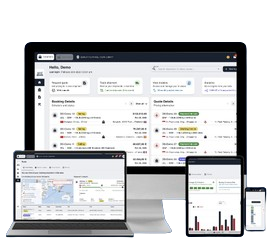
DocShipper Platform
One platform. Your entire supply chain
Sourcing, freight, customs & documents — all centralised, all visible, 24/7.
Conclusion
Bridge points represent a strategic lever for companies seeking to optimize international logistics networks. By balancing cost, speed, and flexibility, these hubs enable competitive advantages in increasingly complex global markets.
Need expert guidance on implementing bridge point strategies for your supply chain? Contact DocShipper for a customized logistics assessment.
📚 Quiz
Test Your Knowledge: Bridge Point
Q1 — What best defines a Bridge Point in logistics?
Q2 — A common misconception about Bridge Points is that they always slow down delivery. What does the data actually show?
Q3 — A European retailer sources electronics from five different Asian suppliers. Which approach best leverages a Bridge Point strategy?
🎯 Your Result
📞 Free Quote in 24hFAQ | Bridge Point: Definition, Role & Practical Examples in Logistics
Bridge points prioritize rapid throughput and transshipment operations, whereas warehouses focus on longer-term storage. Bridge points typically process cargo within 24-72 hours, emphasizing sorting and modal conversion over inventory holding.
By consolidating shipments from multiple origins in a free trade zone, bridge points enable single customs declarations at the final destination. This simplifies documentation, reduces clearance delays, and minimizes administrative overhead for importers.
Retail, automotive, electronics, and fashion industries gain significant advantages due to high SKU counts, global sourcing networks, and time-sensitive delivery requirements. Companies with diverse supplier bases see the greatest cost reductions.
Fees vary by location and service scope but generally range from $75-$200 per container for basic consolidation. Value-added services like repackaging, labeling, or quality inspections incur additional charges of $30-$80 per hour.
Yes, major bridge points offer refrigerated facilities for perishables and pharmaceuticals. These specialized zones maintain temperature ranges from -25°C to +25°C with continuous monitoring and backup power systems ensuring cold chain integrity.
Consider origin-destination routes, carrier connectivity, customs regulations, facility capabilities, and total landed cost modeling. Analyze transit time trade-offs against cost savings to determine the most economically viable hub for your specific supply chain.
Standard requirements include commercial invoices, packing lists, bills of lading, and certificates of origin. For bonded warehousing, additional customs bonds and entry documentation may be necessary depending on destination country regulations.
When properly managed, bridge points do not significantly increase damage rates. Reputable facilities implement strict handling protocols, use modern equipment, and carry comprehensive insurance. Selecting certified operators minimizes risk exposure.
Initial setup typically requires 4-8 weeks including partner selection, contract negotiation, system integration, and staff training. Pilot programs often launch within 30 days to test operational workflows before full-scale implementation.
Modern bridge points utilize cloud-based WMS, EDI integration, IoT sensors for real-time tracking, and AI-driven demand forecasting tools. These systems enable visibility across the entire supply chain and automated decision-making for inventory positioning.
Yes, through shared consolidation services. Freight forwarders aggregate shipments from multiple small importers, enabling access to bridge point benefits without requiring dedicated container volumes. Minimum shipment sizes typically start at 1 cubic meter.
Trade agreements, tariff structures, and political stability significantly influence hub viability. Diversifying across multiple bridge points mitigates risk from regulatory changes, sanctions, or infrastructure disruptions in any single location.
Need Help with
Logistics or Sourcing ?
First, we secure the right products from the right suppliers at the right price by managing the sourcing process from start to finish. Then, we simplify your shipping experience - from pickup to final delivery - ensuring any product, anywhere, is delivered at highly competitive prices.


Fill the Form
Prefer email? Send us your inquiry, and we’ll get back to you as soon as possible.
Contact us