In short ⚡
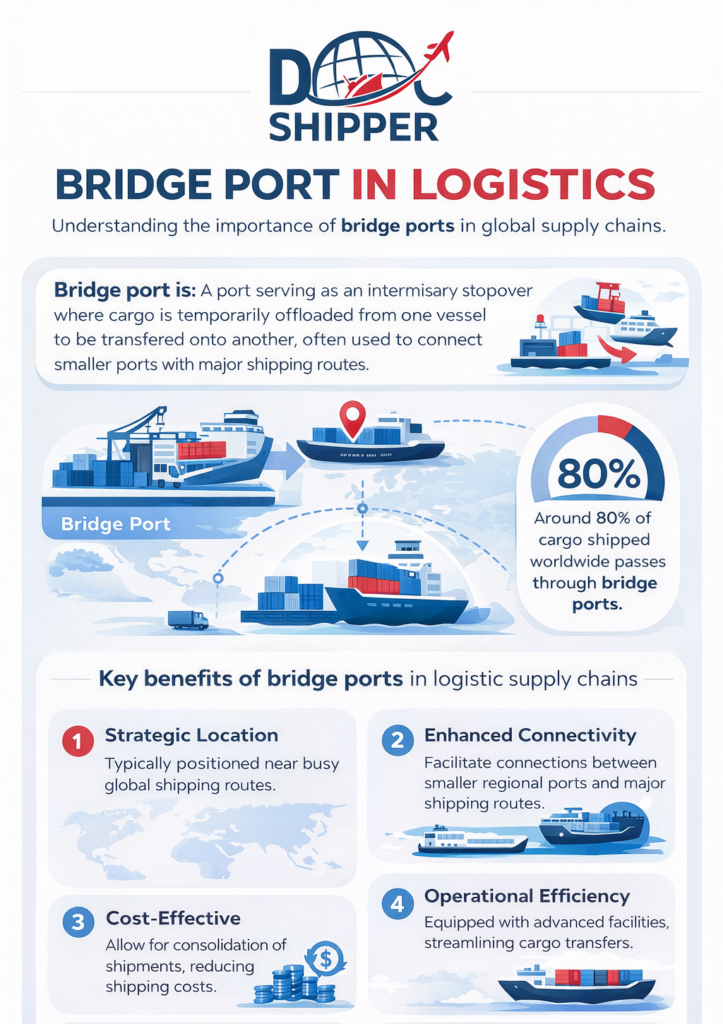
Bridge Port is an intermediate port facility strategically positioned to connect cargo flows between major shipping routes and regional destinations. It serves as a transshipment hub where containers are transferred between ocean vessels, feeder ships, or alternative transport modes, optimizing global supply chain efficiency and reducing transit times.
Introduction
Shippers frequently struggle with choosing optimal routing for intercontinental cargo. Direct port-to-port connections aren’t always available or economically viable. This is where bridge ports become essential infrastructure.
In international trade, these facilities act as critical nodes connecting deep-sea shipping lanes with regional distribution networks. They enable cargo consolidation, deconsolidation, and modal transfers without requiring direct vessel calls to final destinations.
Key characteristics include:
- Geographic positioning between major trade corridors and secondary markets
- Advanced handling infrastructure for rapid container transfers
- Multimodal connectivity linking ocean, rail, barge, and truck transport
- Customs facilitation allowing bonded transshipment operations
- Feeder network integration serving smaller regional ports efficiently
Strategic Role & Operational Mechanisms
Bridge ports function as cargo redistribution centers within global shipping networks. When mainline vessels cannot economically serve all destination ports, containers are offloaded at these hubs for onward transport via smaller feeder vessels or land-based modes.
The transshipment process involves several coordinated steps. Containers arrive on large mother vessels, undergo customs documentation verification, then transfer to appropriate onward carriers based on final destination requirements. This operation typically completes within 24-72 hours depending on port efficiency.
From a regulatory perspective, bridge ports operate under specific customs frameworks. The World Customs Organization’s Revised Kyoto Convention establishes international standards for transshipment procedures, ensuring goods can transit without full import clearance. The WCO guidelines provide harmonized protocols that bridge ports must implement.
Operational advantages for shippers include reduced vessel waiting times, lower port call costs for carriers, and improved schedule reliability. Shipping lines consolidate cargo volumes at bridge ports, achieving economies of scale on mainline routes while maintaining service coverage to secondary markets.
The infrastructure requirements are substantial. Effective bridge ports need deep-water berths for large vessels, extensive container yards, advanced crane systems, robust IT platforms for cargo tracking, and efficient hinterland connections. At DocShipper, we systematically evaluate bridge port capabilities when designing optimal routing solutions for our clients’ international shipments.
Concrete Examples & Comparative Data
Several ports worldwide exemplify the bridge port model. Singapore handles over 37 million TEUs annually, with approximately 85% being transshipment cargo connecting Asia-Pacific routes with European and American destinations.
Rotterdam serves as Europe’s primary bridge port, linking deep-sea vessels with barge networks serving inland European markets. The port processes 14.5 million TEUs yearly, with 30% involving transshipment operations.
| Bridge Port | Annual Volume (TEU) | Transshipment Rate | Primary Connectivity |
|---|---|---|---|
| Singapore | 37.2 million | 85% | Asia-Europe-Americas |
| Rotterdam | 14.5 million | 30% | European inland waterways |
| Dubai (Jebel Ali) | 13.5 million | 70% | Middle East-Indian Subcontinent |
| Panama (Balboa/Cristobal) | 6.8 million | 55% | Pacific-Atlantic crossover |
Use Case: Asia-Europe Shipment via Singapore
A manufacturer in Vietnam exports electronics to Poland. Direct vessel service doesn’t exist on this route. The cargo ships to Singapore (7 days), undergoes transshipment (2 days), then continues to Rotterdam (21 days), followed by barge transport to Gdansk (4 days). Total transit: 34 days versus 42+ days via alternative routing through Suez without transshipment optimization.
Cost implications vary significantly. Bridge port transshipment adds $150-$300 per container in handling fees, but reduces overall freight costs by 15-25% compared to direct services requiring smaller, less efficient vessels on extended routes.
Environmental benefits are measurable. Larger vessels serving bridge ports achieve 40% better fuel efficiency per TEU-mile than smaller direct-service ships. This consolidation model reduces the global shipping industry’s carbon footprint substantially.
DocShipper Platform
Cut logistics costs. Not corners.
See exactly where your logistics costs are bleeding — and how to fix it. Book your expert demo.
Conclusion
Bridge ports represent essential infrastructure enabling global trade efficiency through strategic cargo consolidation and redistribution. Their role optimizing vessel utilization and connecting disparate markets makes them indispensable to modern supply chains.
Need expert guidance on routing strategies involving bridge ports? Contact DocShipper for customized logistics solutions tailored to your international shipping requirements.
📚 Quiz
Test Your Knowledge: Bridge Port
Q1 — What best defines a Bridge Port in international logistics?
Q2 — A common misconception about bridge ports is that transiting cargo must go through full customs import clearance at the bridge port. Is this correct?
Q3 — A Vietnamese manufacturer ships electronics to Poland. There is no direct vessel service available. Which routing correctly illustrates the bridge port model?
🎯 Your Result
📞 Free Quote in 24hFAQ | Bridge Port: Definition, Role & Practical Examples in Logistics
Bridge ports specifically connect major shipping routes with regional feeder networks, whereas standard transshipment hubs may only facilitate cargo transfers between similar-sized vessels on comparable routes.
Typically no. Goods in transshipment remain under customs bond, requiring only manifest documentation until reaching the final import destination where full clearance occurs.
They add 1-3 days for transshipment handling but often reduce overall transit by enabling more efficient mainline vessel schedules and avoiding longer alternative routes.
Per-container handling fees increase by $150-$300, but total freight costs typically decrease 15-25% due to economies of scale on mainline routes.
Containerized manufactured goods, non-perishable commodities, and shipments to markets without direct vessel service gain maximum advantage from bridge port networks.
Yes, if the port has adequate reefer infrastructure and transshipment completes within 48 hours. Temperature-controlled container monitoring ensures product integrity throughout transfer.
Selection criteria include geographic positioning, handling efficiency, infrastructure capacity, feeder network connectivity, customs facilitation, and port service costs.
The container waits for the next available feeder service, typically departing within 3-7 days. Carriers usually absorb storage costs for operational delays they cause.
Most bridge ports accommodate standard 20ft and 40ft containers efficiently. Specialized equipment may be required for oversized, open-top, or flat-rack containers.
Automated systems enable real-time cargo tracking, predictive berth allocation, optimized crane scheduling, and seamless data exchange between carriers, reducing transshipment time by 20-30%.
Modern ports maintain damage rates below 0.5% through standardized handling procedures, trained personnel, and advanced container inspection systems before onward transport.
Yes. Most bridge ports provide online tracking platforms showing container location, transfer status, and estimated departure times for connecting vessels in real-time.
Need Help with
Logistics or Sourcing ?
First, we secure the right products from the right suppliers at the right price by managing the sourcing process from start to finish. Then, we simplify your shipping experience - from pickup to final delivery - ensuring any product, anywhere, is delivered at highly competitive prices.


Fill the Form
Prefer email? Send us your inquiry, and we’ll get back to you as soon as possible.
Contact us