In short ⚡
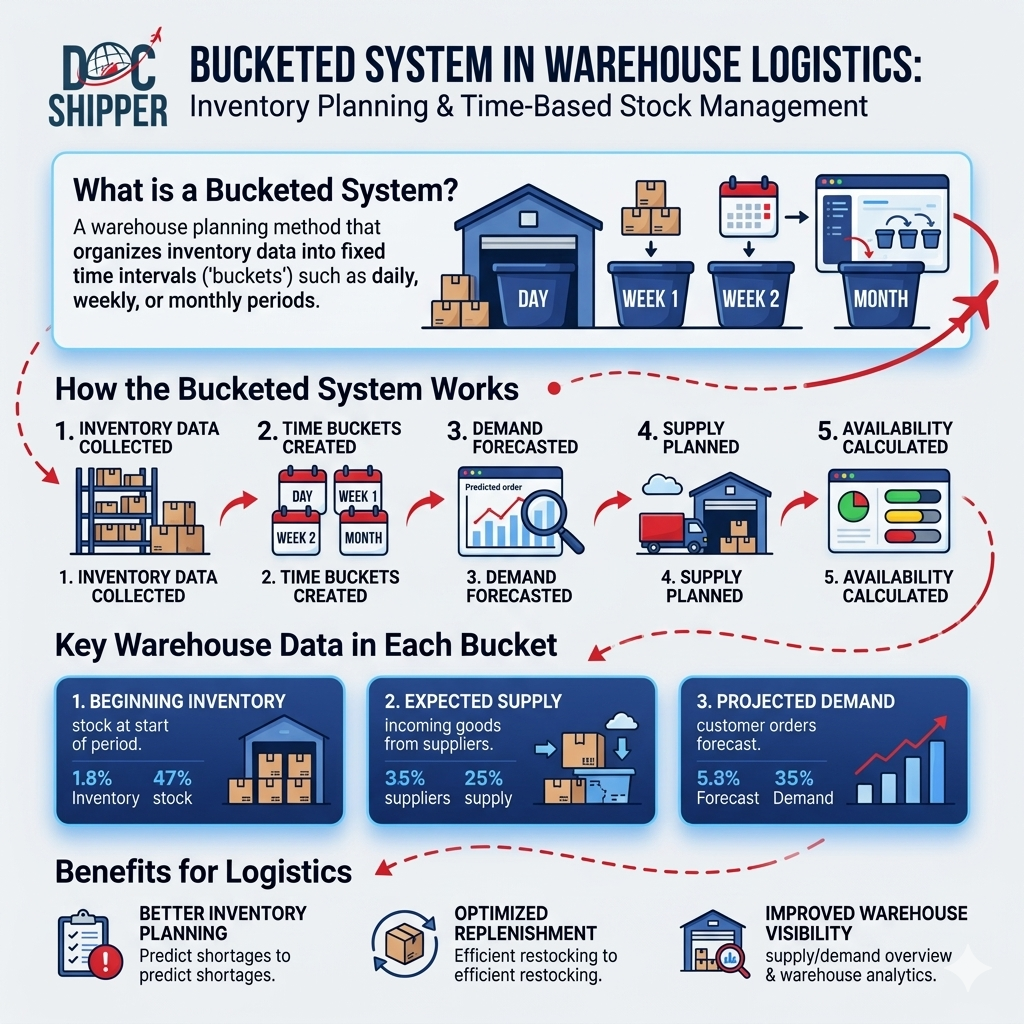
The Bucketed System is a warehouse inventory management methodology that organizes products into predefined categories or "buckets" based on specific criteria such as turnover rate, handling requirements, or destination. This classification enables optimized storage allocation, faster picking operations, and streamlined order fulfillment in international logistics operations.
Introduction
Many importers struggle with inefficient warehouse layouts that increase picking time and operational costs. Without proper categorization, high-demand products sit alongside slow-moving inventory, creating bottlenecks in order processing.
The bucketed system addresses this challenge by introducing strategic segmentation. In import/export operations, where speed and accuracy directly impact customer satisfaction and cash flow, this approach becomes essential for maintaining competitive advantage.
Key characteristics of bucketed systems include:
- ABC classification – Products grouped by sales velocity or value contribution
- Zone-based storage – Physical separation according to handling requirements
- Dynamic reallocation – Periodic bucket adjustments based on performance metrics
- Picking optimization – Reduced travel time through strategic product placement
- Inventory visibility – Enhanced tracking through categorical organization
Bucketed System Methodology & Strategic Implementation
The foundation of any bucketed system lies in criteria definition. Companies typically segment inventory using the Pareto principle: 20% of SKUs generate 80% of revenue. These become “A-bucket” items positioned in prime warehouse locations near packing stations.
Temperature-controlled buckets apply to perishable goods or pharmaceuticals requiring specific environmental conditions. This segmentation ensures regulatory compliance while preventing product degradation during storage.
Destination-based bucketing groups products by shipping route or customer region. Importers handling multiple markets benefit from this approach, as it enables consolidated picking for specific geographic zones, reducing handling errors.
Legal considerations include customs bonded warehouse requirements, where duty-unpaid goods must remain physically separated from cleared inventory. The U.S. Customs and Border Protection mandates distinct storage zones to prevent unauthorized mixing of bonded and non-bonded merchandise.
Seasonal bucketing accommodates fluctuating demand patterns. Retailers adjust bucket allocations before peak seasons, moving anticipated high-sellers to accessible zones while relocating off-season items to secondary storage.
At DocShipper, we implement customized bucketing strategies during warehouse setup phases, ensuring your inventory classification aligns with operational workflows and compliance requirements from day one.
Practical Applications & Performance Data
Real-world implementation demonstrates measurable efficiency gains. A comparative analysis of bucketed versus non-bucketed warehouses reveals significant operational differences:
| Performance Metric | Traditional System | Bucketed System | Improvement |
|---|---|---|---|
| Average Pick Time per Order | 8.5 minutes | 5.2 minutes | 38.8% faster |
| Picking Accuracy Rate | 94.2% | 98.7% | +4.5 points |
| Labor Cost per 1000 Units | $420 | $275 | 34.5% reduction |
| Space Utilization Rate | 68% | 82% | +14 points |
| Inventory Turnover Days | 45 days | 32 days | 28.9% faster |
Use Case: Electronics Importer – A mid-sized electronics distributor handling 15,000 SKUs implemented a three-tier bucketed system. High-velocity items (smartphones, laptops) occupied 25% of warehouse space but represented 68% of order volume. By positioning these in a dedicated A-bucket near shipping docks, they reduced fulfillment time from 24 hours to 8 hours while cutting mispick rates by 62%.
Pharmaceutical Cold Chain – Temperature-sensitive products require strict bucketing. A vaccine distributor segregated inventory into four temperature zones (2-8°C, -20°C, -70°C, ambient). This system ensured regulatory compliance while enabling traceable storage conditions for audit purposes.
Seasonal Fashion Retailer – A clothing importer adjusted bucket allocations quarterly. Summer apparel moved to primary zones in March, while winter stock shifted to secondary storage. This dynamic approach maintained 92% picking efficiency year-round despite inventory composition changes.
Key implementation factors include:
- WMS integration – Warehouse management systems must support bucket-based logic for automated slot assignment
- Staff training – Pickers require clear bucket identification protocols to maintain accuracy
- Performance monitoring – Monthly SKU velocity analysis ensures buckets reflect current demand patterns
- Scalability planning – Bucket structures should accommodate inventory growth without complete reorganization
- Exception handling – Procedures for oversized items or hazardous materials that don’t fit standard buckets
DocShipper Platform
One platform. Your entire supply chain
Sourcing, freight, customs & documents — all centralised, all visible, 24/7.
Conclusion
The bucketed system transforms warehouse operations from reactive storage to strategic inventory positioning. By aligning product placement with business priorities, importers achieve faster fulfillment, reduced costs, and improved accuracy.
Need assistance implementing a bucketed system for your import operations? Contact DocShipper for customized warehouse optimization solutions tailored to your product mix and operational requirements.
📚 Quiz
Test Your Knowledge: Bucketed System
Q1 — What is the primary purpose of a Bucketed System in warehouse management?
Q2 — A common misconception is that a Bucketed System and ABC analysis are the same thing. What is the correct distinction?
Q3 — An electronics distributor handling 15,000 SKUs wants to reduce fulfillment time. Which approach best reflects a correct application of the Bucketed System?
🎯 Your Result
📞 Free Quote in 24hFAQ | Bucketed System: Definition, Implementation & Practical Examples
ABC analysis is the classification methodology (categorizing items by value/velocity), while a bucketed system is the physical implementation of that analysis in warehouse layout. The bucketed approach applies ABC principles to actual storage locations.
Most operations review bucket allocations quarterly, with high-volume warehouses conducting monthly assessments. Seasonal businesses may adjust buckets before peak periods to accommodate demand shifts.
Yes. Even facilities with 2,000-5,000 SKUs see efficiency gains from basic two-tier bucketing (fast/slow movers). The system scales to operation size, requiring minimal investment beyond initial planning.
Typically 20-30% of total storage space, though this varies by industry. High-velocity items require accessible locations, but excessive A-bucket space reduces overall capacity utilization.
Organized categorization reduces search time and mispicks. Studies show 15-25% accuracy improvement when pickers work within clearly defined bucket zones versus random storage layouts.
While advanced WMS platforms optimize bucket management, basic systems can operate with spreadsheet-based tracking. However, automated slot assignment significantly improves efficiency in operations exceeding 10,000 SKUs.
Reclassification triggers a physical relocation during the next cycle count or replenishment cycle. WMS updates the product's primary storage location, and pickers receive new location assignments for future orders.
Yes. Cross-dock facilities use destination-based bucketing, grouping inbound shipments by outbound route. This minimizes handling time and enables direct transfer from receiving to shipping docks.
Most implementations include a dedicated "quarantine bucket" for returns, defects, or pending inspection items. This prevents contamination of sellable inventory and streamlines quality control workflows.
Initial training covers bucket identification, location codes, and exception procedures. Most staff adapt within 3-5 days. Ongoing training focuses on performance metrics and seasonal bucket changes.
Absolutely. ASRS technology integrates seamlessly with bucket logic, using velocity data to optimize robotic retrieval sequences. The combination delivers the fastest picking speeds in modern warehousing.
Initial SKU classification requires historical sales data analysis. Physical reorganization may temporarily disrupt operations. Resistance to change from staff accustomed to previous systems also presents challenges requiring clear communication of benefits.
Need Help with
Logistics or Sourcing ?
First, we secure the right products from the right suppliers at the right price by managing the sourcing process from start to finish. Then, we simplify your shipping experience - from pickup to final delivery - ensuring any product, anywhere, is delivered at highly competitive prices.


Fill the Form
Prefer email? Send us your inquiry, and we’ll get back to you as soon as possible.
Contact us