In short ⚡
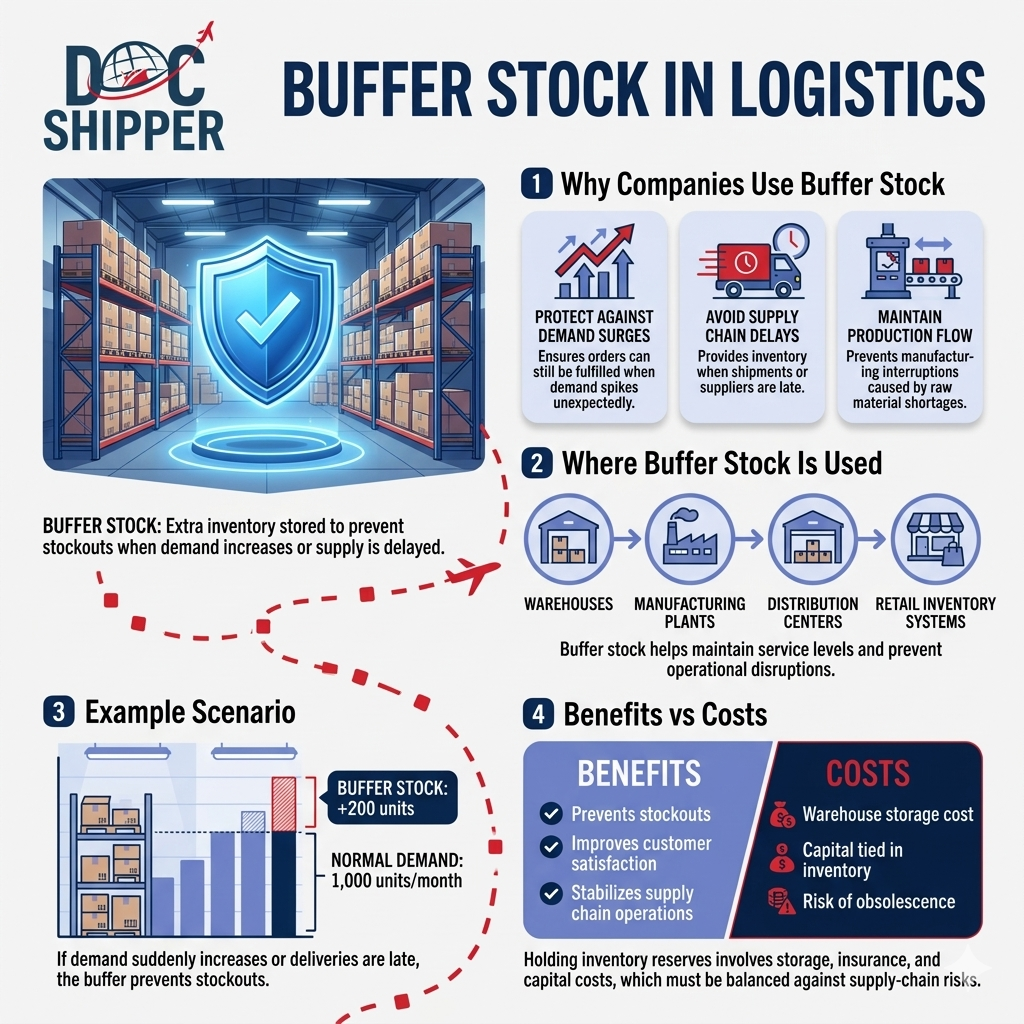
Buffer stock is a strategic inventory reserve maintained to absorb demand fluctuations and supply chain disruptions. This safety cushion prevents stockouts during unexpected demand spikes or supplier delays, ensuring business continuity while balancing holding costs against service level requirements in international logistics operations.Introduction
Many importers face a recurring dilemma: order too little and risk losing sales, order too much and tie up capital in excess inventory. This balancing act becomes critical in international trade where lead times span weeks or months.
Buffer stock addresses this challenge by creating a calculated safety margin. Unlike regular working stock that covers predictable demand, buffer inventory specifically protects against uncertainty—delayed shipments, customs holds, sudden order surges, or supplier production issues.
In global supply chains, buffer stock serves multiple strategic functions:
- Risk mitigation: Absorbs variability in demand forecasting and supply reliability
- Service level protection: Maintains customer satisfaction during disruptions
- Lead time coverage: Compensates for extended international shipping durations
- Seasonal buffering: Prepares for predictable demand peaks without overstocking
- Supplier flexibility: Reduces dependency on single-source or just-in-time deliveries
In-Depth Analysis & Expert Insights
Buffer stock calculation involves sophisticated statistical methods. The most common formula combines demand variability and lead time uncertainty through standard deviation analysis. The basic equation: Buffer Stock = Z-score × √(Lead Time) × Standard Deviation of Demand.
The Z-score represents the desired service level—a 95% service level uses Z=1.65, while 99% requires Z=2.33. Higher service levels demand proportionally larger buffers, directly impacting working capital requirements. Companies must balance customer expectations against inventory carrying costs.
Lead time variability significantly affects buffer requirements in international logistics. A shipment from Asia to Europe averaging 35 days might fluctuate between 28-45 days due to port congestion, customs clearance, or weather delays. This 17-day variance demands substantial buffer coverage compared to domestic operations.
Regulatory considerations also influence buffer strategies. According to EU customs warehousing regulations, bonded inventory can serve dual purposes—acting as buffer stock while deferring duty payments until market release. This approach optimizes both cash flow and inventory positioning.
Dynamic buffer management adjusts safety stock levels based on real-time supply chain performance. Advanced systems track supplier reliability metrics, seasonal patterns, and demand volatility to automatically recalibulate buffer requirements. At DocShipper, we implement monitoring systems that alert clients when buffer levels drop below calculated thresholds, preventing stockout situations before they impact operations.
The cost-benefit equilibrium remains crucial. Holding costs typically range from 20-30% of inventory value annually, encompassing warehousing, insurance, obsolescence risk, and capital opportunity cost. Companies must weigh these expenses against the revenue loss and customer relationship damage from stockouts, which can exceed 50% of the sale value when considering lifetime customer value.
Concrete Examples & Data
Consider a European electronics importer sourcing smartphones from China. Average monthly demand: 1,000 units. Lead time: 45 days. Demand standard deviation: 150 units. Target service level: 98% (Z=2.05).
Calculation: Buffer Stock = 2.05 × √(45/30) × 150 = 2.05 × 1.22 × 150 = 375 units. This importer should maintain approximately 375 smartphones as buffer inventory beyond their working stock to achieve 98% service reliability.
| Service Level | Z-Score | Buffer Stock (Units) | Annual Holding Cost | Stockout Risk |
|---|---|---|---|---|
| 90% | 1.28 | 234 | €35,100 | 10% |
| 95% | 1.65 | 302 | €45,300 | 5% |
| 98% | 2.05 | 375 | €56,250 | 2% |
| 99.5% | 2.58 | 472 | €70,800 | 0.5% |
Assumptions: Unit cost €150, holding cost 25% annually.
Industry benchmarks reveal significant sectoral variation. Pharmaceutical importers typically maintain 99%+ service levels due to regulatory requirements and patient safety concerns, resulting in buffer stocks representing 60-90 days of demand. Conversely, fast-fashion retailers accept 92-95% service levels, prioritizing capital efficiency over perfect availability for trend-sensitive merchandise.
Seasonal adjustment case: A toy importer preparing for December holidays increases buffer stock by 40% starting September. Historical data shows demand volatility triples during Q4, while shipping delays from Asian manufacturers increase by 25% due to port congestion. The adjusted buffer calculation incorporates these seasonal multipliers, temporarily raising safety stock from 500 to 700 units.
Multi-location strategy: Companies operating across multiple markets often centralize buffer stock in strategic hubs. A distributor serving France, Germany, and Spain might maintain 70% of buffer inventory in a Rotterdam bonded warehouse, with 10% positioned in each destination country. This approach reduces total buffer requirements by 30% compared to independent country-level buffers while maintaining service levels through rapid cross-border redistribution.
ABC classification impact: High-value A-items (top 20% of SKUs generating 80% of revenue) warrant higher buffer levels than C-items. A typical allocation: A-items at 98% service level, B-items at 95%, C-items at 90%. This tiered approach optimizes working capital deployment toward revenue-critical inventory.
DocShipper Platform
Optimize Your Global Logistics with Cutting-Edge Solutions
Enhance efficiency, cut costs, and gain 24/7 visibility  over your entire supply chain.
- Cut your shipping costs and maximize your margins
- Manage sourcing, freight, & customs on one platform
- Get real-time tracking and analytics
Conclusion
Buffer stock represents a calculated investment in supply chain resilience. Proper sizing balances service reliability against capital efficiency, particularly critical in international logistics where lead times and uncertainties magnify risk exposure.
Need assistance optimizing your buffer stock strategy for international operations? Contact DocShipper for expert guidance on inventory positioning and supply chain risk management.
📚 Quiz
Test Your Knowledge: Buffer Stock
1. What is the primary purpose of buffer stock in a supply chain?
2. A company wants to achieve a 99% service level instead of 95%. What is the direct consequence on their buffer stock?
3. A toy importer notices that demand volatility triples every Q4 and shipping delays from Asia increase by 25%. What is the correct buffer stock approach for September?
🎯 Your Result
📞 Free Quote in 24hFAQ | Buffer Stock: Definition, Calculation & Practical Examples
The terms are interchangeable. Both refer to extra inventory held beyond expected demand to protect against uncertainty. Some organizations use "buffer stock" for raw materials and "safety stock" for finished goods, but no universal distinction exists.
Review quarterly as baseline practice. Recalculate immediately when lead times change significantly, demand patterns shift, or supplier reliability deteriorates. Seasonal businesses should adjust monthly during peak periods.
Absolutely. Excessive buffer inventory ties up working capital, increases obsolescence risk, and inflates warehousing costs. The optimal level balances stockout prevention against holding expenses—typically achieving 95-98% service levels for most commercial operations.
Yes, but with modified approaches. Perishable items require rotation-focused buffers with shorter coverage periods. A fresh produce importer might maintain 5-7 days buffer versus 30-45 days for durable goods, accepting higher stockout risk to minimize spoilage.
Customs delays directly extend effective lead time. If clearance averages 3 days but occasionally reaches 10 days, this 7-day variance must be incorporated into buffer calculations. Experienced customs brokers can reduce this variability through proper documentation and compliance management.
Critical. Higher forecast accuracy (lower standard deviation) reduces required buffer stock proportionally. Improving forecast accuracy from 70% to 85% can cut buffer requirements by 25-35%, directly improving cash flow and reducing holding costs.
Include it for accurate financial reporting, but analyze separately for operational insights. Buffer stock naturally lowers turnover ratios but serves a strategic purpose. Track "working stock turnover" and "total inventory turnover" as distinct metrics.
High tariff rates increase per-unit holding costs, potentially justifying lower buffer levels. Conversely, tariff uncertainty might warrant higher buffers to avoid emergency shipments if rates suddenly increase. Bonded warehousing can defer tariff payments while maintaining buffer inventory.
For interchangeable or modular products, yes. A clothing importer might maintain buffer fabric inventory that serves multiple garment SKUs. This "component-level buffering" reduces total inventory investment while maintaining flexibility across product lines.
Reduce proportionally but maintain relative coverage. If monthly demand drops from 1,000 to 600 units, recalculate buffer using the new baseline. Avoid eliminating buffers entirely—demand volatility often increases during market contractions due to customer behavior unpredictability.
Access to expedited shipping options can reduce buffer requirements by 20-40%. If emergency air freight can deliver in 5 days versus 35-day ocean shipping, companies can maintain lower buffers knowing rapid replenishment exists, though at premium cost.
The statistical safety stock formula (Z-score × σ × √LT) is widely accepted. However, specific industries modify it—automotive uses different calculations for MRP systems, while retail often employs service-level tables. Adapt standard formulas to your operational realities rather than applying them rigidly.
Need Help with
Logistics or Sourcing ?
First, we secure the right products from the right suppliers at the right price by managing the sourcing process from start to finish. Then, we simplify your shipping experience - from pickup to final delivery - ensuring any product, anywhere, is delivered at highly competitive prices.


Fill the Form
Prefer email? Send us your inquiry, and we’ll get back to you as soon as possible.
Contact us