


In short ⚡
Build to Order (BTO) is a manufacturing strategy where products are assembled only after receiving a confirmed customer order. This approach minimizes inventory costs, reduces waste, and enables mass customization by aligning production directly with actual demand rather than forecasted sales.Introduction
Many businesses struggle with excess inventory or stockouts due to inaccurate demand forecasting. Build to Order eliminates this dilemma by synchronizing production with actual customer commitments.
In international trade and logistics, BTO transforms supply chain dynamics. It reduces warehousing needs, shortens cash conversion cycles, and enables agile responses to market fluctuations.
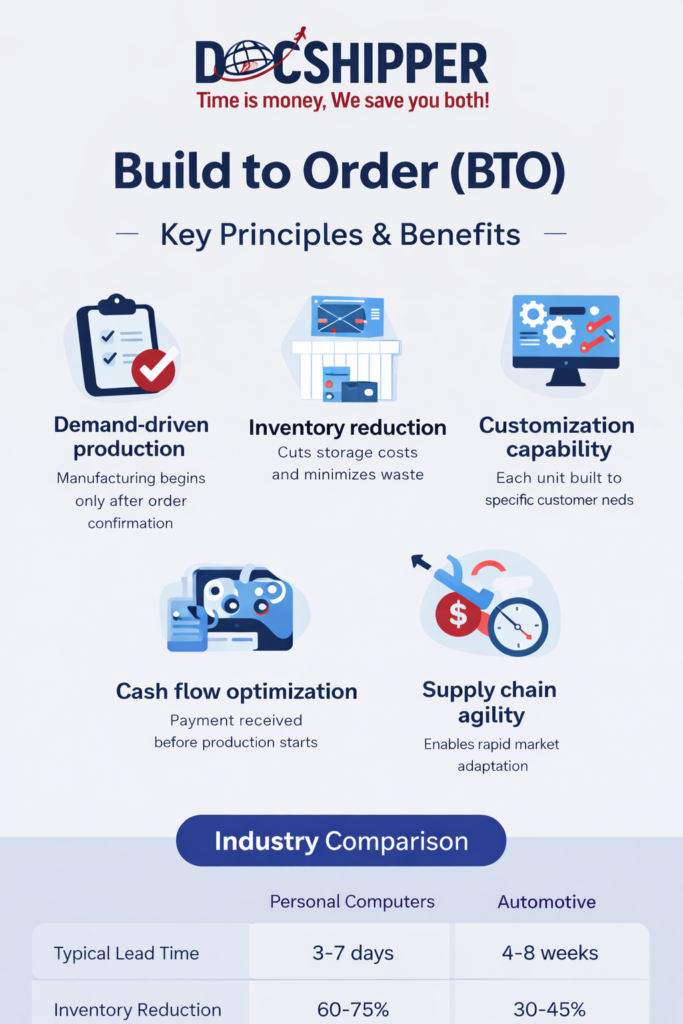
- Demand-driven production: Manufacturing begins only after order confirmation
- Inventory reduction: Eliminates finished goods storage costs
- Customization capability: Each unit can be tailored to customer specifications
- Cash flow optimization: Payment received before production costs are incurred
- Supply chain agility: Rapid adaptation to changing market conditions
BTO Mechanics & Strategic Implementation
Build to Order requires sophisticated coordination between sales, production, and procurement. The process begins with order capture systems that immediately trigger manufacturing workflows.
Supply chain integration is critical. Suppliers must deliver components on tight schedules aligned with production slots. Many BTO manufacturers maintain strategic component inventories while avoiding finished goods stockpiles.
The production lead time becomes a competitive differentiator. Companies like Dell revolutionized PC manufacturing by reducing BTO cycles to days rather than weeks, combining modular design with streamlined assembly processes.
Quality control in BTO environments demands zero-defect approaches. Since each unit is pre-sold, rework or defects directly impact customer satisfaction and delivery commitments.
From a customs and logistics perspective, BTO shipments often qualify for preferential tariff treatment under free trade agreements. At DocShipper, we help clients structure BTO operations to maximize duty savings while ensuring compliance with origin rules.
Regulatory compliance requires careful documentation. The WTO Customs Valuation Agreement governs how BTO goods are valued for import duties, particularly when customization adds significant value post-order.
Real-World Applications & Performance Data
Build to Order strategies vary significantly across industries. Automotive, electronics, and industrial equipment sectors have pioneered BTO with measurable results.
| Industry | Typical Lead Time | Inventory Reduction | Customization Level |
|---|---|---|---|
| Personal Computers | 3-7 days | 60-75% | High |
| Automotive | 4-8 weeks | 30-45% | Medium-High |
| Industrial Machinery | 6-12 weeks | 40-55% | Very High |
| Consumer Electronics | 5-10 days | 50-65% | Medium |
Case Study: A European machinery manufacturer implementing BTO reduced working capital requirements by €2.3 million annually. By eliminating speculative production, they cut finished goods inventory from 45 days to 8 days while maintaining 98% on-time delivery.
The financial impact extends beyond inventory. Obsolescence costs drop dramatically—critical in technology sectors where product lifecycles span months rather than years.
International logistics under BTO models requires precision timing. Shipments are often consolidated at regional hubs before final distribution. At DocShipper, we coordinate multi-origin consolidations to optimize both transit times and landed costs for BTO shipments.
Risk mitigation becomes paramount. Supply chain disruptions affect BTO operations more severely than make-to-stock models. Leading practitioners maintain dual sourcing for critical components and use predictive analytics to anticipate bottlenecks.
Performance metrics for BTO success include order-to-delivery cycle time, first-pass yield rates, component supplier reliability, and customer satisfaction scores. Best-in-class operations achieve 95%+ on-time delivery with less than 2% defect rates.
Conclusion
Build to Order represents a fundamental shift from forecast-driven to demand-driven manufacturing. It delivers measurable financial benefits while enabling unprecedented product customization.
Successful implementation requires integrated systems, reliable suppliers, and logistics partners who understand time-critical delivery requirements. Contact DocShipper to explore how BTO strategies can optimize your international supply chain.
DocShipper Platform
Cut logistics costs. Not corners.
See exactly where your logistics costs are bleeding — and how to fix it. Book your expert demo.

📚 Quizz
Test Your Knowledge: Build to Order (BTO)
Q1. What is the defining characteristic of a Build to Order (BTO) manufacturing strategy?
Q2. A common misconception about BTO is that it eliminates all inventory. What does BTO actually do regarding inventory?
Q3. A European machinery manufacturer wants to reduce working capital and stop producing units that may never sell. Which strategy best fits their situation?
🎯 Your Result
📞 Free Quote in 24hFAQ | Build to Order (BTO): Definition, Implementation & Real-World Examples
Build to Order produces goods only after receiving customer orders, while Make to Stock manufactures based on demand forecasts and maintains finished goods inventory. BTO reduces inventory costs but requires longer customer wait times.
High-value, customizable products with short lifecycles benefit most—including computers, automobiles, industrial equipment, and specialized electronics. Industries with high inventory carrying costs see the greatest financial impact.
BTO shipments are typically direct-to-customer, requiring precise customs documentation. Products may qualify for preferential tariffs under trade agreements if properly documented. Timing becomes critical to avoid storage fees at ports.
Primary risks include supply chain disruptions delaying production, quality defects affecting pre-sold units, demand spikes exceeding capacity, and longer customer wait times compared to stock-based models.
Yes, particularly for niche products or services. Small manufacturers can leverage BTO to compete without large capital investments in inventory. Digital tools and contract manufacturing make BTO accessible to businesses of all sizes.
Cycle times vary by industry complexity—from 3-7 days for computers to 4-8 weeks for automobiles. Lead time depends on component availability, manufacturing complexity, and customization depth.
Core systems include order management platforms, production scheduling software, supplier integration tools, and real-time inventory tracking. ERP systems that integrate sales, manufacturing, and logistics are fundamental.
BTO typically improves cash flow by receiving payment before or during production rather than after goods sit in inventory. This reduces working capital requirements and minimizes financial risk from unsold inventory.
Suppliers must offer reliable delivery schedules, consistent quality, flexible order quantities, and responsive communication. Geographic proximity or established logistics partnerships help maintain tight production schedules.
Yes, hybrid approaches are common. Companies may use BTO for customized products while maintaining stock of high-volume standard items. This "assemble-to-order" model balances responsiveness with efficiency.
BTO products often have detailed build records enabling better troubleshooting and targeted service. However, customized configurations may require specialized parts inventory for repairs, increasing service complexity.
Key metrics include order-to-delivery cycle time, production yield rates, supplier on-time delivery, inventory turnover, customer satisfaction scores, and total cost per unit including logistics and customization expenses.
Need Help with
Logistics or Sourcing ?
First, we secure the right products from the right suppliers at the right price by managing the sourcing process from start to finish. Then, we simplify your shipping experience - from pickup to final delivery - ensuring any product, anywhere, is delivered at highly competitive prices.


Fill the Form
Prefer email? Send us your inquiry, and we’ll get back to you as soon as possible.
Contact us




:%20Definition%20&%20Guide%20for%202026)