


In short ⚡
Build to Stock (BTS) is a production strategy where manufacturers produce goods in anticipation of customer demand, maintaining finished inventory ready for immediate sale. This approach enables rapid order fulfillment and consistent product availability, making it ideal for standardized products with predictable demand patterns.Introduction
Many businesses struggle with the fundamental question: should we produce before orders arrive or wait for confirmed demand? This dilemma directly impacts delivery speed, inventory costs, and customer satisfaction. Build to Stock represents one of the core production philosophies in modern supply chain management.
In international trade and logistics, BTS strategy determines how quickly products reach global markets. Companies using this approach maintain warehouse inventories across distribution networks, enabling same-day or next-day shipping capabilities that customers increasingly expect.
Key characteristics of Build to Stock include:
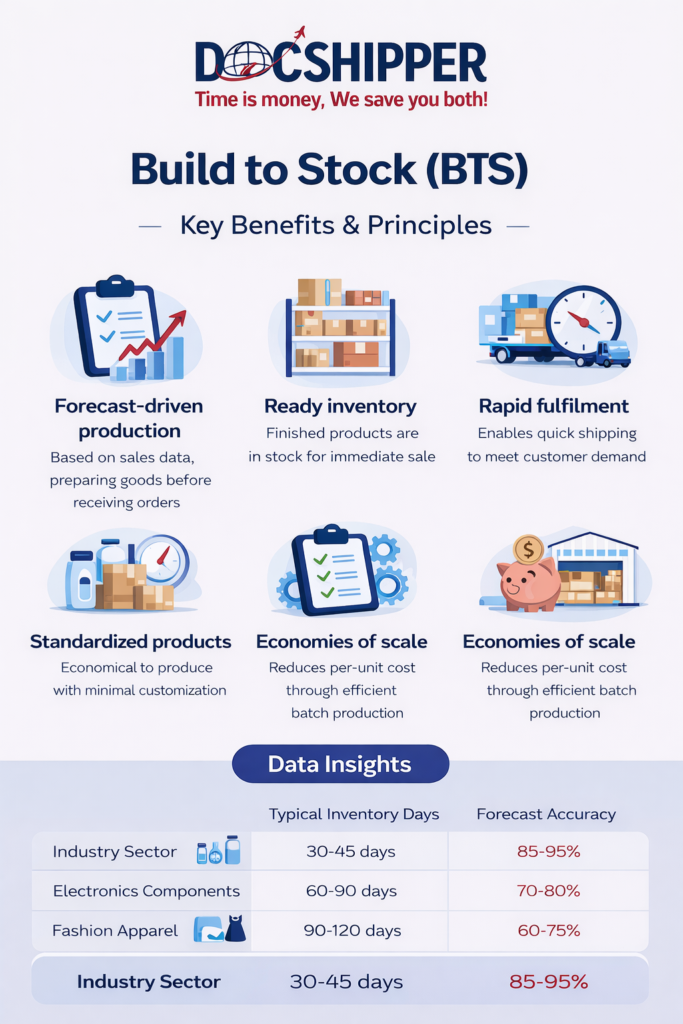
- Forecast-driven production based on historical sales data and market analysis
- Standardized products with minimal customization requirements
- Immediate availability for order fulfillment without production delays
- Inventory carrying costs balanced against service level targets
- Economies of scale through batch production and optimized manufacturing runs
BTS Strategy: Mechanisms & Implementation
The Build to Stock model operates on demand forecasting algorithms that analyze historical patterns, seasonal trends, and market indicators. Manufacturers establish safety stock levels to buffer against forecast errors while minimizing obsolescence risk. Production planning systems calculate optimal batch sizes considering setup costs, storage capacity, and working capital constraints.
Inventory positioning becomes critical in BTS operations. Companies strategically place finished goods across distribution centers based on regional demand profiles. This geographic distribution reduces transportation time and costs while improving customer service levels. Advanced systems use predictive analytics to anticipate demand shifts and reposition inventory proactively.
The production-inventory cycle in BTS follows a continuous replenishment model. When inventory reaches predetermined reorder points, manufacturing schedules trigger new production runs. This cyclical process maintains target stock levels while optimizing production efficiency through consistent capacity utilization.
Quality control integration occurs during production rather than post-order, allowing manufacturers to identify and correct defects before products reach customers. This proactive approach reduces returns and warranty claims while maintaining brand reputation. Finished goods undergo final inspection before entering inventory systems.
According to the U.S. Department of Commerce, manufacturers using BTS strategies typically maintain inventory turnover ratios between 4 and 12 times annually, depending on industry and product lifecycle characteristics. At DocShipper, we help clients optimize their BTS inventory positioning across international markets, ensuring products arrive at distribution hubs before peak demand periods to avoid customs delays and stockouts.
Practical Examples & Industry Data
Build to Stock applications vary significantly across industries. Consumer electronics manufacturers produce smartphones and laptops months before retail launch dates, accumulating inventory to meet anticipated first-day demand. Pharmaceutical companies maintain BTS production for over-the-counter medications with stable demand patterns, ensuring continuous availability at retail pharmacies.
The automotive parts industry demonstrates BTS effectiveness for high-volume replacement components. Brake pads, filters, and spark plugs are produced in large batches and distributed to aftermarket warehouses globally. This approach enables same-day availability at repair shops while achieving manufacturing cost efficiencies through scale production.
| Industry Sector | Typical Inventory Days | Forecast Accuracy | Obsolescence Risk |
|---|---|---|---|
| Consumer Packaged Goods | 30-45 days | 85-95% | Low |
| Electronics Components | 60-90 days | 70-80% | Medium |
| Fashion Apparel | 90-120 days | 60-75% | High |
| Industrial Supplies | 45-75 days | 80-90% | Low |
Cost-benefit analysis reveals that BTS becomes economically viable when production setup costs exceed 15-20% of per-unit manufacturing costs. For example, a beverage company producing canned drinks incurs significant line changeover expenses. By producing 500,000 units per run and storing inventory, they reduce per-unit costs by 35% compared to smaller batch production.
A practical case study involves a European furniture manufacturer exporting to North American markets. By implementing BTS with warehouses in Los Angeles and New Jersey, they reduced average delivery time from 8 weeks to 3 days. Inventory holding costs increased by $2.4 million annually, but sales volume grew 67% due to improved availability, generating $8.9 million in additional gross profit.
DocShipper manages BTS inventory logistics for clients across 50+ countries, coordinating production timing with international shipping schedules to optimize customs clearance and minimize storage duration at destination ports. This synchronization reduces total landed costs by 12-18% compared to uncoordinated shipments.
Conclusion
Build to Stock remains essential for businesses prioritizing immediate product availability and operational efficiency in predictable markets. Success requires balancing inventory investment against service level objectives while continuously refining demand forecasting capabilities.
Need expert guidance on implementing BTS strategies for your international supply chain? Contact DocShipper for customized logistics solutions that optimize your inventory positioning across global markets.
DocShipper Platform
One platform. Your entire supply chain
Sourcing, freight, customs & documents — all centralised, all visible, 24/7.
📚 Quiz
Test Your Knowledge: Build to Stock (BTS)
Q1. What is the defining characteristic of a Build to Stock (BTS) production strategy?
Q2. A fashion apparel brand is considering switching to a Build to Stock model. What is the PRIMARY risk they should be most concerned about?
Q3. A pharmaceutical company wants to ensure continuous availability of a best-selling over-the-counter painkiller at retail pharmacies worldwide. Which production strategy is most appropriate?
🎯 Your Result
📞 Free Quote in 24hFAQ | Build to Stock (BTS): Definition, Strategy & Practical Examples
Build to Stock produces goods before receiving orders based on demand forecasts, while Build to Order begins production only after customer orders are confirmed. BTS prioritizes speed and availability; BTO emphasizes customization and reduced inventory risk.
Consumer packaged goods, pharmaceuticals, automotive parts, and standardized electronics benefit most from BTS. These industries feature predictable demand patterns, long product lifecycles, and minimal customization requirements that make forecast-driven production economically viable.
Companies use demand forecasting models combined with service level targets, lead time variability, and carrying cost analysis. Safety stock calculations account for forecast error and supply chain uncertainty to maintain availability while minimizing excess inventory.
Key risks include inventory obsolescence from demand forecast errors, working capital tied up in unsold stock, storage costs, and potential product expiration. Market shifts or technology changes can rapidly devalue accumulated inventory.
BTS enables consolidated shipments and advance customs documentation preparation since products exist before orders. This reduces per-unit shipping costs and customs processing time compared to individual order fulfillment from manufacturing locations.
Yes, hybrid approaches combine BTS for high-volume standard products with Build to Order for customized variants. This "postponement strategy" produces base products to stock while completing final customization after receiving orders.
Enterprise Resource Planning (ERP) systems, Warehouse Management Systems (WMS), demand forecasting software, and inventory optimization tools support BTS. Advanced implementations integrate artificial intelligence for predictive analytics and automated replenishment decisions.
Seasonal products require advance production ramp-up before peak periods, increasing inventory carrying costs. Companies analyze multi-year seasonal patterns to optimize production timing, balancing early production cost savings against extended storage expenses.
Key performance indicators include inventory turnover ratio, forecast accuracy percentage, stockout frequency, carrying cost as percentage of sales, and order fill rate. Companies also track obsolescence rates and working capital efficiency.
Tariff changes can suddenly increase landed costs of pre-produced inventory. Companies using BTS for international markets must monitor trade policy developments and maintain flexibility to adjust production locations or inventory positioning in response to regulatory changes.
Full BTS implementation typically requires 6-12 months, including demand forecasting model development, inventory policy establishment, warehouse capacity expansion, and system integration. Pilot programs with limited product lines often precede full-scale deployment.
BTS can slow product innovation since inventory must be sold before introducing replacements. Companies balance this by limiting initial production quantities for new products, gradually increasing BTS volumes as demand patterns stabilize and forecast confidence improves.
Need Help with
Logistics or Sourcing ?
First, we secure the right products from the right suppliers at the right price by managing the sourcing process from start to finish. Then, we simplify your shipping experience - from pickup to final delivery - ensuring any product, anywhere, is delivered at highly competitive prices.


Fill the Form
Prefer email? Send us your inquiry, and we’ll get back to you as soon as possible.
Contact us



:%20Definition%20&%20Strategy%20in%202026)