In short ⚡
Bulk Area refers to a designated storage zone in warehouses, ports, or terminals specifically designed for handling and storing unpackaged goods in large quantities. These areas accommodate commodities like grains, minerals, liquids, or raw materials transported without individual packaging, requiring specialized infrastructure for efficient loading, unloading, and inventory management.
Introduction
Many importers struggle with storage solutions when dealing with commodities that cannot be containerized or palletized. The bulk area solves this challenge by providing dedicated infrastructure for loose cargo handling.
In international trade, bulk areas represent critical nodes in the supply chain. They bridge production sites and distribution networks, particularly for industries dependent on raw materials. Understanding their configuration directly impacts logistics costs, handling times, and cargo integrity.
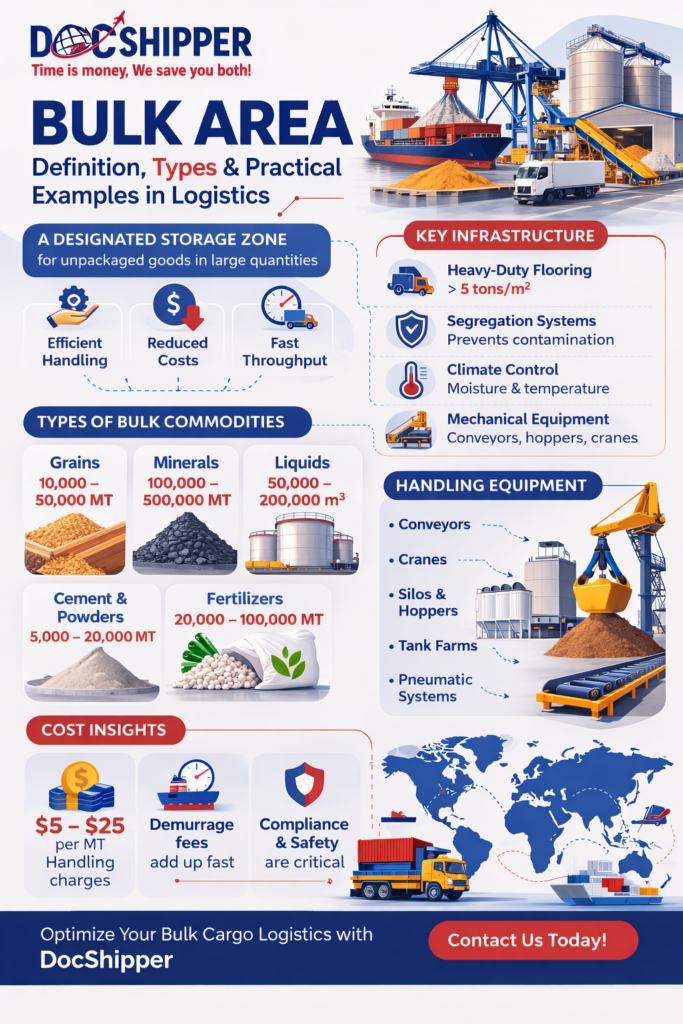
- Specialized flooring resistant to heavy loads and chemical exposure
- Segregation systems preventing contamination between different commodities
- Climate control capabilities for moisture-sensitive materials
- Mechanical handling equipment including conveyors, hoppers, and pneumatic systems
- Direct access points for trucks, railcars, or vessel holds
Technical Infrastructure & Operational Requirements
Bulk areas differ fundamentally from general warehousing spaces. Their design prioritizes volumetric efficiency over accessibility, with storage capacity measured in cubic meters rather than pallet positions. Floor load ratings typically exceed 5 tons per square meter to support heavy machinery and material accumulation.
Material segregation constitutes a primary operational concern. Physical barriers, ventilation zones, or separate bays prevent cross-contamination between incompatible goods. Food-grade grains must never contact industrial minerals, while hazardous bulk materials require isolated sections complying with IMDG regulations.
The discharge and loading systems determine throughput efficiency. Gravity-fed hoppers work for free-flowing materials like grains or pellets. Pneumatic conveyors handle powders. Screw conveyors manage sticky or compacted substances. Port bulk areas often feature ship loaders with capacities exceeding 2,000 tons per hour.
Inventory management in bulk areas relies on weight-based systems rather than piece counting. Weighbridges, load cells, or volumetric calculations provide stock levels. Advanced facilities integrate real-time monitoring sensors tracking temperature, humidity, and material levels to prevent spoilage or structural failures.
At DocShipper, we conduct pre-shipment bulk area assessments to verify that receiving facilities meet commodity-specific requirements, preventing costly delays or rejections at destination ports.
Regulatory compliance varies by commodity type. The International Maritime Organization publishes specific codes for bulk cargo handling, including moisture limits for coal and grain stability requirements. Non-compliance can result in vessel detention or cargo condemnation.
Practical Applications & Industry Data
Bulk areas serve distinct commodity categories, each demanding tailored infrastructure. Understanding these applications helps shippers select appropriate facilities and anticipate handling costs.
| Commodity Type | Storage Method | Handling Equipment | Typical Capacity |
|---|---|---|---|
| Grains (wheat, corn) | Silos or open stockpiles | Belt conveyors, bucket elevators | 10,000–50,000 MT |
| Minerals (iron ore, coal) | Open yards with drainage | Grab cranes, reclaimers | 100,000–500,000 MT |
| Liquids (crude oil, chemicals) | Tank farms | Pumping systems, pipelines | 50,000–200,000 m³ |
| Cement & powders | Enclosed silos | Pneumatic conveyors | 5,000–20,000 MT |
| Fertilizers | Covered warehouses | Front-end loaders, conveyors | 20,000–100,000 MT |
Cost implications vary significantly. Port bulk handling charges range from $5 to $25 per metric ton depending on commodity type and equipment requirements. Specialized facilities for hazardous materials or temperature-controlled storage command premium rates. Demurrage fees accumulate rapidly when discharge rates fall below contracted minimums.
A practical scenario illustrates these dynamics: A 60,000-ton coal shipment arrives at a port with two bulk area options. Facility A offers mechanized discharge at 3,000 tons/hour for $12/ton. Facility B uses slower grab cranes at 1,500 tons/hour for $8/ton. While B appears cheaper, the extended discharge time (40 hours vs. 20 hours) incurs $50,000 in additional vessel demurrage, making A the economical choice despite higher handling fees.
Environmental considerations increasingly influence bulk area operations. Dust suppression systems, runoff containment, and emission controls add infrastructure costs but ensure compliance with environmental regulations. Modern facilities invest in covered storage and automated handling to minimize environmental impact while improving operational efficiency.
Conclusion
Bulk areas form the backbone of commodity logistics, requiring specialized infrastructure matched to cargo characteristics. Proper facility selection balances handling efficiency, compliance requirements, and total landed costs.
Need expert guidance on bulk cargo logistics? Contact DocShipper for tailored solutions that optimize your supply chain from origin to destination.
DocShipper Platform
Optimize Your Global Logistics with Cutting-Edge Solutions
Enhance efficiency, cut costs, and gain 24/7 visibility  over your entire supply chain.
- Cut your shipping costs and maximize your margins
- Manage sourcing, freight, & customs on one platform
- Get real-time tracking and analytics
📚 Quiz
Test Your Knowledge: Bulk Area
Q1 — What is the primary purpose of a Bulk Area in logistics?
Q2 — How is inventory typically measured in a bulk storage facility?
Q3 — A 60,000-ton coal shipment has two discharge options: Facility A at $12/ton with 3,000 tons/hour, and Facility B at $8/ton with 1,500 tons/hour. Vessel demurrage costs $2,500/hour. Which facility is the most economical choice?
🎯 Your Result
📞 Free Quote in 24hFAQ | Bulk Area: Definition, Types & Practical Examples in Logistics
Bulk areas handle unpackaged loose materials with specialized equipment and flooring, while warehouses store palletized or containerized goods. Bulk facilities prioritize volumetric capacity and material-specific handling systems over unit-level inventory tracking.
Only compatible materials should share space. Physical segregation prevents cross-contamination between food-grade and industrial products. Hazardous materials require isolated zones per IMDG Code regulations to ensure safety and compliance.
Weight-based systems using weighbridges or load cells provide accurate measurements. Volumetric calculations estimate quantities in open stockpiles. Advanced facilities deploy sensors for real-time monitoring of stock levels and material conditions.
Commodity type, discharge equipment, tonnage rates, and facility specifications drive costs. Additional charges apply for specialized services like dust suppression, temperature control, or hazardous material handling. Demurrage fees accrue when operations exceed contracted timeframes.
No. Minerals like iron ore and coal tolerate outdoor storage. Moisture-sensitive materials like grains, cement, and fertilizers require covered facilities or silos to prevent degradation. Regulatory requirements and quality specifications determine coverage needs.
Equipment varies by material: conveyors and elevators for grains, grab cranes for minerals, pumps for liquids, and pneumatic systems for powders. Weighbridges, dust suppression units, and material handling vehicles support operations across all commodity types.
Modern facilities implement dust suppression systems, runoff containment, and emission controls. Covered storage reduces environmental exposure. Regular monitoring ensures operations meet local and international environmental standards while minimizing community impact.
Isolated storage zones, specialized ventilation, fire suppression systems, and trained personnel are mandatory. Facilities must comply with IMDG Code requirements, maintain Material Safety Data Sheets, and implement emergency response procedures for hazardous commodity handling.
Yes, if proper segregation exists. Multi-commodity facilities maintain separate bays or zones with dedicated equipment. Cross-contamination prevention measures and independent discharge systems enable simultaneous handling of different bulk materials without quality compromise.
Humidity impacts moisture-sensitive commodities, requiring dehumidification or covered storage. Temperature extremes affect material flowability and stability. Tropical climates demand enhanced ventilation, while cold regions need heating systems to prevent material freezing or equipment malfunction.
Weight certificates, quality analysis reports, safety data sheets, and storage agreements are standard. Hazardous materials require additional permits and compliance certificates. Customs documentation includes commercial invoices and certificates of origin for imported commodities.
Capacity is measured in metric tons or cubic meters depending on material density. Calculations account for safe stacking heights, equipment clearances, and segregation requirements. Operational capacity typically runs 70-85% of theoretical maximum to maintain handling efficiency.
Need Help with
Logistics or Sourcing ?
First, we secure the right products from the right suppliers at the right price by managing the sourcing process from start to finish. Then, we simplify your shipping experience - from pickup to final delivery - ensuring any product, anywhere, is delivered at highly competitive prices.


Fill the Form
Prefer email? Send us your inquiry, and we’ll get back to you as soon as possible.
Contact us