In short ⚡
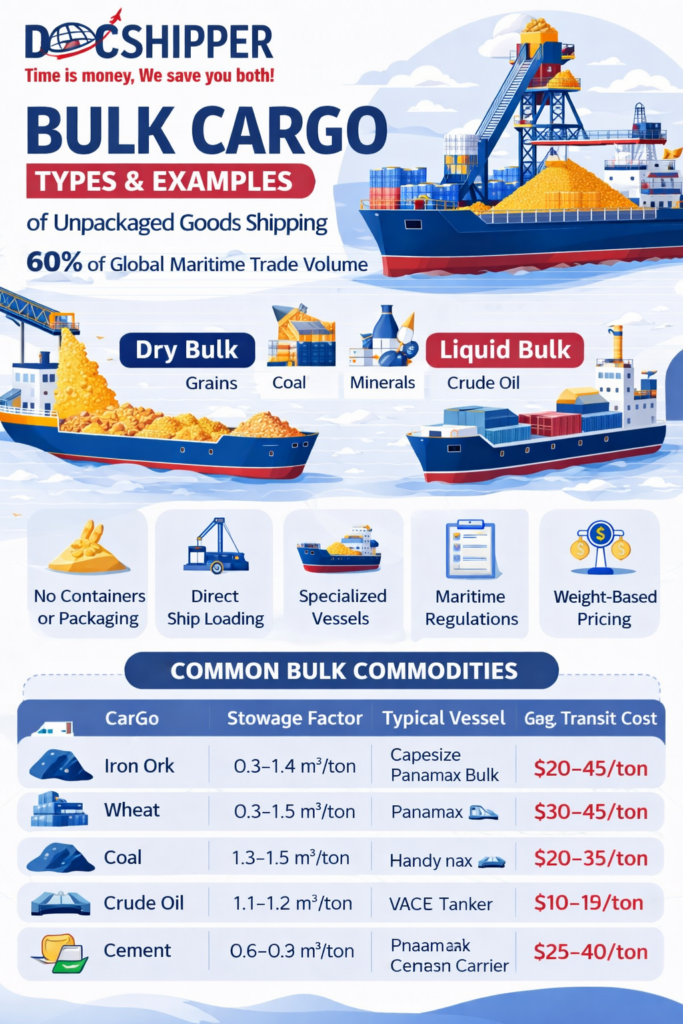
Bulk cargo refers to unpackaged goods transported in large quantities directly loaded into vessel holds or containers. This shipping method includes dry bulk (grains, coal, minerals) and liquid bulk (oil, chemicals). It represents approximately 60% of global maritime trade volume.
Introduction
Many importers confuse bulk cargo with containerized freight, leading to improper documentation and costly delays at customs. Understanding bulk shipping is critical for businesses handling raw materials, agricultural products, or industrial commodities.
Bulk cargo forms the backbone of international trade. It enables cost-efficient transportation of homogeneous goods without individual packaging. This method reduces handling costs and optimizes vessel capacity.
Key characteristics of bulk cargo include:
- Transported loose without containers or packaging
- Loaded directly into ship holds using specialized equipment
- Requires specific vessel types (bulkers, tankers)
- Subject to distinct maritime regulations and insurance requirements
- Pricing based on weight or volume with different calculation methods
Understanding Bulk Cargo: Technical & Regulatory Framework
Bulk cargo divides into two primary categories: dry bulk and liquid bulk. Each category requires specialized vessels and handling procedures. Dry bulk includes commodities like iron ore, coal, grain, and cement. Liquid bulk encompasses petroleum products, liquefied natural gas (LNG), and chemical substances.
The International Maritime Organization (IMO) regulates bulk cargo through specific conventions. The SOLAS Convention (Safety of Life at Sea) mandates strict loading procedures to prevent vessel instability. The IMO Cargo Guidelines establish safety protocols for dangerous bulk materials.
Stowage factors determine how much space cargo occupies relative to its weight. Light bulk cargo (like grain) has high stowage factors, while dense materials (like iron ore) have low factors. This calculation directly impacts freight costs and vessel selection.
Documentation for bulk cargo differs significantly from containerized freight. The Bill of Lading must specify cargo characteristics, moisture content, and loading/unloading terms. Certificates of quality and quantity verification are mandatory for most commodities.
Cargo segregation prevents contamination between different bulk materials. Vessels maintain separate holds with cleaning protocols between shipments. At DocShipper, we coordinate pre-shipment inspections to ensure cargo quality meets contractual specifications and prevent disputes at destination.
Practical Examples & Industry Data
Understanding bulk cargo becomes clearer through real-world scenarios. The following table compares common bulk cargo types with their shipping characteristics:
| Cargo Type | Stowage Factor | Typical Vessel | Average Transit Cost |
|---|---|---|---|
| Iron Ore | 0.3-0.4 m³/ton | Capesize Bulker | $15-25/ton |
| Wheat | 1.3-1.5 m³/ton | Panamax Bulker | $30-45/ton |
| Coal | 0.8-1.2 m³/ton | Handymax Bulker | $20-35/ton |
| Crude Oil | 1.1-1.2 m³/ton | VLCC Tanker | $10-18/ton |
| Cement | 0.6-0.9 m³/ton | Pneumatic Cement Carrier | $25-40/ton |
Use Case: Agricultural Bulk Export
A European grain trader exports 50,000 tons of wheat from France to Egypt. The cargo requires a Panamax vessel with grain-tight holds. Loading takes 48 hours using conveyor systems at a rate of 1,000 tons/hour. Transit time: 12 days through the Mediterranean. Total freight cost: $1,750,000 ($35/ton). Documentation includes phytosanitary certificates, fumigation reports, and weight/quality certificates verified by independent surveyors.
Key operational considerations for bulk cargo:
- Loading rates vary from 500 to 5,000 tons per hour depending on port infrastructure
- Demurrage costs average $15,000-50,000 daily for vessel delays beyond laytime
- Cargo loss during transit typically ranges 0.5-2% for dry bulk
- Insurance premiums cost 0.2-0.8% of cargo value for standard bulk commodities
- Port storage charges apply after free time periods (usually 3-7 days)
DocShipper coordinates bulk cargo operations from origin to destination, including surveyor appointments, documentation compliance, and claims management if cargo discrepancies occur during discharge.
Conclusion
Bulk cargo shipping requires specialized knowledge of vessel types, loading procedures, and regulatory compliance. Understanding stowage factors and documentation requirements prevents costly errors in international trade operations.
Need assistance with your bulk cargo shipment? Contact DocShipper for expert guidance on documentation, vessel booking, and cargo surveying services.
DocShipper Platform
Cut logistics costs. Not corners.
See exactly where your logistics costs are bleeding — and how to fix it. Book your expert demo.

📚 Quiz
Test Your Knowledge: Bulk Cargo
Q1 — Which of the following best defines bulk cargo?
Q2 — A shipper notices that iron ore has a stowage factor of 0.3–0.4 m³/ton, while wheat has a stowage factor of 1.3–1.5 m³/ton. What does this mean for vessel selection and freight costs?
Q3 — A European grain trader ships 50,000 tons of wheat from France to Egypt. The vessel takes 3 extra days to unload beyond the agreed laytime. What is the most likely financial consequence?
🎯 Your Result
📞 Free Quote in 24hFAQ | Bulk Cargo: Definition, Types & Practical Examples
Bulk cargo is homogeneous material loaded loose (grain, coal), while break bulk consists of individual packaged units (machinery, steel coils) loaded separately. Bulk requires specialized vessels; break bulk uses general cargo ships.
Dry bulk uses weight (metric tons) or volume (cubic meters) depending on stowage factor. Liquid bulk calculates by volume (barrels, cubic meters) or weight. The method yielding higher revenue applies per freight agreement terms.
Handysize (10,000-35,000 DWT), Handymax (35,000-60,000 DWT), Panamax (60,000-80,000 DWT), and Capesize (over 100,000 DWT) for dry bulk. Tankers range from product carriers to VLCCs (Very Large Crude Carriers) exceeding 200,000 DWT.
Yes, through flexitanks (liquid bulk) or bulk containers with discharge hatches (dry bulk). This method suits smaller quantities (20-24 tons) and offers better protection but costs more per ton than traditional bulk shipping.
Laytime is the contractual period allowed for loading/unloading without additional charges. Typical rates: 3,000-10,000 tons per day. Exceeding laytime triggers demurrage charges; completing early may earn dispatch money.
Rain damages hygroscopic cargoes (grain, sugar). Wind disrupts loading operations. Extreme temperatures affect liquid bulk viscosity. Vessels use hatch covers, heating coils, and weather routing to minimize cargo deterioration during transit.
Bill of Lading, commercial invoice, packing list (cargo characteristics), certificate of origin, quality/quantity certificates, phytosanitary certificates (agricultural products), and dangerous goods declaration (if applicable). Requirements vary by commodity and destination country.
Contamination occurs when residues from previous cargoes affect current shipment. Prevention requires hold cleaning inspections, separate cargo holds, and certificates of cleanliness. Common issues: odor transfer, chemical reactions, or physical mixing.
Through independent surveyors who verify quantity/quality at loading and discharge. Draft surveys measure cargo weight via vessel displacement. Disputes typically resolve via arbitration per charter party terms or FOSFA/GAFTA rules for commodities.
A shipping and trade index measuring costs of transporting raw materials by sea. It tracks daily charter rates for Capesize, Panamax, and Supramax vessels. The index serves as an economic indicator reflecting global commodity demand.
Yes, following IMO's International Maritime Dangerous Goods (IMDG) Code and IMSBC Code for solid bulk cargoes. Materials like fertilizers, coal, and certain chemicals require special declarations, cargo plans, and emergency procedures. Vessel certification is mandatory.
Marine cargo insurance under Institute Cargo Clauses (A, B, or C). Coverage includes total loss, damage, shortage, contamination, and general average contributions. Premium rates depend on commodity type, route, vessel age, and declared value.
Need Help with
Logistics or Sourcing ?
First, we secure the right products from the right suppliers at the right price by managing the sourcing process from start to finish. Then, we simplify your shipping experience - from pickup to final delivery - ensuring any product, anywhere, is delivered at highly competitive prices.


Fill the Form
Prefer email? Send us your inquiry, and we’ll get back to you as soon as possible.
Contact us