


In short ⚡
Bulk freight rate is the shipping cost per unit of volume or weight for transporting unpackaged commodities in large quantities, such as coal, grain, or minerals. Unlike containerized cargo, bulk rates fluctuate based on vessel availability, route demand, and commodity type, making them critical for cost forecasting in international trade.
Introduction
Many importers underestimate how volatile bulk shipping costs can be. Unlike standard container rates with fixed schedules, bulk freight operates in a spot market where prices shift daily based on global supply chains.
Understanding bulk freight rates is essential for industries relying on raw materials. From energy producers to agricultural exporters, this pricing model directly impacts profit margins and delivery timelines.
- Commodity-specific pricing: Rates vary significantly between dry bulk (grain, coal) and liquid bulk (oil, chemicals).
- Vessel charter types: Voyage charter, time charter, and contract of affreightment each have distinct pricing structures.
- Market indices: Baltic Dry Index (BDI) and Baltic Exchange serve as global benchmarks for rate trends.
- Seasonal fluctuations: Harvest cycles, weather patterns, and industrial demand create predictable rate peaks.
- Route-dependent costs: Major shipping lanes like Brazil-China grain routes command different rates than regional trades.
Rate Mechanisms & Market Dynamics
Bulk freight rates operate through a complex interplay of vessel supply and cargo demand. Unlike liner shipping with published tariffs, bulk carriers negotiate rates for each shipment based on current market conditions.
The charter party agreement forms the legal foundation. This contract specifies the freight rate, laytime (loading/unloading duration), demurrage penalties for delays, and cargo handling responsibilities. Negotiating favorable terms requires understanding both maritime law and commodity markets.
Vessel size categories significantly influence pricing. Handysize vessels (10,000-35,000 DWT) serve smaller ports but cost more per ton than Capesize ships (100,000+ DWT) handling major bulk routes. The choice depends on cargo volume and port infrastructure.
Market volatility stems from inelastic vessel supply. Building new bulk carriers takes 18-24 months, so sudden demand spikes create rate surges. The 2021 iron ore boom saw Capesize rates triple within weeks as Chinese steel production accelerated.
Bunker fuel costs represent 30-50% of total voyage expenses. Recent IMO 2020 sulfur regulations increased fuel prices, forcing carriers to pass costs through higher freight rates or implement bunker adjustment factors (BAF).
At DocShipper, we monitor Baltic Exchange indices daily to advise clients on optimal booking windows. Our network of vetted carriers ensures competitive rates even during market peaks, while our charter party review prevents costly contractual oversights.
For authoritative market data and regulatory updates, consult the Baltic Exchange, which publishes real-time freight assessments used industry-wide.
Calculation Methods & Real-World Examples
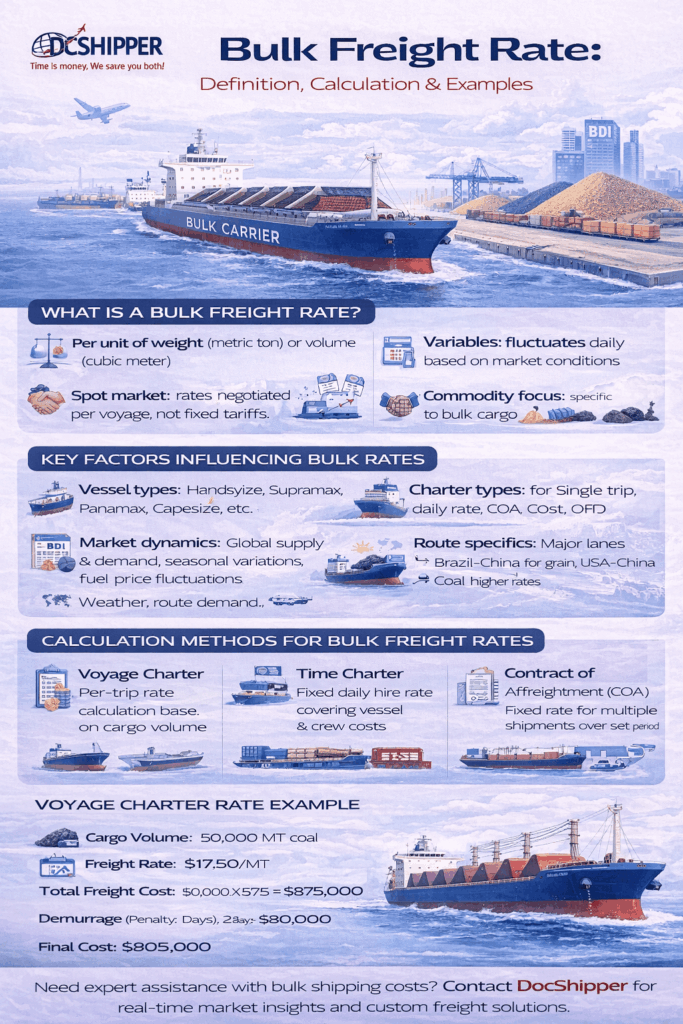
Bulk freight rates typically quote in dollars per metric ton or as a lump sum for the entire voyage. The calculation method depends on charter type and commodity characteristics.
Voyage Charter Rate Calculation
For a voyage charter, the rate covers a single trip from loading port to discharge port. Example:
| Parameter | Value | Calculation |
|---|---|---|
| Cargo Volume | 50,000 MT coal | — |
| Freight Rate | $18.50/MT | — |
| Total Freight Cost | — | 50,000 × $18.50 = $925,000 |
| Demurrage (3 days delay) | $15,000/day | 3 × $15,000 = $45,000 |
| Final Cost | — | $970,000 |
This scenario illustrates how demurrage penalties escalate costs when port operations exceed agreed laytime. Efficient cargo handling becomes financially critical.
Time Charter Equivalent (TCE) Analysis
Shipowners evaluate profitability using TCE rates, which convert voyage earnings into a daily hire rate:
TCE = (Total Freight Revenue – Voyage Costs) / Voyage Duration
Case study: A Panamax vessel earns $1.2 million transporting grain from U.S. Gulf to Japan. Voyage costs (fuel, port fees, canal tolls) total $450,000 over 35 days:
- Net Revenue: $1,200,000 – $450,000 = $750,000
- TCE Rate: $750,000 ÷ 35 days = $21,429/day
Comparing this TCE against current time charter market rates (typically $15,000-$25,000/day for Panamax) reveals whether the voyage is profitable.
Worldscale for Liquid Bulk
Oil tankers use the Worldscale system, a standardized rate index. A Worldscale 100 (WS100) represents the base rate for a specific route. Actual rates quote as percentages:
- WS100 for Persian Gulf-China crude oil route: $25/MT
- Negotiated rate: WS75 (75% of base)
- Effective freight: $25 × 0.75 = $18.75/MT
This system simplifies comparisons across routes and vessel classes while accounting for fuel price fluctuations through built-in adjustments.
Contract of Affreightment (COA) Structures
Long-term agreements fix rates for multiple shipments over months or years. A COA for 500,000 MT iron ore delivered quarterly might guarantee:
| Quarter | Volume (MT) | Fixed Rate ($/MT) | Total Cost |
|---|---|---|---|
| Q1 2024 | 125,000 | $22.00 | $2,750,000 |
| Q2 2024 | 125,000 | $22.00 | $2,750,000 |
| Q3 2024 | 125,000 | $22.00 | $2,750,000 |
| Q4 2024 | 125,000 | $22.00 | $2,750,000 |
| Annual Total | $11,000,000 |
COAs hedge against rate volatility but require accurate demand forecasting. Underutilizing contracted tonnage still incurs costs, while exceeding volumes forces spot market exposure.
DocShipper’s procurement team analyzes historical rate data and forward curves to structure optimal COA terms. We’ve helped mining clients save 18-23% annually by timing renewals during market troughs and negotiating flexible tonnage clauses.
Conclusion
Mastering bulk freight rates requires understanding market dynamics, charter structures, and cost calculation methods. Whether navigating spot market volatility or structuring long-term contracts, informed decision-making protects margins in commodity trading.
Need expert guidance on bulk shipping procurement? Contact DocShipper for tailored freight solutions and real-time market intelligence.
📚 Quiz
Test Your Knowledge: Bulk Freight Rate
Q1 — What is a bulk freight rate?
Q2 — A shipper books a voyage charter for 50,000 MT of coal at $18.50/MT, but port operations are delayed by 3 days. The demurrage rate is $15,000/day. What is the final total cost?
Q3 — An oil tanker route has a Worldscale base rate (WS100) of $25/MT. The negotiated rate is WS75. Which statement correctly describes the effective freight rate?
🎯 Your Result
📞 Free Quote in 24hFAQ | Bulk Freight Rate: Definition, Calculation & Concrete Examples
Vessel availability, fuel prices, seasonal cargo demand, geopolitical events, and port congestion all impact rates. The Baltic Dry Index tracks these variables for dry bulk markets globally.
Dry bulk uses dollar-per-ton or lump sum rates, while liquid bulk (tankers) employs the Worldscale percentage system. Liquid bulk also factors in cargo-specific handling costs like tank cleaning.
Demurrage is a daily penalty when loading/unloading exceeds agreed laytime. Rates typically range $10,000-$30,000/day depending on vessel size, significantly increasing freight expenses if operations delay.
Spot markets offer flexibility and potential savings during rate dips but expose you to volatility. Long-term contracts (COAs) provide budget certainty but may cost more if markets decline. Hybrid strategies often work best.
Larger vessels (Capesize, VLCC) achieve lower per-ton costs through economies of scale but require deep-water ports. Smaller vessels (Handysize) access more ports but charge premium rates per unit.
The BDI aggregates shipping rates across major dry bulk routes and vessel classes. It serves as a leading economic indicator, reflecting global commodity demand and manufacturing activity.
Unlike container shipping, bulk rates are fully negotiable. Factors like cargo flexibility, loading efficiency, and shipper reputation influence final pricing. Market timing is critical for leverage.
BAF clauses allow carriers to adjust rates based on fuel price changes. Post-IMO 2020 regulations, low-sulfur fuel costs increased BAF surcharges by 15-25% on many routes.
TCE = (Freight Revenue - Voyage Costs) / Voyage Days. This metric helps compare voyage profitability against time charter market rates and assess whether to accept specific cargoes.
Laytime is the contractual period allowed for cargo operations without penalty. It's calculated in hours/days based on cargo tonnage and agreed loading/discharge rates (e.g., 10,000 MT/day).
No. Bulk rates cover only ocean transport. Shippers must arrange cargo insurance (marine insurance), customs brokerage, and inland haulage separately unless negotiating door-to-door terms.
Timing depends on market conditions. During tight vessel supply, book 4-6 weeks ahead. In oversupplied markets, waiting until 2-3 weeks before loading may secure better rates.
Need Help with Logistics or Sourcing ?
First, we secure the right products from the right suppliers at the right price by managing the sourcing process from start to finish. Then, we simplify your shipping experience - from pickup to final delivery - ensuring any product, anywhere, is delivered at highly competitive prices.


Fill the Form
Prefer email? Send us your inquiry, and we’ll get back to you as soon as possible.
Contact us


