


In short ⚡
Bulk storage refers to the warehousing method for storing large quantities of unpackaged or loosely packaged goods in dedicated facilities. This logistics solution optimizes space utilization and handling costs for commodities like grains, liquids, minerals, and raw materials, enabling efficient distribution throughout global supply chains.Introduction
Many importers struggle with storage costs when dealing with large commodity volumes. Traditional pallet storage becomes economically inefficient when handling thousands of tons of raw materials. This is where bulk storage becomes essential.
In international trade, bulk storage represents a critical infrastructure component. It bridges production sites and end consumers while maintaining product integrity. The method directly impacts freight costs, inventory management, and supply chain velocity.
Key characteristics of bulk storage include:
- Volume optimization: Maximizes cubic capacity without individual packaging requirements
- Specialized infrastructure: Silos, tanks, open yards, or covered warehouses designed for specific materials
- Handling equipment: Conveyors, pneumatic systems, pumps, or grab cranes for efficient loading/unloading
- Material segregation: Prevents contamination between different commodity batches
- Climate control options: Temperature and humidity management for sensitive bulk goods
Bulk Storage Mechanisms & Expertise
Bulk storage operates through three primary facility types. Dry bulk storage handles solid materials like grains, coal, cement, or minerals in silos or covered warehouses. Liquid bulk storage uses tanks for petroleum products, chemicals, or food-grade liquids. Open-air storage accommodates weather-resistant materials like scrap metal or aggregates.
The selection depends on material properties. Flow characteristics determine handling systems—free-flowing materials need different infrastructure than cohesive powders. Degradation risks influence protection requirements against moisture, oxidation, or temperature fluctuations. Regulatory compliance becomes critical for hazardous or food-grade commodities.
International regulations govern bulk storage operations. The International Maritime Organization (IMO) establishes standards for maritime bulk cargo handling. The IMSBC Code (International Maritime Solid Bulk Cargoes) classifies materials and defines safety protocols during sea transport and storage.
Inventory management systems track bulk quantities through weight-based measurements rather than unit counts. Advanced facilities employ laser scanning, pressure sensors, or radar technology for real-time inventory monitoring. This precision prevents stockouts and optimizes reorder timing.
At DocShipper, we conduct thorough facility assessments before recommending bulk storage solutions. Our logistics experts evaluate material compatibility, throughput requirements, and regulatory compliance to ensure seamless warehouse operations for your import/export activities.
Practical Examples & Data Analysis
Cost efficiency becomes measurable when comparing storage methods. A 10,000-ton grain shipment illustrates the economic advantage:
| Storage Method | Monthly Cost (USD) | Handling Time | Space Required |
|---|---|---|---|
| Bagged Storage (Pallets) | $45,000 | 72 hours | 8,500 m² |
| Bulk Silo Storage | $18,000 | 18 hours | 3,200 m² |
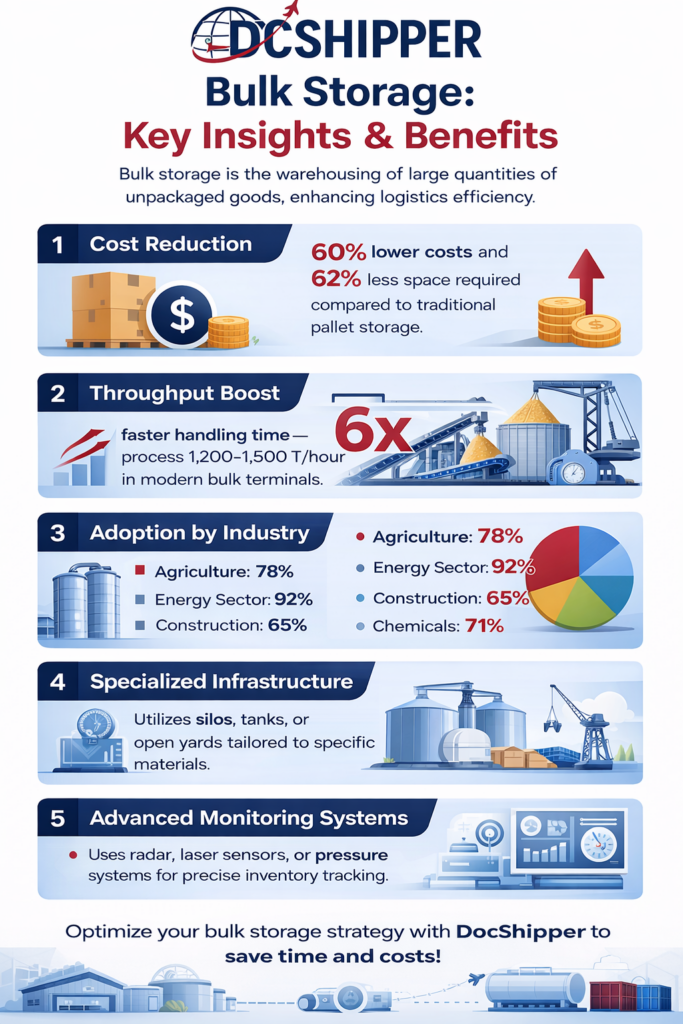
The comparison reveals 60% cost reduction and 75% faster turnaround. Space utilization improves by 62%, freeing warehouse capacity for additional inventory.
Real-world application: A European chemical importer transitioned from drum storage to bulk tank farms. The initial infrastructure investment of $2.3 million generated annual savings of $890,000 through reduced packaging costs, labor expenses, and disposal fees. ROI was achieved within 2.6 years.
Industry data shows bulk storage adoption varies by sector:
- Agriculture: 78% of grain imports utilize bulk facilities
- Energy sector: 92% of petroleum products stored in bulk tanks
- Construction materials: 65% adoption rate for cement and aggregates
- Food processing: 54% of raw ingredients handled in bulk systems
- Chemical industry: 71% of industrial chemicals stored in bulk infrastructure
Throughput capacity directly correlates with facility design. Modern automated bulk terminals process 1,200-1,500 tons per hour, compared to 180-250 tons per hour for conventional warehouses. This 6x efficiency gain reduces demurrage charges and accelerates inventory turnover.
Conclusion
Bulk storage transforms commodity logistics through cost reduction, space optimization, and operational efficiency. Understanding facility types and material requirements enables strategic warehouse decisions that strengthen supply chain competitiveness.
Need expert guidance on bulk storage solutions for your import/export operations? Contact DocShipper for customized logistics consulting.
📚 Quiz
Test Your Knowledge: Bulk Storage
Q1. What best defines bulk storage in logistics?
Q2. How is inventory quantity typically tracked in a bulk storage facility?
Q3. A European chemical importer switches from drum storage to bulk tank farms. Based on the article data, which outcome is most accurate?
🎯 Your Result
📞 Free Quote in 24hFAQ | Bulk Storage: Definition, Types & Practical Applications
Commodities like grains, coal, cement, petroleum, chemicals, minerals, sugar, and fertilizers work best. Materials must tolerate minimal packaging and allow mechanical handling without quality degradation.
It eliminates individual packaging expenses, reduces labor through automation, maximizes warehouse space utilization, and accelerates loading/unloading operations, cutting overall supply chain costs by 40-65%.
Facilities must comply with OSHA standards, IMO guidelines, local fire codes, environmental protection regulations, and industry-specific requirements like FDA rules for food-grade materials or ATEX directives for explosive atmospheres.
Yes, with proper climate control. Refrigerated bulk tanks store liquid foods, while temperature-controlled silos handle grains. Monitoring systems prevent spoilage through precise environmental management.
Capacities range from 500 tons for small silos to 100,000+ tons for major port terminals. Selection depends on throughput requirements, inventory turnover rates, and available land area.
Weight-based systems using load cells, pressure sensors, radar level indicators, or laser scanning technology provide real-time quantity monitoring. Advanced facilities integrate with ERP systems for automated reordering.
Vertical silos for dry materials, horizontal tanks for liquids, covered warehouses for weather-sensitive goods, open stockpiles for durable commodities, and specialized containers for temperature-controlled storage.
Duration varies by material. Grains last 6-12 months with proper aeration, petroleum products remain stable for years, while cement requires use within 3-6 months to prevent hydration issues.
Coverage should address contamination risks, fire hazards, structural failures, environmental liability, and cargo damage. Policies typically require regular facility inspections and compliance documentation.
Bulk shipments require accurate weight declarations, proper commodity classification, and sometimes sampling for quality verification. Customs may mandate specific storage conditions for bonded warehouses holding dutiable goods.
Facilities must prevent dust emissions, manage runoff contamination, control odors, implement spill containment systems, and comply with air quality standards. Environmental permits are mandatory for most operations.
Absolutely. Modern facilities integrate blending, packaging, quality testing, and distribution services. This value-added approach creates logistics hubs that streamline supply chain operations beyond simple storage.
Need Help with Logistics or Sourcing ?
First, we secure the right products from the right suppliers at the right price by managing the sourcing process from start to finish. Then, we simplify your shipping experience - from pickup to final delivery - ensuring any product, anywhere, is delivered at highly competitive prices.


Fill the Form
Prefer email? Send us your inquiry, and we’ll get back to you as soon as possible.
Contact us


