



In short ⚡
Burn rate is the speed at which a company depletes its cash reserves to cover operating expenses before generating positive cash flow. This financial metric measures monthly cash consumption, critical for startups and businesses in expansion phases to assess runway and financial sustainability.
Introduction
Many logistics and import/export companies fail not due to poor market demand, but because they run out of cash before reaching profitability. The burn rate reveals how quickly capital evaporates when operational costs exceed revenue—a common scenario during international expansion, warehouse setup, or customs compliance investments.
In global trade operations, understanding burn rate becomes essential when companies invest heavily in infrastructure, inventory, or compliance systems before sales stabilize. A freight forwarder opening new offices across three continents, or an importer building inventory for seasonal demand, must monitor this metric religiously.
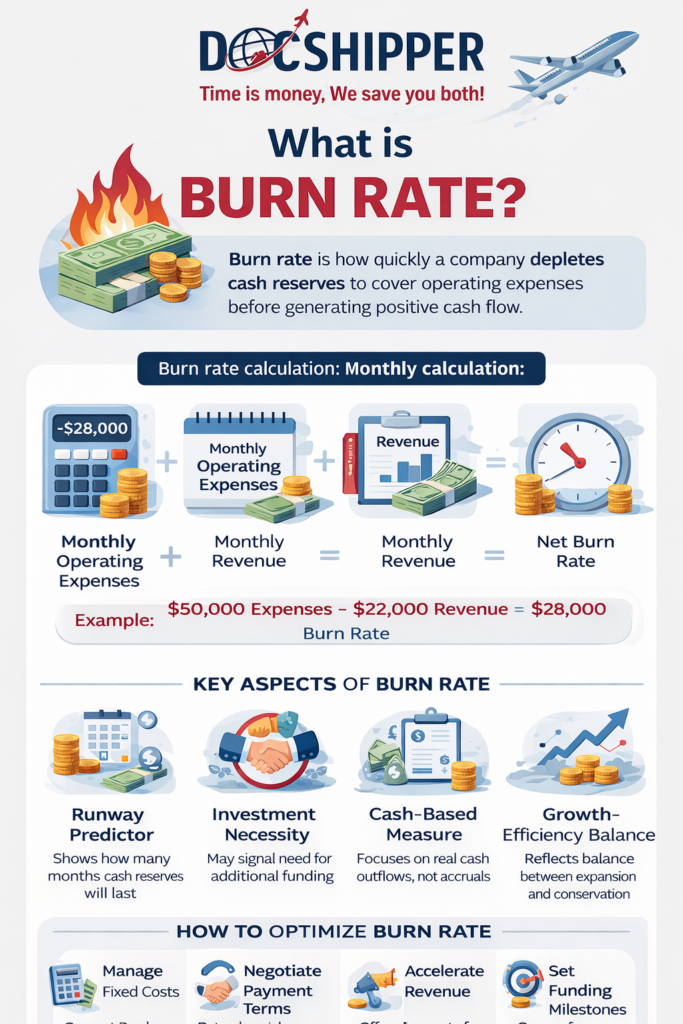
Key characteristics of burn rate in logistics context:
- Cash-based measurement: Focuses on actual outflows, not accounting profits
- Time-sensitive indicator: Typically calculated monthly to track short-term sustainability
- Runway predictor: Determines how many months operations can continue with existing capital
- Investment signal: High burn rate may necessitate additional funding rounds or operational adjustments
- Growth vs. efficiency balance: Reflects strategic choices between rapid expansion and conservative cash management
Understanding Burn Rate & Financial Implications
Burn rate manifests in two distinct forms: gross burn rate and net burn rate. Gross burn rate represents total monthly cash expenditures regardless of income, while net burn rate subtracts monthly revenue from expenses, showing actual cash depletion. For logistics companies, the distinction matters significantly during contract negotiations or seasonal fluctuations.
The runway calculation directly derives from burn rate: divide available cash by monthly net burn to determine survival months. A customs brokerage with $500,000 in reserves and $50,000 monthly net burn has a 10-month runway—time to achieve profitability or secure additional capital.
Several factors accelerate burn rate in international trade operations. Regulatory compliance costs for new markets often spike unexpectedly. Warehouse lease commitments, technology infrastructure for customs management systems, and staff expansion to handle increased volume all contribute to cash depletion. Insurance premiums for cargo and liability coverage represent fixed costs that persist regardless of transaction volume.
The cash conversion cycle in logistics creates unique burn rate challenges. Companies often pay carriers, warehouse operators, and staff before receiving payment from clients. Net 30 or Net 60 payment terms mean revenue lags expenses by weeks or months, artificially inflating burn rate during growth phases.
According to the Bank for International Settlements, trade finance gaps and payment delays significantly impact working capital requirements for companies engaged in cross-border commerce. At DocShipper, we structure payment milestones aligned with shipment progress to help clients manage cash flow and reduce effective burn rate during complex international operations.
Calculation Methods & Concrete Examples
Calculating burn rate requires precise tracking of cash movements, not accrual accounting figures. The formula is straightforward but demands discipline in financial record-keeping:
Net Burn Rate = Monthly Operating Expenses – Monthly Revenue
For logistics companies, operating expenses typically include:
- Staff salaries and contractor payments
- Warehouse and office rent
- Technology subscriptions (TMS, customs software, CRM)
- Insurance premiums (cargo, liability, professional indemnity)
- Marketing and business development costs
Concrete Use Case: Freight Forwarder Expansion
A European freight forwarder decides to open operations in Southeast Asia. Initial setup costs and monthly burn rate analysis:
| Expense Category | Monthly Cost (USD) |
|---|---|
| Office lease (3 locations) | $12,000 |
| Staff salaries (15 employees) | $35,000 |
| Technology & software licenses | $4,500 |
| Insurance & compliance | $6,000 |
| Marketing & client acquisition | $8,500 |
| Total Monthly Expenses | $66,000 |
| Monthly Revenue (Months 1-6) | $22,000 |
| Net Burn Rate | $44,000 |
With $350,000 in expansion capital and a $44,000 monthly net burn rate, this company has approximately 8 months of runway. If revenue doesn’t increase substantially by month 6, they must either reduce costs, secure additional funding, or risk operational shutdown.
Optimization Strategies
Scenario planning helps logistics companies model different burn rate trajectories. Creating best-case, realistic, and worst-case projections allows management to establish triggers for cost reduction or fundraising initiatives before cash reserves deplete critically.
Variable cost conversion reduces fixed burn rate exposure. Using independent contractor networks instead of full-time staff, or partnering with established warehouse operators rather than leasing dedicated space, transforms fixed monthly costs into variable expenses tied to transaction volume.
Revenue acceleration tactics directly impact net burn rate. Offering discounts for advance payment, implementing deposit requirements for new clients, or factoring receivables converts future revenue into immediate cash, effectively reducing the burn rate calculation.
Milestone-based funding aligns capital injection with operational achievements. Rather than raising large amounts upfront, securing commitments for tranched funding based on revenue targets or client acquisition metrics provides safety nets without diluting ownership prematurely.
Industry benchmarks suggest logistics startups should target reaching breakeven within 18-24 months of launch. Companies burning through capital faster than planned must demonstrate clear paths to profitability or risk investor confidence erosion. DocShipper maintains disciplined financial controls and transparent milestone tracking to ensure sustainable growth without excessive cash consumption during market entry phases.
Conclusion
Burn rate represents more than an accounting metric—it’s a survival indicator for logistics companies navigating capital-intensive international expansion. Understanding calculation methods, monitoring trends, and implementing optimization strategies separates sustainable operations from cash-strapped failures.
Need expert guidance on managing financial metrics during your international logistics expansion? Contact DocShipper for strategic consultation on sustainable growth planning.
📚 Quiz
Test Your Knowledge: Burn Rate
1. What does "burn rate" measure in a business context?
2. A logistics startup has $350,000 in capital and a net burn rate of $44,000/month. Is a high burn rate always a sign of poor financial management?
3. A freight forwarder has $300,000 in cash reserves and spends $50,000/month while generating $20,000/month in revenue. How many months of runway does it have?
🎯 Your Result
📞 Free Quote in 24hFAQ | Burn Rate: Definition, Calculation & Concrete Examples
Gross burn rate measures total monthly cash expenditures regardless of income, while net burn rate subtracts monthly revenue from expenses, showing actual cash depletion. Net burn rate provides a more accurate picture of financial sustainability.
Divide your current cash reserves by monthly net burn rate. For example, $300,000 in cash with $30,000 monthly net burn gives you a 10-month runway before capital exhaustion.
Not necessarily. High burn rate during strategic expansion or market entry can be justified if accompanied by proportional revenue growth and clear paths to profitability. The key is intentional spending aligned with growth objectives.
Industry standards suggest maintaining at least 12-18 months of runway. Acceptable burn rate depends on capital availability, revenue growth trajectory, and investor expectations. Most successful logistics startups target breakeven within 24 months.
Longer payment terms from suppliers reduce immediate cash outflow, lowering burn rate. Conversely, offering clients extended terms increases the period between expense and revenue collection, temporarily raising effective burn rate.
One-time capital expenditures should be separated from recurring monthly burn rate calculations. Track them independently to avoid distorting the monthly operational cash consumption metric used for runway projections.
Monthly reviews are standard, but companies in rapid growth phases or facing cash constraints should monitor weekly. Real-time dashboards tracking cash position and major expenditures enable proactive management.
When runway drops below 6 months, or when actual burn rate exceeds projections by 20% for two consecutive months, immediate cost reduction initiatives become critical to avoid cash crisis.
Yes, but calculate both peak and off-season burn rates separately. Use weighted annual averages and maintain sufficient reserves to cover high-burn months when revenue drops but fixed costs continue.
Investors assess burn rate relative to revenue growth, market opportunity size, and competitive positioning. They look for efficient customer acquisition costs and clear unit economics demonstrating eventual profitability.
Customer acquisition cost (CAC) directly impacts burn rate—the marketing and sales expenses required to gain each client. High CAC with slow revenue ramp-up accelerates burn rate and shortens runway.
Yes, all cash outflows including founder compensation should be included for accurate burn rate calculation. Some early-stage companies defer founder salaries to extend runway, but this should be explicitly noted in financial projections.
Need Help with Logistics or Sourcing ?
First, we secure the right products from the right suppliers at the right price by managing the sourcing process from start to finish. Then, we simplify your shipping experience - from pickup to final delivery - ensuring any product, anywhere, is delivered at highly competitive prices.


Fill the Form
Prefer email? Send us your inquiry, and we’ll get back to you as soon as possible.
Contact us


