In short ⚡
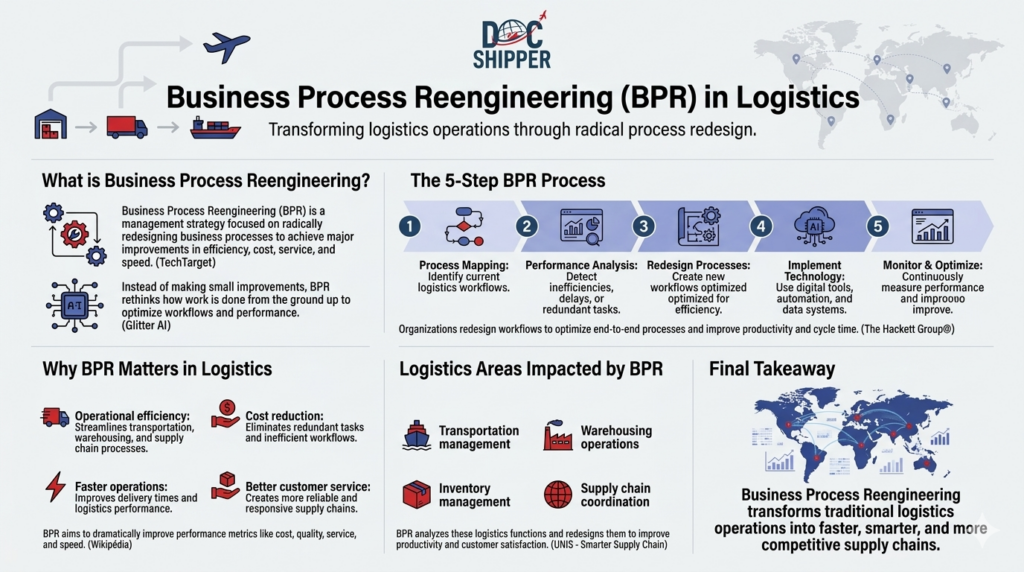
Business Process Reengineering (BPR) is a management strategy involving the radical redesign of core business processes to achieve dramatic improvements in productivity, cycle times, and quality. Unlike incremental optimization, BPR fundamentally rethinks how work is done to deliver superior value.Introduction
Many companies struggle with outdated workflows that slow operations and inflate costs. Traditional process improvement offers marginal gains, but global competition demands transformational change.
Business Process Reengineering emerged in the 1990s as a solution to systemic inefficiencies. In international logistics and supply chain management, BPR enables companies to eliminate redundancies, accelerate shipments, and reduce operational expenses dramatically.
Key characteristics of BPR include:
- Radical redesign rather than incremental improvements
- Process-centric focus replacing departmental silos
- Technology enablement leveraging digital tools for automation
- Customer-oriented outcomes prioritizing end-user value
- Cross-functional integration breaking organizational barriers
BPR Methodology & Strategic Framework
Business Process Reengineering follows a structured approach beginning with process identification. Organizations map existing workflows to identify critical processes impacting customer satisfaction and profitability. In logistics, this includes order fulfillment, customs clearance, and inventory management.
The next phase involves process analysis where teams question fundamental assumptions. Why does a shipment require seven approval steps? Can customs documentation be automated? This critical examination reveals inefficiencies embedded in legacy systems.
Process redesign represents the core BPR activity. Teams envision ideal workflows unconstrained by current limitations. For freight forwarding, this might mean consolidating multiple touchpoints into a single digital platform where clients track shipments in real-time.
Implementation requires change management strategies addressing employee resistance. Training programs, communication campaigns, and leadership commitment ensure successful adoption. According to research from the International Organization for Standardization, organizations with robust change management are 3.5 times more likely to achieve BPR objectives.
Finally, continuous monitoring measures performance against defined metrics. Key Performance Indicators (KPIs) track cycle time reduction, cost savings, and error rates. At DocShipper, we apply BPR principles to streamline customs processes, reducing clearance times by up to 40% for our clients.
Implementation Cases & Performance Data
Real-world BPR applications demonstrate measurable impact across industries. Consider these documented examples:
| Industry | Process Redesigned | Result |
|---|---|---|
| Manufacturing | Order-to-delivery workflow | 78% cycle time reduction |
| Logistics | Customs documentation | 60% faster clearance |
| E-commerce | Returns management | 50% cost reduction |
| Freight forwarding | Quote-to-booking process | 85% faster response time |
Case Study: International Shipping Optimization
A European importer faced 12-day average customs clearance due to fragmented documentation processes. After BPR implementation:
- Consolidated 23 documents into 5 digital forms
- Automated compliance checks using AI validation
- Integrated real-time tracking with customs authorities
- Reduced clearance time to 4.5 days (62% improvement)
- Decreased documentation errors by 91%
Financial impact quantification reveals BPR’s value. Research indicates companies achieve average cost reductions of 30-50% in reengineered processes. Operational efficiency gains translate to improved cash flow and competitive positioning.
Technology plays a crucial role. Cloud-based platforms, robotic process automation (RPA), and blockchain enable process transformation previously impossible. Modern logistics providers leverage these tools to create seamless customer experiences.
DocShipper Platform
Cut logistics costs. Not corners.
See exactly where your logistics costs are bleeding — and how to fix it. Book your expert demo.

Conclusion
Business Process Reengineering offers transformational potential for organizations willing to challenge conventional workflows. In international logistics, BPR eliminates bottlenecks that delay shipments and inflate costs.
Need expert guidance implementing BPR in your supply chain operations? Contact DocShipper to discover how our optimized processes deliver faster, more reliable international shipping.
📚 Quizz
Test Your Knowledge: Business Process Reengineering (BPR)
Q1 — What best defines Business Process Reengineering (BPR)?
Q2 — A common misconception about BPR is that it simply optimizes existing processes. What does BPR actually do differently?
Q3 — A European importer applies BPR to its customs clearance process, consolidating 23 documents into 5 digital forms and automating compliance checks. What outcome best reflects a successful BPR result in this scenario?
🎯 Your Result
📞 Free Quote in 24hFAQ | Business Process Reengineering (BPR): Definition, Methodology & Concrete Examples
BPR seeks radical transformation through complete process redesign, while continuous improvement focuses on incremental enhancements to existing workflows. BPR questions fundamental assumptions rather than optimizing current methods.
Implementation timelines vary from 6 to 18 months depending on process complexity and organizational readiness. Pilot programs often launch within 3-4 months to demonstrate value before full-scale deployment.
Primary failure causes include inadequate change management, insufficient leadership support, unrealistic expectations, and technology-first approaches that ignore human factors. Approximately 50-70% of BPR initiatives fail without proper planning.
Absolutely. Small businesses often achieve faster BPR results due to organizational agility. Focused reengineering of critical processes like order fulfillment or customer service delivers proportionally greater impact.
Prioritize processes with high customer impact, significant cost implications, or severe performance gaps. In logistics, customs clearance, shipment tracking, and documentation management typically offer maximum reengineering value.
Reengineering typically reduces manual tasks while expanding decision-making authority. Employees transition from specialized functions to broader process ownership, requiring reskilling and cross-functional training.
Essential technologies include workflow automation platforms, data analytics tools, cloud infrastructure, and integration software. Investment levels depend on process scope, with cloud solutions offering scalable, cost-effective options.
Key metrics include cycle time reduction, cost per transaction, error rates, customer satisfaction scores, and employee productivity. Baseline measurements before redesign enable quantifiable impact assessment.
BPR remains highly relevant as digital transformation's strategic foundation. Modern technologies enable radical process redesigns previously impossible, making BPR principles more applicable than ever.
Customer insights identify pain points driving redesign priorities. Voice-of-customer data reveals which process improvements deliver maximum value, ensuring reengineering efforts align with market needs.
International logistics represents an ideal BPR application due to inherent complexity, regulatory requirements, and multiple stakeholder coordination. Reengineering customs processes, documentation workflows, and shipment tracking yields substantial efficiency gains.
Quarterly performance reviews identify optimization opportunities, while comprehensive reassessments every 2-3 years ensure processes remain aligned with evolving business requirements and technological capabilities.
Need Help with
Logistics or Sourcing ?
First, we secure the right products from the right suppliers at the right price by managing the sourcing process from start to finish. Then, we simplify your shipping experience - from pickup to final delivery - ensuring any product, anywhere, is delivered at highly competitive prices.


Fill the Form
Prefer email? Send us your inquiry, and we’ll get back to you as soon as possible.
Contact us