In short ⚡
Buyer behavior refers to the decision-making processes and actions consumers undertake when purchasing goods or services. It encompasses psychological, social, and economic factors influencing purchase decisions, timing, and preferences. Understanding buyer behavior enables businesses to optimize marketing strategies, improve customer satisfaction, and enhance supply chain responsiveness.Introduction
Why do some products fly off shelves while others stagnate? The answer lies in buyer behavior—the complex interplay of motivations, perceptions, and external influences driving purchase decisions.
In international trade and logistics, understanding buyer behavior is critical. It determines inventory levels, shipping frequencies, packaging requirements, and market entry strategies. Misreading consumer preferences can lead to overstocking, obsolete inventory, or missed market opportunities.
- Purchase triggers: Emotional, rational, or situational factors initiating buying decisions
- Decision journey: The multi-stage process from awareness to post-purchase evaluation
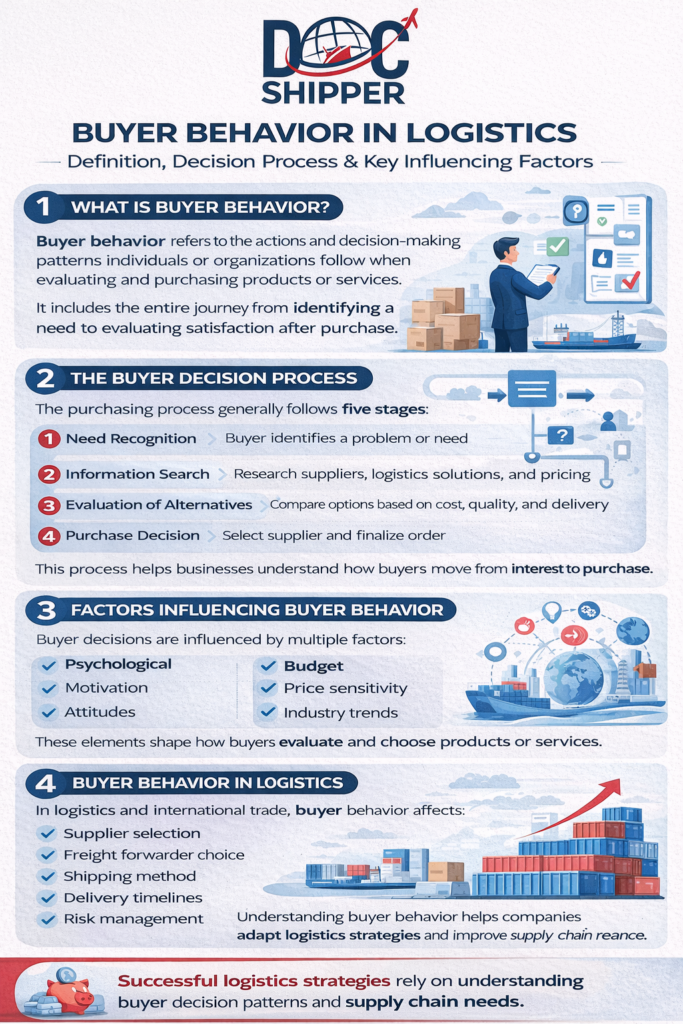
- Influencing factors: Cultural norms, social proof, economic conditions, and personal preferences
- Channel preferences: Online versus offline, direct versus intermediary purchasing patterns
- Loyalty drivers: Elements fostering repeat purchases and brand advocacy
In-Depth Analysis & Expertise
Buyer behavior operates through distinct psychological and behavioral mechanisms. The consumer decision-making process typically follows five stages: need recognition, information search, evaluation of alternatives, purchase decision, and post-purchase behavior. Each stage presents opportunities and challenges for importers and exporters.
Cultural dimensions significantly impact purchasing patterns. Hofstede’s cultural dimensions theory demonstrates how individualism versus collectivism, uncertainty avoidance, and power distance shape consumer preferences across markets. Products successful in Western markets may require substantial adaptation for Asian or Middle Eastern consumers.
The psychological pricing effect influences perceived value. Charm pricing (ending prices in .99) increases sales in price-sensitive markets, while prestige pricing positions products as premium. International logistics must account for these strategies when determining packaging sizes and shipment quantities.
Reference groups and social influence drive conformity and aspiration-based purchases. Social media amplifies this effect, with influencer marketing creating rapid demand spikes. According to the European Commission’s consumer behavior studies, 68% of European consumers consult online reviews before purchasing imported goods.
At DocShipper, we analyze buyer behavior patterns to optimize inventory positioning across our warehousing network. By understanding seasonal demand fluctuations and cultural purchasing cycles, we help clients reduce lead times and improve order fulfillment rates.
The omnichannel experience now defines modern buyer behavior. Consumers research online, compare prices across platforms, and may purchase through multiple touchpoints. This requires synchronized logistics supporting both e-commerce fulfillment and traditional retail distribution.
Concrete Examples & Data
Understanding buyer behavior through real-world scenarios illustrates its impact on international logistics and supply chain decisions.
Use Case: Seasonal Electronics Import
A European electronics importer analyzed buyer behavior data showing 73% of annual gaming console sales occur between October and December. By front-loading shipments from Asian manufacturers in August-September, they reduced air freight costs by 42% while maintaining 98% stock availability during peak demand. Pre-positioning inventory in regional distribution centers based on historical purchasing patterns cut delivery times from 7 days to 2 days.
Comparative Analysis: B2B vs. B2C Buyer Behavior
| Factor | B2B Behavior | B2C Behavior |
|---|---|---|
| Decision timeframe | 3-12 months average | Minutes to days |
| Purchase drivers | ROI, specifications, reliability | Emotion, convenience, price |
| Stakeholders involved | 5-8 decision-makers | 1-2 individuals |
| Order frequency | Scheduled, contractual | Impulse or planned |
| Logistics requirement | Bulk shipments, predictable | Small parcels, variable |
DocShipper Platform
Optimize Your Global Logistics with Cutting-Edge Solutions
Enhance efficiency, cut costs, and gain 24/7 visibility  over your entire supply chain.
- Cut your shipping costs and maximize your margins
- Manage sourcing, freight, & customs on one platform
- Get real-time tracking and analytics
Key Behavioral Insights for Logistics Planning
- Price sensitivity varies by category: Commodity products show 85% price elasticity, while premium/luxury items demonstrate only 23% sensitivity to price changes.
- Mobile commerce acceleration: 61% of global e-commerce transactions now occur on mobile devices, requiring logistics solutions supporting same-day or next-day delivery.
- Sustainability influence: 47% of European consumers pay premium prices for eco-friendly packaging and carbon-neutral shipping options.
- Return behavior patterns: Fashion e-commerce experiences 30-40% return rates, necessitating reverse logistics infrastructure.
- Regional payment preferences: Cash-on-delivery remains dominant in 68% of Southeast Asian markets, affecting order confirmation and fulfillment timing.
Conclusion
Buyer behavior analysis transforms logistics from reactive operations to strategic competitive advantage. By aligning supply chain decisions with consumer psychology and purchasing patterns, businesses optimize inventory, reduce costs, and improve customer satisfaction.
Need expert guidance on adapting your logistics strategy to buyer behavior trends? Contact DocShipper for customized solutions supporting your international trade operations.
📚 Quiz
Test Your Knowledge: Buyer Behavior
Q1 — What does "buyer behavior" refer to in the context of international trade and logistics?
Q2 — A common misconception is that B2B and B2C buyer behavior are essentially the same. What is a key difference between them?
Q3 — A European electronics importer notices that 73% of gaming console sales happen between October and December. Based on buyer behavior analysis, what is the most effective logistics strategy?
🎯 Your Result
📞 Free Quote in 24hFAQ | Buyer Behavior: Definition, Analysis & Practical Examples
Cultural values, economic conditions, legal frameworks, language barriers, and local competition shape purchasing decisions. Payment methods, trust in foreign brands, and logistics reliability also significantly impact cross-border buyer behavior.
Emerging markets show higher price sensitivity, preference for cash transactions, and stronger influence from family/community. Developed markets prioritize convenience, sustainability, and personalized experiences, with greater adoption of digital purchasing channels.
Packaging influences 72% of purchase decisions at point-of-sale. It communicates quality, protects products during transit, and must comply with local regulations. Sustainable packaging increasingly drives purchasing among environmentally-conscious consumers.
Analyze historical sales data, monitor social media trends, conduct market research surveys, and track competitor activities. Predictive analytics using machine learning models can forecast demand shifts with 75-85% accuracy when properly trained.
Impulse buying refers to unplanned purchases triggered by emotional responses or strategic product placement. It requires flexible logistics supporting rapid order fulfillment, proximity warehousing, and efficient last-mile delivery to capitalize on spontaneous demand.
Seasonal patterns create predictable demand spikes (holidays, weather changes, cultural events). Importers must forecast 3-6 months ahead, pre-position inventory, and secure shipping capacity during peak seasons to avoid stockouts and premium freight rates.
The buyer's journey encompasses awareness, consideration, decision, and post-purchase stages. Each stage requires different logistics support—from product availability during research to fast delivery during decision and easy returns post-purchase.
Color symbolism, size preferences, flavor profiles, and product functionality vary culturally. Red signifies luck in China but danger in Western markets. Japanese consumers prefer compact packaging while Americans favor bulk sizes. Understanding these nuances prevents costly market entry mistakes.
Social proof (reviews, ratings, testimonials) influences 93% of online purchase decisions. Products with 50+ positive reviews convert 4.6 times better than those without. Logistics must support rapid fulfillment to generate positive post-purchase experiences driving reviews.
Behavioral analytics reveal purchase frequency, preferred quantities, and seasonal patterns. This enables just-in-time inventory strategies, reduces holding costs by 25-40%, and improves stock turnover rates while maintaining service levels above 95%.
Cart abandonment occurs when shoppers add items but don't complete purchases. High shipping costs cause 48% of abandonments. Offering transparent pricing, multiple delivery options, and competitive shipping rates reduces abandonment by 20-35%.
Gen Z prioritizes sustainability and social media influence; Millennials value experiences and convenience; Gen X focuses on quality and value; Boomers prefer traditional channels and personal service. Multi-channel logistics strategies must accommodate these diverse preferences simultaneously.
Need Help with
Logistics or Sourcing ?
First, we secure the right products from the right suppliers at the right price by managing the sourcing process from start to finish. Then, we simplify your shipping experience - from pickup to final delivery - ensuring any product, anywhere, is delivered at highly competitive prices.


Fill the Form
Prefer email? Send us your inquiry, and we’ll get back to you as soon as possible.
Contact us