



In short ⚡
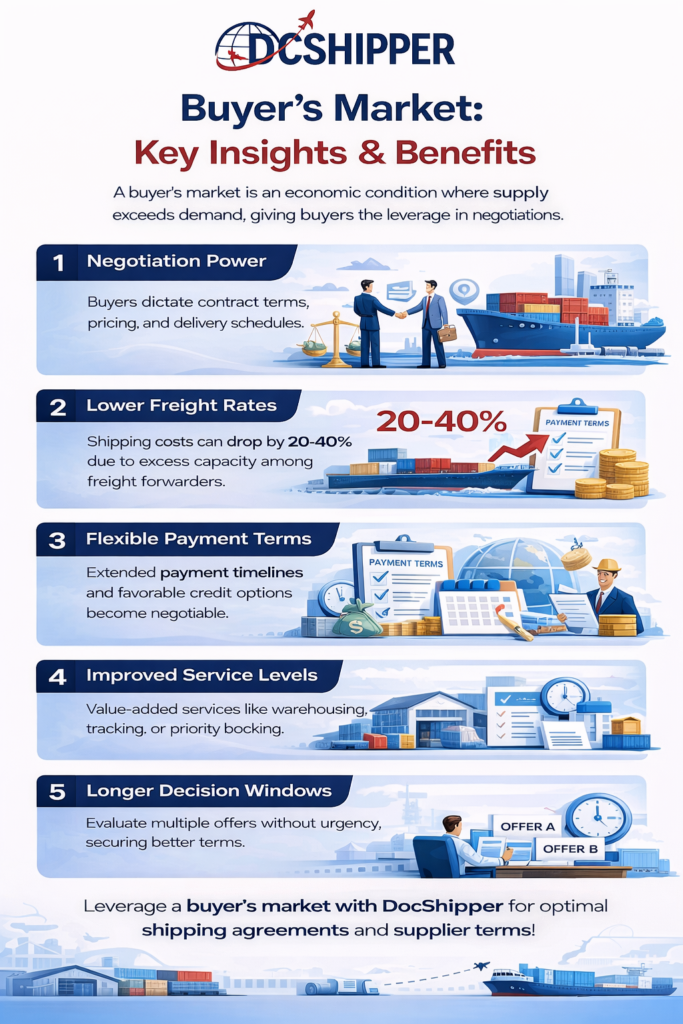
A Buyer's Market is an economic condition where supply exceeds demand, giving purchasers significant negotiating power over pricing, terms, and delivery conditions. This market dynamic forces sellers to compete aggressively, often reducing margins to secure contracts in international trade and logistics.
Introduction
Many importers struggle to identify the right moment to negotiate favorable shipping rates or secure better supplier terms. Understanding whether you’re operating in a buyer’s or seller’s market directly impacts your procurement strategy and bottom line.
In international logistics, a buyer’s market emerges when freight capacity outpaces cargo volume, or when manufacturing output exceeds global demand. This imbalance creates opportunities for cost optimization but requires strategic timing and market awareness.
Key characteristics of a buyer’s market include:
- Excess capacity: More available shipping space than cargo volume
- Price competition: Freight forwarders and suppliers reduce rates to attract clients
- Extended payment terms: Sellers offer flexible financing to close deals
- Enhanced service offerings: Value-added services become negotiation tools
- Longer decision cycles: Buyers can compare multiple offers without urgency
Market Mechanisms & Strategic Implications
A buyer’s market fundamentally shifts the balance of power in commercial negotiations. When supply exceeds demand, sellers must differentiate through pricing, service quality, or contractual flexibility rather than simply offering availability.
In maritime shipping, this phenomenon becomes evident when vessel utilization rates drop below 85%. Carriers begin offering spot rate discounts of 20-40% to fill empty containers. The World Shipping Council tracks these fluctuations through weekly container rate indices.
From a procurement perspective, strategic sourcing becomes more effective. Buyers can leverage competitive tension between suppliers by requesting parallel quotes and extending evaluation periods. This approach reduces rushed decisions and improves contract terms.
The inventory management strategy also changes. Companies can adopt just-in-time practices with less risk since supplier reliability improves when they’re competing for orders. Lead times often shorten as manufacturers prioritize confirmed buyers.
However, a persistent buyer’s market may signal economic weakness. Reduced demand often correlates with recession indicators, requiring buyers to balance short-term savings against long-term supplier viability. At DocShipper, we monitor market conditions to advise clients on optimal procurement timing while ensuring supply chain continuity.
Legal considerations include contract renegotiation clauses. Buyers should include market-adjustment provisions allowing price revisions if conditions shift dramatically. The International Chamber of Commerce provides model clauses for such scenarios in their Incoterms guidelines.
Concrete Examples & Data Analysis
The 2023 post-pandemic shipping market exemplifies a classic buyer’s market transition. Container rates from Shanghai to Los Angeles dropped from $15,000 per FEU in September 2021 to $2,500 by October 2023—an 83% decrease reflecting overcapacity.
| Market Condition | Buyer’s Market | Seller’s Market |
|---|---|---|
| Negotiation Power | Buyer controls terms | Seller dictates conditions |
| Pricing Trend | Declining or stable | Rising rapidly |
| Lead Times | Shorter (1-2 weeks) | Extended (4-8 weeks) |
| Service Quality | Enhanced to attract buyers | Minimal—availability priority |
| Contract Flexibility | High (volume adjustments allowed) | Rigid (fixed commitments) |
Use Case: Electronics Importer Strategy
A European electronics distributor importing from Shenzhen capitalized on 2023’s buyer’s market by renegotiating annual contracts. Previously paying €8,500 per 40ft container with 30-day payment terms, they secured:
- €5,200 per container rate (39% reduction)
- 60-day payment terms
- Free warehousing for 10 days at destination port
- Priority booking during peak season
This saved €264,000 annually on 80 container shipments while improving cash flow management.
At DocShipper, we track real-time market indicators across 150+ trade lanes, alerting clients when buyer’s market conditions emerge. Our procurement team leverages these windows to lock in multi-year contracts at optimal rates.
Conclusion
Recognizing and exploiting buyer’s market conditions separates strategic importers from reactive ones. The ability to negotiate aggressively when supply exceeds demand directly impacts profitability and competitive positioning.
Need expert guidance on market timing and contract negotiation? Contact DocShipper for a customized procurement strategy aligned with current market dynamics.
📚 Quiz
Test Your Knowledge: Buyer's Market
Q1 — What best defines a Buyer's Market in international logistics?
Q2 — A persistent buyer's market in shipping can sometimes be a warning sign. What does it often indicate?
Q3 — A European importer is considering locking in a 18-month freight contract. Container spot rates have been falling for 10 consecutive weeks and vessel utilization is at 82%. What is the most strategic move?
🎯 Your Result
📞 Free Quote in 24hFAQ | Buyer's Market: Definition, Impact & Strategic Examples
Monitor container rate indices (Freightos Baltic Index), vessel utilization rates below 85%, and increasing blank sailings. Declining spot rates over 8-12 weeks signal buyer's market conditions.
A buyer's market features excess supply giving purchasers negotiation power, while a seller's market has limited supply allowing providers to dictate terms and pricing.
Yes. Asia-Europe lanes may experience buyer's conditions while Trans-Pacific routes remain tight due to regional capacity imbalances and demand variations.
Strategic buyers lock favorable rates through 12-24 month contracts when markets bottom out, but include renegotiation clauses if conditions worsen further.
Historical cycles range from 6 months to 3 years. The 2016-2019 period saw prolonged buyer's conditions, while 2020-2021 shifted rapidly to seller's dominance.
Pushing suppliers too hard may compromise service quality, priority treatment, or long-term relationships. Balance cost savings with partnership sustainability.
Air freight shows less volatility due to limited capacity expansion. Buyer's markets are milder (10-20% rate drops) compared to ocean's 40-60% swings.
Brokers often bundle services or reduce per-shipment fees to retain volume. Expect 15-25% negotiation room on standard clearance charges during soft markets.
Often yes. Persistent excess capacity reflects weakening consumer demand. The 2008 financial crisis and 2023 slowdown both created extended buyer's markets.
Monitor global PMI indices, container production rates, vessel order books, and inventory-to-sales ratios. Combined indicators forecast transitions 3-6 months ahead.
We provide real-time rate benchmarking across carriers, negotiate volume discounts through consolidated buying power, and structure contracts with protective clauses for market volatility.
Both benefit differently. New importers gain easier market entry with lower barriers, while established buyers leverage existing relationships for premium service at reduced costs.
Need Help with Logistics or Sourcing ?
First, we secure the right products from the right suppliers at the right price by managing the sourcing process from start to finish. Then, we simplify your shipping experience - from pickup to final delivery - ensuring any product, anywhere, is delivered at highly competitive prices.


Fill the Form
Prefer email? Send us your inquiry, and we’ll get back to you as soon as possible.
Contact us


