


In short ⚡
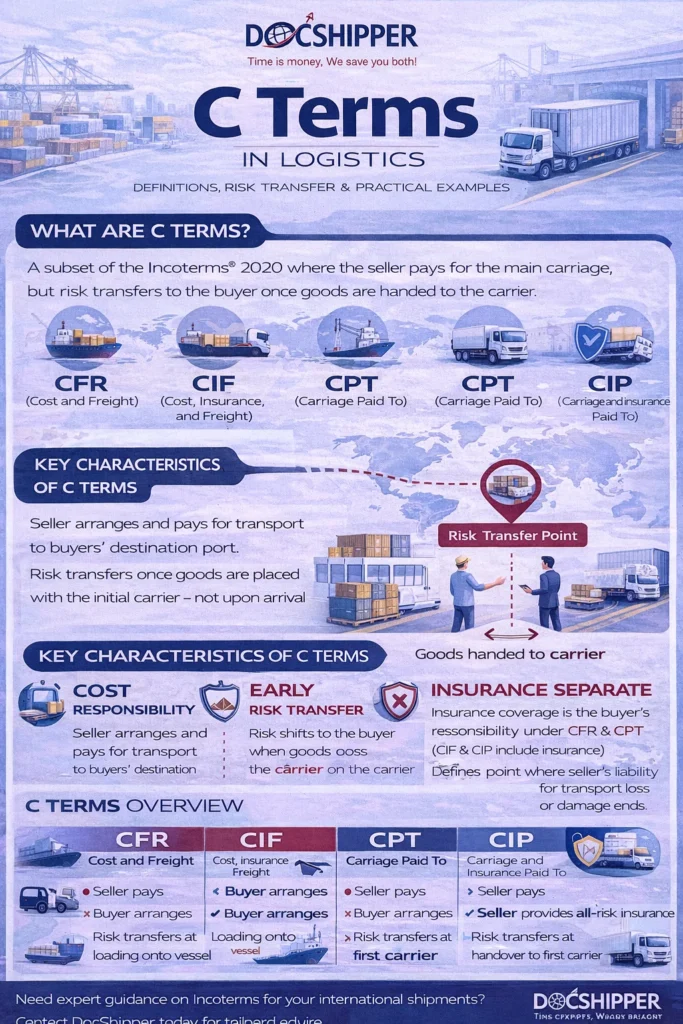
C Terms (also called C Rules or C Incoterms) are a subset of the 11 Incoterms® 2020 rules where the seller arranges and pays for main carriage to a named destination, but risk transfers to the buyer earlier—typically when goods are handed to the carrier. These include CFR, CIF, CPT, and CIP.Introduction
One of the most common misunderstandings in international trade is confusing who bears the risk when the seller pays for transport. Many importers assume that because the seller arranges shipping under C Terms, they also retain responsibility until goods arrive—this is incorrect.
C Terms are critical in global logistics because they clearly delineate cost responsibility from risk transfer. Under these rules, the seller covers freight and sometimes insurance to the destination, yet the buyer assumes risk from the moment goods are handed to the first carrier.
Understanding C Terms is essential for:
- Determining who pays for cargo insurance
- Clarifying liability in case of loss or damage during transit
- Negotiating commercial contracts with overseas suppliers
- Properly documenting export and import declarations
- Managing cash flow and financial planning in cross-border transactions
C Terms Explained: Seller Obligations & Risk Transfer
The four C Terms—CFR, CIF, CPT, and CIP—share a fundamental principle: the seller pays for carriage, but risk transfers earlier. This dual split between cost and risk is what distinguishes C Terms from all other Incoterms.
CFR (Cost and Freight) applies exclusively to sea and inland waterway transport. The seller delivers goods on board the vessel at the port of shipment and pays freight to the named port of destination. Risk, however, passes when goods cross the ship’s rail. The buyer must arrange cargo insurance if desired.
CIF (Cost, Insurance and Freight) mirrors CFR but adds a critical obligation: the seller must procure minimum cargo insurance (Institute Cargo Clauses C or equivalent, covering 110% of contract value). Like CFR, risk transfers at the ship’s rail, not at destination. At DocShipper, we systematically verify insurance certificates under CIF terms to ensure compliance and protect our clients from coverage gaps.
CPT (Carriage Paid To) is mode-neutral and suitable for any transport method—air, road, rail, or multimodal. The seller pays carriage to the named destination, but risk transfers when goods are handed to the first carrier. This is particularly important in containerized shipments where the carrier takes custody at an inland terminal, not the port.
CIP (Carriage and Insurance Paid To) adds mandatory insurance to CPT. Under Incoterms® 2020, the seller must provide Institute Cargo Clauses A coverage (or equivalent all-risk insurance) covering 110% of contract value. This is a higher insurance standard than CIF, reflecting the broader applicability of CIP across transport modes. Risk still transfers at the first carrier handover.
A critical distinction: under all C Terms, the buyer bears the risk during the main carriage. If goods are damaged at sea or in transit, the buyer—not the seller—must file insurance claims. This is why understanding the exact point of risk transfer is essential for procurement and logistics teams. For regulatory context, consult the ICC official Incoterms® 2020 guidelines.
Practical Examples & Comparative Data
To illustrate how C Terms function in real-world scenarios, consider the following comparative table for a shipment of electronics from Shanghai to Hamburg:
| Incoterm | Seller Pays | Buyer Pays | Risk Transfer Point | Insurance Obligation |
|---|---|---|---|---|
| CFR Hamburg | Export clearance, freight to Hamburg | Import clearance, unloading, inland transport, insurance | On board vessel, Shanghai | Buyer arranges |
| CIF Hamburg | Export clearance, freight to Hamburg, minimum insurance | Import clearance, unloading, inland transport | On board vessel, Shanghai | Seller provides ICC(C) minimum |
| CPT Hamburg | Export clearance, carriage to Hamburg | Import clearance, unloading, insurance | Handover to first carrier, Shanghai | Buyer arranges |
| CIP Hamburg | Export clearance, carriage to Hamburg, all-risk insurance | Import clearance, unloading | Handover to first carrier, Shanghai | Seller provides ICC(A) all-risk |
Use Case: A European importer orders €100,000 worth of smartphones under CIF Hamburg. The Chinese supplier books ocean freight, provides export clearance, and secures basic insurance (ICC(C), 110% coverage = €110,000). The container is loaded in Shanghai, and risk transfers at that moment. During the voyage, the container is damaged in rough seas. The importer files a claim with the insurer named by the seller, but discovers the ICC(C) policy excludes certain perils. Had the contract been CIP, the seller would have provided broader ICC(A) coverage, potentially covering the loss.
Key takeaways from this scenario:
- Insurance quality matters: CIF provides minimum coverage; CIP requires comprehensive protection.
- Risk timing is critical: Even though the seller pays freight, the buyer owns the risk during transit.
- Documentation checks are essential: At DocShipper, we audit insurance certificates to confirm coverage levels match contractual obligations.
- Cost allocation differs: Buyers under CFR/CPT must budget separately for insurance premiums.
- Mode of transport drives choice: CFR/CIF apply only to sea/waterway; CPT/CIP apply to any mode, including air and multimodal.
Conclusion
C Terms offer a practical solution for international buyers who want sellers to arrange main carriage while retaining clarity on risk allocation. Mastering the cost-versus-risk split under CFR, CIF, CPT, and CIP is fundamental to effective supply chain management and dispute prevention.
Need expert guidance on Incoterms selection, cargo insurance, or customs compliance? Contact DocShipper for tailored logistics support.
📚 Quizz
Test Your Knowledge: C Terms (Incoterms)
Q1. Under C Terms (CFR, CIF, CPT, CIP), who arranges and pays for the main carriage to the named destination?
Q2. A common misconception about C Terms is that because the seller pays for freight, they also bear the risk during transit. What is the correct interpretation?
Q3. A European importer is shipping electronics by air from Shanghai. Which C Term should they use, and why?
🎯 Your Result
📞 Free Quote in 24hFAQ | C Terms in Logistics: Definitions, Applications & Practical Examples
Need Help with
Logistics or Sourcing ?
First, we secure the right products from the right suppliers at the right price by managing the sourcing process from start to finish. Then, we simplify your shipping experience - from pickup to final delivery - ensuring any product, anywhere, is delivered at highly competitive prices.


Fill the Form
Prefer email? Send us your inquiry, and we’ll get back to you as soon as possible.
Contact us




