


In short ⚡
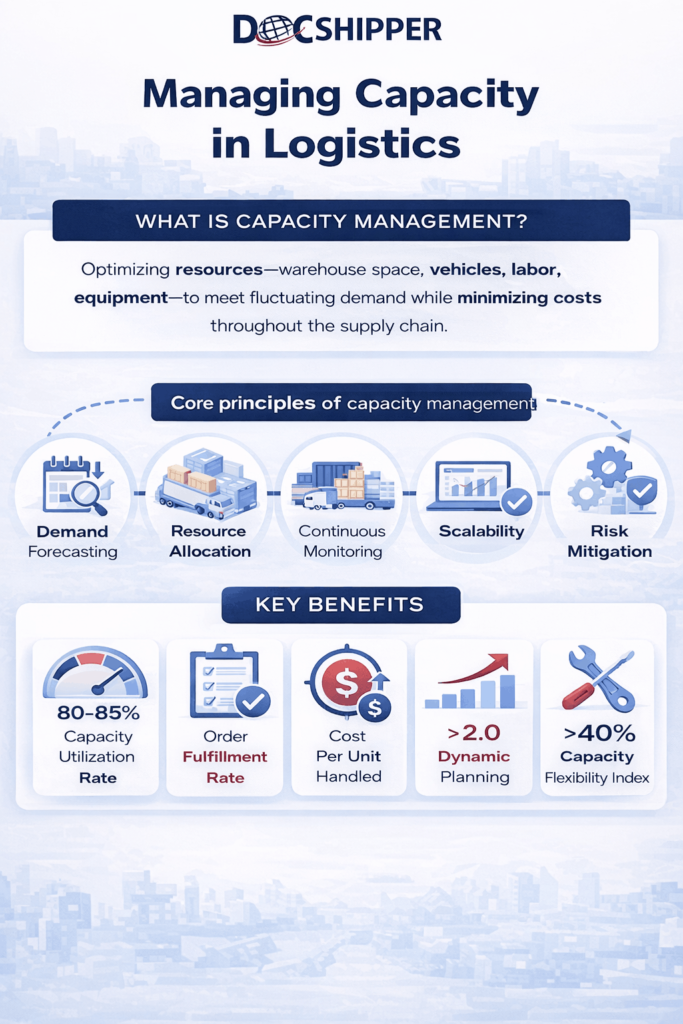
Capacity Management is the strategic process of optimizing available resources—warehouse space, transportation vehicles, labor, and equipment—to meet fluctuating demand while minimizing costs and maintaining service quality throughout the supply chain.Introduction
Most logistics failures stem from a single oversight: misaligned capacity. When warehouse space runs out during peak season or trucks sit idle during slow periods, companies hemorrhage money.
Capacity Management addresses this challenge by balancing supply chain resources with actual demand. In international trade, where lead times span weeks and market conditions shift rapidly, this discipline becomes critical.
- Resource optimization: Aligns physical assets with forecasted demand cycles
- Cost control: Prevents overstaffing, underutilization, and emergency expediting fees
- Service reliability: Maintains delivery commitments despite volume fluctuations
- Scalability: Enables rapid response to market expansion or contraction
- Risk mitigation: Builds contingency buffers for disruptions in global networks
Strategic Mechanisms & Optimization Approaches
Effective capacity management operates on three foundational pillars: demand forecasting, resource allocation, and continuous monitoring. These elements interconnect to create adaptive systems that respond to real-time conditions.
Demand forecasting combines historical data, market trends, and seasonal patterns. Advanced practitioners integrate predictive analytics with machine learning algorithms to anticipate volume spikes three to six months ahead. This foresight enables proactive capacity adjustments rather than reactive scrambling.
Capacity planning models fall into two categories: static and dynamic. Static models allocate fixed resources based on average demand, suitable for stable markets. Dynamic models adjust resources weekly or daily, essential for volatile sectors like e-commerce or perishable goods. At DocShipper, we implement dynamic capacity planning to accommodate our clients’ fluctuating import/export volumes across multiple trade lanes.
The capacity utilization rate measures efficiency: (Actual Output / Maximum Possible Output) × 100. Industry benchmarks target 75-85% utilization. Below 70% signals waste; above 90% risks bottlenecks and quality degradation. Transportation fleets typically aim for 80-85% to balance efficiency with flexibility.
Resource pooling strategies distribute shared assets across multiple clients or routes. Warehouse operators consolidate inventory from various shippers to maximize cubic space utilization. Freight forwarders combine partial loads into full container shipments (LCL consolidation), reducing per-unit costs by 30-40%.
Legal and contractual frameworks govern capacity commitments. Service Level Agreements (SLAs) define guaranteed capacity thresholds, penalty clauses for underperformance, and force majeure provisions. The International Chamber of Commerce provides standardized arbitration mechanisms when capacity disputes arise in cross-border contracts.
Practical Examples & Performance Metrics
Consider a European electronics importer preparing for Black Friday. Historical data shows November volumes surge 250% compared to September baseline. The capacity management strategy involves:
| Resource Type | Baseline Capacity | Peak Capacity | Adjustment Method |
|---|---|---|---|
| Warehouse Space | 5,000 m² | 12,000 m² | Temporary 3PL contract (Oct-Dec) |
| Labor Force | 25 workers | 65 workers | Seasonal hires + overtime shifts |
| Delivery Vehicles | 10 trucks | 28 trucks | Rental fleet + carrier partnerships |
| IT Infrastructure | 500 orders/hour | 1,500 orders/hour | Cloud-based WMS scaling |
Case Study: Container Shipping Capacity Crunch (2021-2022)
During the post-pandemic surge, container availability dropped 40% on Asia-Europe routes. Companies with rigid capacity contracts faced delays exceeding 60 days. Flexible capacity management strategies included:
- Multi-carrier diversification: Splitting shipments across 4-5 carriers reduced dependency risk
- Alternative routing: Using rail through Central Asia when ocean capacity saturated
- Inventory buffering: Increasing safety stock by 25% to compensate for transit uncertainties
- Demand shaping: Offering early-order discounts to smooth volume spikes
Key Performance Indicators (KPIs):
- Capacity Utilization Rate: Target 80-85% for warehouses, 75-80% for transport fleets
- Order Fulfillment Rate: Percentage of orders shipped within promised timeframes (benchmark: 95%+)
- Cost Per Unit Handled: Total capacity costs divided by units processed (lower = more efficient)
- Peak-to-Baseline Ratio: Measures demand volatility; ratios above 2.0 require dynamic capacity models
- Capacity Flexibility Index: Percentage of resources adjustable within 30 days (target: 40%+)
At DocShipper, we monitor these metrics across our global network to ensure clients receive consistent service during both routine operations and demand surges, particularly when coordinating multi-modal shipments involving air, sea, and ground transportation.
Conclusion
Capacity Management transforms logistics from reactive firefighting into proactive strategy. Companies that master resource optimization gain competitive advantages through lower costs, faster delivery, and superior customer satisfaction.
Need expert guidance on optimizing your supply chain capacity? Contact DocShipper for tailored capacity planning solutions across your international trade operations.
📚 Quiz
Test Your Knowledge: Capacity Management
Q1. What is the primary goal of Capacity Management in logistics?
Q2. A warehouse is operating at 93% capacity utilization. According to industry benchmarks, what does this signal?
Q3. An e-commerce company experiences order volumes that triple every November. Which capacity planning model is best suited to their operations?
🎯 Your Result
📞 Free Quote in 24hFAQ | Capacity Management: Definition, Calculation & Practical Examples
Capacity planning is the strategic process of determining future resource requirements based on forecasts. Capacity management is the ongoing operational execution of adjusting resources in real-time to match actual demand fluctuations.
Optimal warehouse capacity equals (Peak Demand Volume × Storage Duration × Safety Factor) / Space Utilization Rate. Most operations target 80-85% utilization, leaving 15-20% buffer for unexpected volume spikes or operational flexibility.
The four primary constraints are physical space (warehouses, yards), equipment availability (forklifts, trucks), labor capacity (trained personnel), and processing throughput (loading docks, customs clearance). Transportation network congestion represents a fifth external constraint.
Strategic capacity plans require annual reviews aligned with budget cycles. Tactical adjustments occur quarterly based on demand forecasts. Operational monitoring happens daily or weekly, particularly for high-velocity distribution centers or seasonal businesses.
Capacity smoothing reduces demand volatility through pricing incentives, promotional timing adjustments, or production scheduling changes. This technique minimizes the need for expensive peak capacity resources by redistributing demand across time periods.
Proper capacity management reduces freight costs by 15-30% through consolidated shipments, optimized route planning, and avoiding emergency expedited shipping. Underutilized capacity increases per-unit costs, while overcapacity forces expensive spot market purchases.
Modern capacity management relies on Warehouse Management Systems (WMS), Transportation Management Systems (TMS), and predictive analytics platforms. These tools provide real-time visibility, automated resource allocation, and scenario modeling for decision support.
Customs processing times create capacity bottlenecks at borders. Effective capacity management accounts for clearance delays by building buffer time into transit schedules and maintaining bonded warehouse capacity for goods awaiting documentation approval.
Excess capacity increases fixed costs but improves service reliability. Tight capacity reduces costs but risks stockouts and delays. The optimal balance depends on industry margins, customer expectations, and competitive positioning.
Disruption management requires pre-established alternative suppliers, flexible transportation contracts, safety stock buffers, and rapid reallocation protocols. Scenario planning identifies critical vulnerabilities before crises occur.
Dynamic allocation continuously reassigns resources based on real-time demand signals, inventory positions, and service priorities. This approach uses algorithms to optimize asset utilization across multiple customers or product lines simultaneously.
B2B operations handle larger, less frequent shipments with predictable patterns, allowing static capacity models. B2C logistics face high order variability and tight delivery windows, requiring dynamic capacity with rapid scalability for peak periods.
Need Help with Logistics or Sourcing ?
First, we secure the right products from the right suppliers at the right price by managing the sourcing process from start to finish. Then, we simplify your shipping experience - from pickup to final delivery - ensuring any product, anywhere, is delivered at highly competitive prices.


Fill the Form
Prefer email? Send us your inquiry, and we’ll get back to you as soon as possible.
Contact us


