


In short ⚡
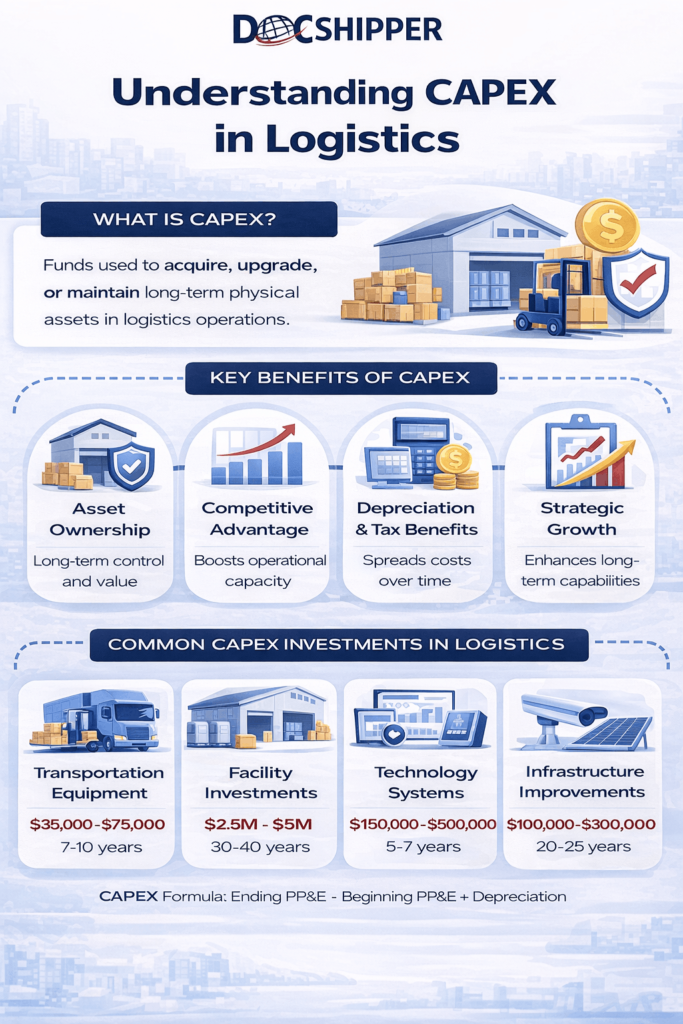
CAPEX (Capital Expenditure) refers to funds invested by a company in acquiring, upgrading, or maintaining long-term physical assets such as warehouses, transportation equipment, or technology infrastructure. These expenditures create lasting value and are capitalized on the balance sheet, distinguishing them from operational expenses that support day-to-day activities.Introduction
Many logistics companies struggle to distinguish between strategic investments and routine costs. This confusion can lead to poor financial planning and missed growth opportunities. Understanding CAPEX is essential for anyone managing international supply chains, warehouse operations, or freight forwarding businesses.
In import/export operations, capital expenditures directly impact competitiveness and operational capacity. Whether expanding warehouse space, purchasing container handling equipment, or implementing a new WMS (Warehouse Management System), these investments shape long-term business performance.
- Asset ownership: CAPEX involves purchasing tangible or intangible assets that remain on the balance sheet
- Long-term value: These investments typically provide benefits beyond one fiscal year
- Depreciation: CAPEX assets are depreciated over their useful life rather than expensed immediately
- Strategic impact: Capital expenditures determine operational capacity and competitive positioning
- Tax treatment: Different accounting rules apply compared to operational expenses (OPEX)
Understanding CAPEX in Logistics Operations
Capital expenditures represent the foundation of logistics infrastructure. Unlike operational expenses (fuel, labor, utilities), CAPEX investments create assets that generate value over multiple years. This distinction matters significantly for financial reporting, tax optimization, and strategic planning.
In the logistics sector, typical CAPEX categories include transportation equipment (trucks, forklifts, container chassis), facility investments (warehouse construction, loading docks, cold storage units), technology systems (TMS, WMS, automated sorting equipment), and infrastructure improvements (yard expansions, security systems, energy-efficient installations).
The decision to classify an expense as CAPEX follows specific accounting standards. According to IAS 16 (International Accounting Standards), an asset qualifies for capitalization when it provides future economic benefits, has a measurable cost, and exceeds the company’s capitalization threshold (typically $1,000-$5,000 depending on company policy).
The useful life estimation determines depreciation schedules. Warehouse buildings might depreciate over 30-40 years, while material handling equipment typically uses 7-10 year schedules. This impacts both tax deductions and financial statement presentation.
At DocShipper, we help clients evaluate major logistics investments by analyzing the CAPEX implications of warehouse expansions, equipment purchases, and technology implementations. Our financial advisory services ensure that capital allocation decisions align with long-term business objectives and cash flow capabilities.
Understanding return on investment (ROI) for CAPEX projects is critical. A $500,000 automated sorting system might reduce labor costs by $120,000 annually, delivering payback in approximately 4.2 years. These calculations guide strategic decision-making in competitive logistics markets.
CAPEX Calculation & Practical Examples
Calculating total CAPEX involves summing all capital expenditures within a specific period. The basic formula is: CAPEX = Ending PP&E – Beginning PP&E + Depreciation, where PP&E represents Property, Plant, and Equipment values from the balance sheet.
For operational planning, logistics managers often use a more granular approach that tracks individual project investments:
| Investment Category | Example Asset | Typical Cost Range | Useful Life |
|---|---|---|---|
| Transportation Equipment | Heavy-duty forklift | $35,000 – $75,000 | 7-10 years |
| Warehouse Facility | 50,000 sq ft warehouse | $2.5M – $5M | 30-40 years |
| Technology Systems | Warehouse Management System | $150,000 – $500,000 | 5-7 years |
| Material Handling | Automated conveyor system | $200,000 – $800,000 | 10-15 years |
| Infrastructure | Solar panel installation | $100,000 – $300,000 | 20-25 years |
Use Case: Freight Forwarder Expansion
A mid-sized freight forwarder plans to expand operations in 2024. Their CAPEX budget includes:
- Warehouse lease improvements: $450,000 (loading dock expansion, office renovation)
- Material handling equipment: $280,000 (3 forklifts, pallet jacks, racking systems)
- Technology upgrade: $320,000 (new TMS integration, tracking hardware)
- Vehicle acquisition: $180,000 (2 delivery trucks)
- Security systems: $70,000 (cameras, access control, fire suppression)
Total CAPEX: $1,300,000
This investment enables handling 40% more shipment volume while reducing processing time by 25%. The expected annual revenue increase of $850,000 with improved margins delivers an ROI of approximately 18 months, excluding depreciation tax benefits.
When evaluating CAPEX vs. leasing, companies must consider cash flow constraints, tax implications, and technological obsolescence. A $400,000 warehouse automation system might be financed through operating leases to preserve capital for other strategic initiatives, converting what would be CAPEX into OPEX treatment.
Conclusion
Mastering CAPEX management is fundamental to building sustainable logistics operations. Strategic capital allocation determines competitive positioning, operational efficiency, and long-term profitability in the dynamic import/export industry.
Need guidance on optimizing your logistics investments? Contact DocShipper for expert consultation on capital expenditure planning and supply chain infrastructure development.
📚 Quiz
Test Your Knowledge: CAPEX
Q1 — What best defines CAPEX in a logistics context?
Q2 — A logistics company subscribes to a cloud-based TMS (SaaS model) on a monthly basis. How should this expense be classified?
Q3 — A freight forwarder spends $280,000 on forklifts, racking systems, and pallet jacks to expand its warehouse operations. What is the correct CAPEX treatment for this purchase?
🎯 Your Result
📞 Free Quote in 24hFAQ | CAPEX: Definition, Calculation & Concrete Examples in Logistics
Need Help with Logistics or Sourcing ?
First, we secure the right products from the right suppliers at the right price by managing the sourcing process from start to finish. Then, we simplify your shipping experience - from pickup to final delivery - ensuring any product, anywhere, is delivered at highly competitive prices.


Fill the Form
Prefer email? Send us your inquiry, and we’ll get back to you as soon as possible.
Contact us


