


In short ⚡
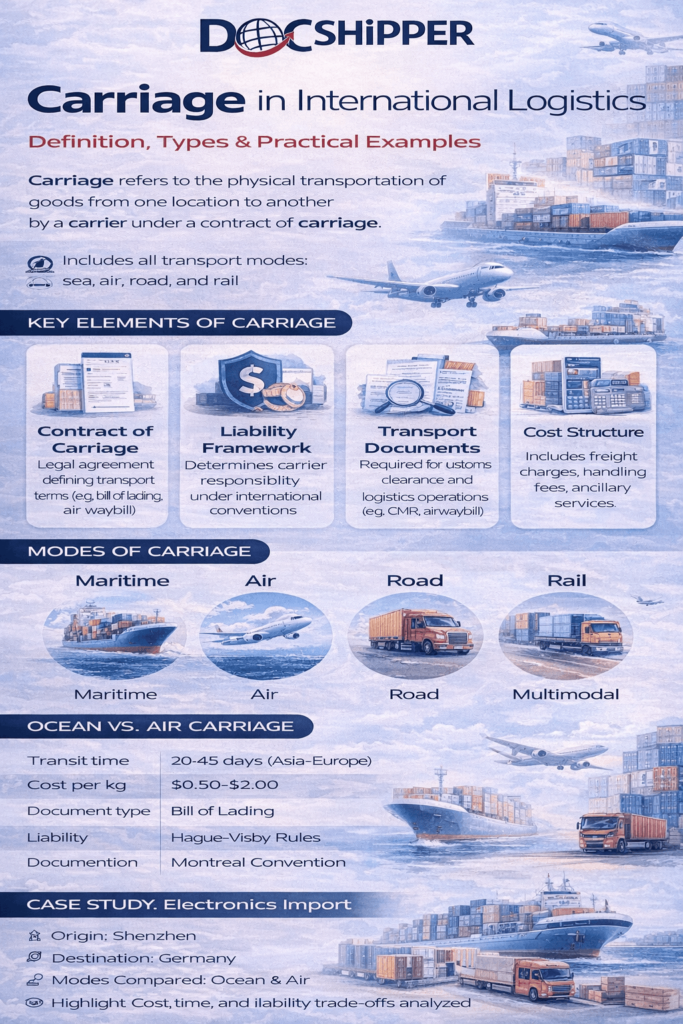
Carriage refers to the physical transportation of goods from one location to another by a carrier, under a contract of carriage. It encompasses all modes of transport—sea, air, road, and rail—and establishes the legal and operational framework governing the movement, liability, and delivery of cargo in international trade.Introduction
Confusion often arises between “carriage,” “freight,” and “shipping”—terms that seem interchangeable but carry distinct legal and operational meanings. Misunderstanding carriage can lead to disputes over liability, delays in customs clearance, and unexpected costs in international supply chains.
In import/export operations, carriage defines the contractual relationship between shipper and carrier. It determines who bears risk during transit, which documents are required, and how claims are processed if goods are damaged or lost.
Key characteristics of carriage include:
- Contractual obligation: Governed by a contract of carriage (bill of lading, air waybill, CMR).
- Modal diversity: Applies to maritime, air, road, rail, and multimodal transport.
- Liability framework: Defines carrier responsibility under international conventions (Hague-Visby, Montreal, CMR).
- Documentation requirements: Requires specific transport documents for customs and legal purposes.
- Cost structure: Includes freight charges, handling fees, and ancillary services.
Carriage Mechanisms & Legal Framework
Carriage operates under internationally recognized conventions that standardize liability, documentation, and dispute resolution. The Hague-Visby Rules govern maritime carriage, limiting carrier liability to specific amounts per package or weight unit. The Montreal Convention regulates air carriage, establishing strict liability for cargo damage up to 22 Special Drawing Rights per kilogram.
The contract of carriage is the foundational legal instrument. It defines the carrier’s obligations, the shipper’s responsibilities, and the conditions under which goods are transported. This contract is evidenced by transport documents: a bill of lading for sea freight, an air waybill for air cargo, or a CMR consignment note for road transport within Europe.
Multimodal carriage involves two or more modes of transport under a single contract. The UNCTAD/ICC Multimodal Transport Rules provide a unified framework, but liability often depends on where damage occurs. This complexity requires precise documentation and clear contractual terms.
The carrier’s liability is limited unless the shipper declares a higher value and pays additional charges. Exclusions apply for inherent vice, inadequate packing, or acts of God. Understanding these limitations is critical for proper insurance coverage and risk management.
At DocShipper, we systematically verify all carriage contracts and transport documents to ensure compliance with international conventions and prevent liability disputes. Our expertise in multimodal logistics helps clients navigate complex regulatory environments across 50+ countries. For authoritative guidance on maritime carriage conventions, consult the UNCTAD Maritime Transport resources.
Practical Examples & Case Studies
Understanding carriage through real-world scenarios clarifies its operational and financial implications. The following examples illustrate how carriage terms affect cost, risk, and documentation in international trade.
Comparative Analysis: Ocean vs. Air Carriage
| Criterion | Ocean Carriage | Air Carriage |
|---|---|---|
| Transit Time | 20-45 days (Asia-Europe) | 3-7 days |
| Cost per kg | $0.50-$2.00 | $4.00-$8.00 |
| Liability Convention | Hague-Visby Rules | Montreal Convention |
| Document Type | Bill of Lading (B/L) | Air Waybill (AWB) |
| Cargo Volume | Full containers (FCL/LCL) | Smaller shipments |
Use Case: Electronics Import from China to Germany
Scenario: A German retailer imports 5,000 smartphones (total weight: 1,200 kg, value: €150,000) from Shenzhen.
Carriage Option 1 – Ocean (FCL):
- Transit time: 35 days via Shanghai-Hamburg route.
- Carriage cost: €1,800 (including BAF, CAF surcharges).
- Document: Negotiable Bill of Lading under Incoterms® CIF Hamburg.
- Liability: Limited to €2.50 per kg under Hague-Visby Rules (maximum €3,000 without declared value).
- Insurance: Marine cargo policy required for full coverage (additional €450).
Carriage Option 2 – Air Express:
- Transit time: 5 days via Hong Kong-Frankfurt.
- Carriage cost: €7,200 (including fuel surcharge, security fee).
- Document: Non-negotiable Air Waybill under Incoterms® CPT Frankfurt.
- Liability: Limited to 22 SDR/kg (~€30/kg, maximum €36,000) under Montreal Convention.
- Insurance: Optional but recommended for high-value electronics (additional €600).
Decision factors: The retailer chose ocean carriage due to lower cost and acceptable lead time. However, they declared full cargo value (€150,000) on the Bill of Lading and purchased comprehensive marine insurance to mitigate the Hague-Visby liability cap.
Key insights:
- Carriage cost represents only 1.2% of cargo value for ocean, 4.8% for air.
- Liability limitations make insurance essential for high-value goods.
- Document type affects negotiability and financing options (B/L allows letters of credit).
- Incoterms® determine when risk transfers from seller to buyer during carriage.
- Customs clearance timing depends on carriage mode (air requires faster processing).
Conclusion
Carriage is the operational and legal backbone of international logistics, defining how goods move, who bears risk, and what documentation governs the transaction. Selecting the appropriate carriage mode and understanding liability frameworks are critical to cost optimization and risk management in global trade.
Need expert guidance on carriage contracts, multimodal logistics, or liability optimization? Contact DocShipper for tailored solutions across all transport modes and trade routes.
📚 Quiz
Test Your Knowledge: Carriage
Q1 – What does "carriage" refer to in international logistics?
Q2 – A shipper's goods are damaged during ocean carriage. They did not declare a higher cargo value on the Bill of Lading. Can they automatically claim the full cargo value from the carrier?
Q3 – A German importer needs to finance a shipment using a letter of credit. Which carriage document should they request from the carrier to make this possible?
🎯 Your Result
📞 Free Quote in 24hFAQ | Carriage: Definition, Types & Practical Examples in International Logistics
Carriage refers to the transportation service and legal relationship between shipper and carrier, while freight specifically denotes the goods being transported or the charges for moving them. Carriage encompasses the entire contractual framework, including liability and documentation.
The Hague-Visby Rules (1968) are the most widely adopted convention for maritime carriage, establishing carrier liability limits and documentation requirements. Some countries apply the Hamburg Rules (1978) or Rotterdam Rules (2009), which offer different liability frameworks.
Not automatically. Carrier liability is limited by international conventions (e.g., €2.50/kg under Hague-Visby). To claim full value, you must declare it on the transport document and pay additional charges, or purchase separate cargo insurance.
Multimodal carriage involves transporting goods using two or more modes of transport (e.g., truck + ship + rail) under a single contract with one carrier or freight forwarder. It simplifies documentation but requires clear liability terms for each transport leg.
Incoterms® define when risk and cost transfer between buyer and seller during carriage. For example, under CIF (Cost, Insurance, Freight), the seller arranges and pays for carriage to the destination port but risk transfers when goods are loaded on the vessel.
The primary documents are: Bill of Lading (B/L) for sea freight, Air Waybill (AWB) for air cargo, CMR consignment note for road transport in Europe, and Railway Consignment Note (CIM) for rail. These documents serve as receipts, contracts, and sometimes documents of title.
No, but highly recommended. Carrier liability is limited by law, often covering only a fraction of cargo value. Separate marine or cargo insurance protects against loss, damage, or theft during carriage, especially for high-value or fragile goods.
Time limits vary by convention: under Hague-Visby Rules, claims must be filed within one year of delivery or the date goods should have been delivered. The Montreal Convention allows two years for air carriage claims. Always check your contract of carriage.
A clean Bill of Lading or Air Waybill indicates the carrier received goods in apparent good condition without damage or shortage. Banks require clean documents for letters of credit. Claused or dirty documents note discrepancies and may prevent payment.
With a negotiable Bill of Lading (ocean carriage), you can endorse it to a new consignee before delivery. Air Waybills are non-negotiable, but some carriers allow consignee changes with proper authorization. Road and rail consignment notes have specific amendment procedures under CMR and CIM conventions.
The carriage document (B/L, AWB, CMR) is mandatory for customs clearance, proving goods have arrived and detailing their origin, weight, and description. Incorrect or missing carriage documents cause delays, fines, or cargo holds at borders.
File a claim immediately with the carrier, providing the transport document and proof of value. The carrier's liability is limited by the applicable convention unless you declared higher value. Cargo insurance covers the difference between actual loss and carrier compensation.
Need Help with Logistics or Sourcing ?
First, we secure the right products from the right suppliers at the right price by managing the sourcing process from start to finish. Then, we simplify your shipping experience - from pickup to final delivery - ensuring any product, anywhere, is delivered at highly competitive prices.


Fill the Form
Prefer email? Send us your inquiry, and we’ll get back to you as soon as possible.
Contact us


