


In short ⚡
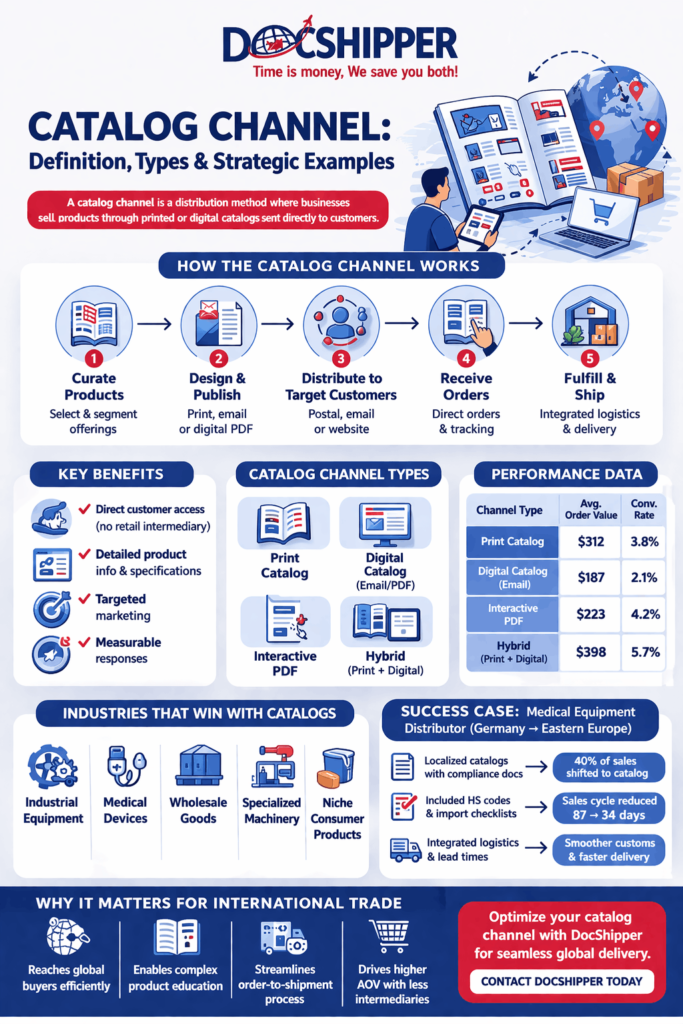
A catalog channel is a distribution method where businesses sell products through printed or digital catalogs sent directly to customers. This B2B and B2C sales approach enables detailed product presentation, targeted marketing, and direct ordering without physical storefronts, commonly used in international trade for specialized equipment, wholesale goods, and niche consumer products.
Introduction
Many businesses struggle to reach international buyers without expensive retail infrastructure. The catalog channel solves this by delivering comprehensive product information directly to decision-makers’ desks or inboxes.
In global logistics and import/export operations, catalog channels remain vital for specialized industries where buyers need detailed specifications before purchasing. This distribution method bridges geographical gaps while maintaining personalized customer relationships.
Key characteristics of catalog channels include:
- Direct customer access without intermediary retailers
- Detailed product documentation including technical specifications and pricing
- Targeted distribution to qualified prospects or existing customers
- Multi-format delivery through print, email, or interactive digital platforms
- Measurable response tracking via order codes and customer analytics
Catalog Channel Mechanisms & Strategic Implications
Catalog channels operate through systematic customer segmentation and product presentation. Businesses curate offerings based on buyer personas, then distribute catalogs through postal services, email campaigns, or downloadable PDFs on websites.
The fulfillment infrastructure differs significantly from retail models. Orders flow directly from catalog to warehouse, requiring integrated inventory management systems that sync catalog availability with actual stock levels. At DocShipper, we help clients establish these connections between catalog systems and international shipping workflows to prevent order delays.
Legal considerations vary by jurisdiction. The European Union’s consumer protection directives mandate specific disclosure requirements for distance selling, including return policies and total pricing transparency. Cross-border catalog sales must comply with both origin and destination country regulations.
Pricing strategies in catalog channels typically include tiered discounts for volume purchases. Unlike dynamic e-commerce pricing, catalog prices remain fixed for the publication period, requiring careful market analysis during production. Currency fluctuations pose particular challenges for international catalogs.
The production cycle demands long lead times. Print catalogs require 8-12 weeks from design to distribution, while digital versions allow rapid updates. Hybrid approaches combine seasonal print editions with real-time digital supplements for pricing adjustments or new product launches.
Practical Examples & Performance Data
Performance metrics reveal catalog channels deliver distinct advantages in specific sectors. Industrial equipment suppliers report 23% higher average order values through catalogs versus online marketplaces, attributed to comprehensive technical information enabling confident bulk purchases.
| Channel Type | Customer Acquisition Cost | Average Order Value | Conversion Rate |
|---|---|---|---|
| Print Catalog | $47 | $312 | 3.8% |
| Digital Catalog (Email) | $12 | $187 | 2.1% |
| Interactive PDF | $8 | $223 | 4.2% |
| Hybrid (Print + Digital) | $34 | $398 | 5.7% |
Use Case: Medical Equipment Distributor
A German surgical instrument supplier shifted 40% of sales to catalog channels targeting hospitals across Eastern Europe. By producing quarterly catalogs in local languages with detailed compliance certifications, they reduced sales cycle time from 87 days to 34 days. The catalog included HS codes and import documentation checklists, streamlining customs clearance.
Key success factors in this implementation:
- Localized content including regulatory approvals for each target market
- Integrated logistics information showing lead times and shipping costs upfront
- Dedicated account codes enabling hospitals to track budgets against specific catalog orders
- Technical support hotline referenced prominently throughout the catalog
- Seasonal promotional inserts for high-demand items during budget cycles
DocShipper clients utilizing catalog channels benefit from our pre-shipment verification services, ensuring catalog specifications match actual product configurations before international transport begins.
Conclusion
Catalog channels provide controlled, information-rich pathways to customers, particularly valuable for complex products requiring detailed specification review before purchase. Strategic implementation combines format selection, regulatory compliance, and logistics integration.
Need support optimizing your catalog distribution for international markets? Contact DocShipper for tailored logistics solutions.
📚 Quizz
Test Your Knowledge: Catalog Channel
Q1 — What best defines a catalog channel as a distribution method?
Q2 — A company is launching an international print catalog. Which pricing challenge is unique to this format compared to digital catalogs?
Q3 — A German surgical instrument supplier wants to reduce its sales cycle when targeting hospitals in Eastern Europe. Which catalog channel approach best fits this scenario?
🎯 Your Result
📞 Free Quote in 24hFAQ | Catalog Channel: Definition, Types & Strategic Examples
High-margin specialized goods requiring detailed specifications perform best: industrial components, medical equipment, professional tools, luxury consumer goods, and B2B office supplies. Products needing tactile evaluation before purchase show lower catalog conversion rates.
Most catalogs display shipping costs separately or use zone-based pricing tables. Advanced implementations integrate real-time shipping calculators linked to order entry systems, showing total delivered cost before purchase confirmation.
Print catalogs typically require 18-24 months to achieve positive ROI due to upfront production costs. Digital catalogs often break even within 6-9 months. Hybrid approaches balance these timelines with 12-16 month payback periods.
Print editions typically run quarterly or biannually for cost efficiency. Digital catalogs update monthly or continuously. Fast-moving industries like electronics may require monthly print supplements between major editions.
Yes. Modern catalog systems sync with e-commerce backends, allowing customers to order via catalog codes on websites. This omnichannel approach increases conversion by 34% compared to catalog-only ordering.
Mandatory disclosures include total pricing with taxes, return policies, delivery timeframes, seller identification, and payment security information. GDPR compliance applies for EU customers. Import restrictions must be clearly stated for regulated products.
Key metrics include response rate, average order value, customer acquisition cost, catalog circulation ROI, and repeat purchase rate. Unique order codes track which catalog versions drive sales.
Catalog channels focus on product sales with ordering mechanisms, while direct mail marketing primarily builds brand awareness. Catalogs contain comprehensive product ranges with pricing; direct mail typically promotes limited offers.
Fixed catalog prices create risk during currency volatility. Mitigation strategies include pricing in stable currencies, building margin buffers, or using digital supplements to adjust prices between print editions.
Expect $2.50-$8.00 per catalog for mid-volume runs (10,000-50,000 copies), including design, printing, and postage. Premium catalogs with specialty finishes may reach $15+ per unit. Digital catalogs cost 85-95% less to distribute.
Regular catalog delivery maintains brand visibility between purchases. Personalized editions based on purchase history increase relevance. Exclusive catalog-only offers reward channel loyalty, improving lifetime customer value by 28%.
Catalogs streamline corporate purchasing by providing pre-approved product selections with negotiated pricing. Procurement teams use catalogs to standardize ordering, control budgets, and simplify approval workflows for routine purchases.
Need Help with Logistics or Sourcing ?
First, we secure the right products from the right suppliers at the right price by managing the sourcing process from start to finish. Then, we simplify your shipping experience - from pickup to final delivery - ensuring any product, anywhere, is delivered at highly competitive prices.


Fill the Form
Prefer email? Send us your inquiry, and we’ll get back to you as soon as possible.
Contact us


