


In short ⚡
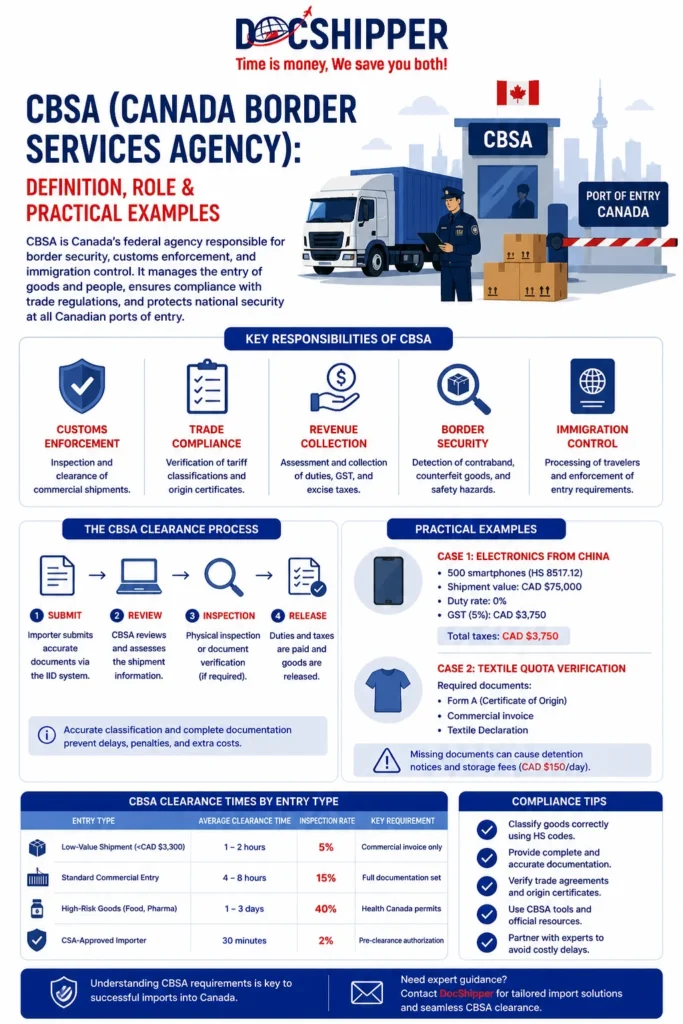
CBSA (Canada Border Services Agency) is Canada's federal agency responsible for border security, customs enforcement, and immigration control. It manages the entry of goods and people, ensures compliance with trade regulations, and protects national security at all Canadian ports of entry.Introduction
Many importers underestimate the complexity of Canadian customs clearance. A single documentation error can trigger costly delays or penalties. Understanding how CBSA operates is essential for anyone shipping goods to Canada.
The Canada Border Services Agency acts as the gatekeeper for international trade. It verifies compliance with federal laws, collects duties and taxes, and prevents prohibited items from entering the country. Whether you’re importing consumer electronics or industrial machinery, CBSA clearance is mandatory.
Key responsibilities of CBSA include:
- Customs enforcement – Inspection and clearance of commercial shipments
- Trade compliance – Verification of tariff classifications and origin certificates
- Revenue collection – Assessment and collection of duties, GST, and excise taxes
- Border security – Detection of contraband, counterfeit goods, and safety hazards
- Immigration control – Processing of travelers and enforcement of entry requirements
CBSA Functions & Regulatory Expertise
CBSA operates under the Customs Act and enforces over 100 federal statutes. Its primary mandate covers three pillars: trade facilitation, border security, and immigration management. Each commercial shipment entering Canada must pass through CBSA’s risk assessment system.
The agency uses the Integrated Import Declaration (IID) system, which consolidates customs and trade data. Importers must submit accurate documentation including commercial invoices, bills of lading, and certificates of origin. CBSA cross-references this information with international databases to detect discrepancies.
Tariff classification determines duty rates. Goods are categorized using the Harmonized System (HS) codes. Misclassification—whether intentional or accidental—can result in audits, penalties, or shipment seizure. CBSA officers have authority to reclassify items based on physical inspection.
The Customs Self-Assessment (CSA) program allows pre-approved importers to expedite clearance. Companies meeting compliance thresholds receive reduced inspection rates. At DocShipper, we assist clients in achieving CSA eligibility, streamlining their supply chain operations.
CBSA enforces trade remedy measures such as anti-dumping duties and countervailing duties. These protect Canadian industries from unfair foreign competition. Importers must verify whether their products fall under active trade cases. Non-compliance can double or triple landed costs.
For regulatory guidance, consult the official CBSA website, which provides tariff lookup tools, import requirements, and compliance bulletins.
Practical Examples & Import Data
Understanding CBSA processes through real scenarios clarifies common challenges. Below are three typical import situations and their outcomes.
Case Study 1: Electronics from China
A Montreal retailer imports 500 smartphones (HS code 8517.12). The shipment value is CAD $75,000. CBSA applies:
- Duty rate: 0% (MFN rate for this category)
- GST: 5% on the duty-paid value = CAD $3,750
- Total taxes: CAD $3,750
The importer must also provide a certificate of origin to claim preferential treatment under trade agreements. Without it, CBSA defaults to standard rates.
Case Study 2: Textile Quota Verification
A Vancouver company imports cotton T-shirts from Bangladesh. CBSA flags the shipment for quota verification. The importer must present:
- Form A (Certificate of Origin) proving GSP eligibility
- Commercial invoice matching the packing list
- Textile Declaration confirming fiber content
Missing documents trigger a detention notice. The shipment remains at the port until compliance is verified, incurring storage fees of CAD $150/day.
Comparative Table: CBSA Clearance Times by Entry Type
| Entry Type | Average Clearance Time | Inspection Rate | Key Requirement |
|---|---|---|---|
| Low-Value Shipment (<CAD $3,300) | 1–2 hours | 5% | Commercial invoice only |
| Standard Commercial Entry | 4–8 hours | 15% | Full documentation set |
| High-Risk Goods (Food, Pharma) | 1–3 days | 40% | Health Canada permits |
| CSA-Approved Importer | 30 minutes | 2% | Pre-clearance authorization |
These timelines assume complete documentation. Errors or missing permits extend clearance by 3–10 business days. At DocShipper, we pre-audit all shipment documents to prevent CBSA holds, ensuring your cargo moves without interruption.
Conclusion
Mastering CBSA requirements is non-negotiable for successful Canadian imports. Proper classification, complete documentation, and proactive compliance reduce costs and delays. The agency’s enforcement mechanisms are rigorous, but predictable when approached systematically.
Need expert guidance on CBSA clearance? Contact DocShipper for tailored import solutions.
📚 Quiz
Test Your Knowledge: CBSA
Q1 – What is the primary mandate of the Canada Border Services Agency (CBSA)?
Q2 – A common misconception is that CBSA physically inspects every commercial shipment entering Canada. What does CBSA actually do?
Q3 – A Vancouver importer brings in cotton T-shirts from Bangladesh but fails to provide a Form A (Certificate of Origin). What is the most likely CBSA outcome?
🎯 Your Result
📞 Free Quote in 24hFAQ | CBSA (Canada Border Services Agency): Definition, Role & Practical Examples
CBSA requires a commercial invoice, bill of lading, packing list, and certificate of origin. Additional permits may be needed for regulated goods like food or medical devices.
Standard clearance takes 4–8 hours. Low-value shipments clear faster, while high-risk goods may require 1–3 days for inspection and permit verification.
Yes. CBSA can seize goods for non-compliance, prohibited items, or unpaid duties. Penalties range from fines to criminal charges depending on the violation severity.
Shipments valued under CAD $20 are duty-free. However, GST applies to goods over CAD $40. The threshold does not apply to alcohol, tobacco, or commercial imports.
Duties are based on the HS code classification and the country of origin. Rates vary from 0% to 35%. Free trade agreements may reduce or eliminate duties for eligible goods.
CBSA conducts post-entry audits to verify compliance. Auditors review import records, invoices, and origin documents. Non-compliance can result in back duties and penalties up to 400% of the owed amount.
No, but it's highly recommended. Brokers ensure accurate classification, submit declarations, and handle CBSA communications. Errors by non-professionals often trigger costly delays.
CSA is a trusted trader program offering expedited clearance for compliant importers. Participants undergo rigorous vetting and receive reduced inspection rates, lowering supply chain costs.
CBSA does not charge storage directly, but goods held at ports incur terminal storage fees. Rates start at CAD $50/day and escalate after 5 days. Prompt clearance prevents these costs.
File a request for re-determination within 90 days of the CBSA decision. If denied, escalate to the Canadian International Trade Tribunal. Legal representation is advisable for complex cases.
Prohibited items include counterfeit goods, obscene materials, certain weapons, and endangered species products. The full list is available on the CBSA website under import restrictions.
No. CBSA uses risk-based targeting. Low-risk shipments pass with document review only. High-risk cargo undergoes physical inspection, x-ray scanning, or laboratory testing.
Need Help with
Logistics or Sourcing ?
First, we secure the right products from the right suppliers at the right price by managing the sourcing process from start to finish. Then, we simplify your shipping experience - from pickup to final delivery - ensuring any product, anywhere, is delivered at highly competitive prices.


Fill the Form
Prefer email? Send us your inquiry, and we’ll get back to you as soon as possible.
Contact us




